About this place
Iglesia de San Miguel Arcángel (Castrojeriz)
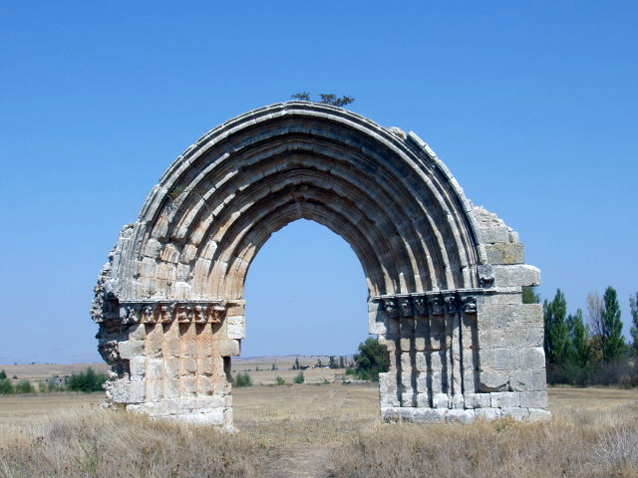
Iglesia de San Miguel Arcángel stands abandoned in Tabanera, a former hamlet within the municipality of Castrojeriz, in the province of Burgos, Castilla y León. Tabanera itself has had no permanent residents for decades, yet the church tower still rises over the surrounding fields, marking where a once-active parish of this corner of the Camino de Santiago region used to stand.
Where exactly does the church stand?
Tabanera existed administratively as a barrio, a dependent settlement of Castrojeriz. The hamlet emptied out gradually through the second half of the 20th century and is now classified as a despoblado, a place with no year-round inhabitants. The church remains the only structure still visible from a distance.
How did the building change over the centuries?
The oldest surviving part of the church is its tower, built in the late 13th century from carefully fitted granite ashlar blocks on a square plan, topped with a pointed spire. Originally a Romanesque church, the building underwent a substantial rebuild in the late 15th century, with further alterations continuing through the 16th and 17th centuries.
The earliest known written record of the parish dates to 29 October 1602, referring to the "parrochial del barrio de Tauanera." In 1607, after part of the structure had collapsed, doña Isabel de Padilla financed its reconstruction, reusing stone from the earlier building — the church was, in fact, a private foundation tied to her family. A subsequent ecclesiastical inspection was recorded in 1714.
What happened to the church's furnishings?
The building was robbed in 1965, and its dismantling and abandonment continued in the following years. The main altarpiece was moved to Burgos, while the bells were relocated to the neighbouring village of Villasilos. For a period, the empty building was even used as a shelter for livestock. Clarissan nuns later asked the Archdiocese of Burgos, the building's owner, for permission to remove and relocate the decorative entrance portal — the archdiocese refused the request.
What condition is the building in today?
The exterior façades and tower are in what is described as an acceptable state, though large cracks run through the walls. The interior, by contrast, is deplorable — dismantled, vandalised, and stripped of many funerary slabs, carried off by visitors over the years. The portico is regarded as the most valuable feature still standing. The church holds no formal heritage protection (it is not classified as a Bien de Interés Cultural), and on 5 July 2014 it was added to Hispania Nostra's Red List of Endangered Heritage, cited for ongoing decay, theft of stonework, and vandalism.
Are religious ceremonies still held there?
Traditionally, on 29 September, the feast of Saint Michael the Archangel, residents from Castrojeriz and the nearby village of Villasilos would gather in Tabanera for the annual patronal celebration. That custom has since faded along with the hamlet's depopulation. Local officials remain doubtful about the prospects for restoration, pointing to the lack of residents and to competing conservation priorities elsewhere across the province of Burgos.
Frequently Asked Questions
Can visitors go inside the church? The building is privately owned by the Archdiocese of Burgos and sits in a ruined state, with no fixed opening hours or organised visitor access — reaching the interior can be difficult.
Why doesn't such an old church have official heritage protection? It has never received a formal Bien de Interés Cultural declaration. It appears only on Hispania Nostra's Red List, which functions as an advocacy and awareness list rather than a legal protection status.
Is this the same church as the well-known Iglesia de San Miguel Arcángel in Trevías, Asturias? No. It is an entirely different building, in a different province and region of Spain. The dedication to Saint Michael the Archangel is extremely common across Spain, so the same church name refers to many unrelated buildings.
Why is the village of Tabanera deserted? Like many small settlements in Burgos province, Tabanera emptied out during the second half of the 20th century as residents moved to larger towns and cities, and it has had no permanent population since.
Nearby places

Earn badges for the places you visit
Download NextOnTrip, discover new places and check off your trails.