About this place
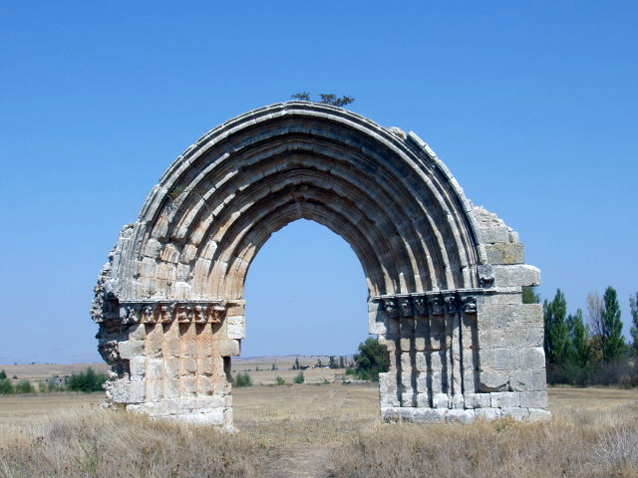
Arco de San Miguel de Mazarreros is a solitary stone portal standing in open farmland northwest of Sasamón, in the province of Burgos, Castile and León. This imposing arch is the only surviving piece of the church that once served the settlement of San Miguel de Mazarreros, a village that vanished from the map at the end of the 15th century.
Where exactly is it located?
The arch stands in open agricultural countryside, close to the Brullés river — a tributary of the local Odra river — a few kilometers from the center of Sasamón, a small town roughly fifteen to twenty kilometers west of Burgos. The easiest way to reach it is by car along local roads northwest of Sasamón; there is no parking area or marked trail on site, so it's worth checking the route in advance, for instance at a local tourist information point.
Why does this arch stand here alone?
Until the end of the 15th century, an independent settlement called San Miguel de Mazarreros existed on this spot, with its own parish church built in the 12th century in the late Romanesque style. When the village depopulated and was administratively absorbed into neighboring Sasamón, most of its buildings, including the church itself, were destroyed or dismantled. Only the church's entrance portal survived, which is why it is now known simply as "the arch" (arco) — the last physical trace of an entire vanished village.
What does the arch look like?
It is a large pointed portal built from seven archivolts — concentric, decorated arches framing the church's former entrance, a design typical of Romanesque architecture around the turn of the 12th and 13th centuries. Even though the rest of the building disappeared long ago, the portal itself has kept a legible form, letting visitors appreciate the craftsmanship of the medieval stonemasons who built it.
Why was the arch at risk of being lost?
For decades, the free-standing portal deteriorated without any conservation care or the protective surroundings the church walls once provided. In 2014, Hispania Nostra, an organization that documents endangered heritage sites across Spain, added the arch to its Red List of monuments at risk, drawing attention to the ongoing decay of the stone structure and the lack of funding for its preservation.
What has changed in recent years?
In 2019, the municipality of Sasamón approved a rehabilitation project for the monument, and the actual conservation work was carried out the following year, in 2020. That intervention stabilized and consolidated the arch's structure, halting further deterioration of the stone. Today the portal, while still standing alone amid the fields, is no longer in immediate danger of collapse.
When is the best time to visit?
Given its exposed, rural setting, the arch is best visited in spring or autumn, when milder temperatures make the surrounding fields pleasant to walk through, away from the peak heat of the Castilian summer. There is no tourist infrastructure on site — no ticket booth or refreshment stands — so it's worth treating a visit as a brief stop on a longer trip through the region, for example combined with a visit to Sasamón itself and its other landmarks.
Frequently asked questions
What exactly is the Arco de San Miguel de Mazarreros? It is the only surviving part — a stone entrance portal — of the former parish church of the vanished settlement of San Miguel de Mazarreros, built in the 12th century in the late Romanesque style.
Why did the settlement of San Miguel de Mazarreros disappear? The village depopulated at the end of the 15th century and was absorbed into neighboring Sasamón; over time, its buildings, apart from the church portal, were destroyed.
What does the arch look like architecturally? It is a pointed portal made up of seven archivolts — concentric, decorated arches surrounding the former entrance, characteristic of late Romanesque design.
Is the monument protected today? Yes. After being added to Hispania Nostra's Red List in 2014, the municipality of Sasamón carried out conservation work in 2020 that consolidated the ruin and stopped its further decay.
Nearby places

Earn badges for the places you visit
Download NextOnTrip, discover new places and check off your trails.