About this place
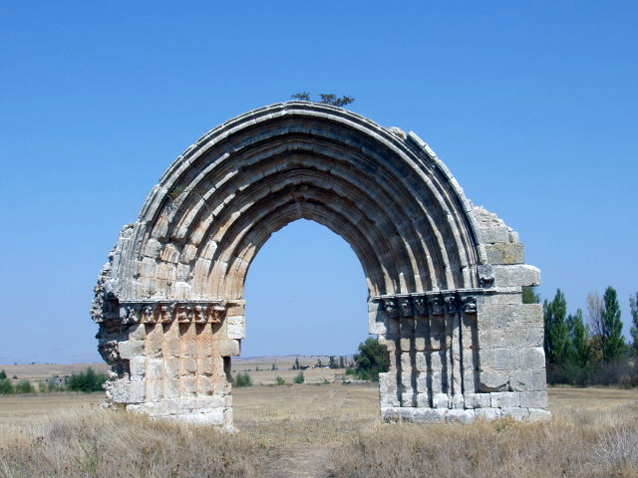
The Monastery of San Antón is a striking set of Gothic ruins a few kilometres outside Castrojeriz, in the province of Burgos, Castilla y León. The site sits directly on the Camino de Santiago (Camino Francés) and is one of the most memorable landmarks on this stretch of the route, since the path runs straight through the surviving archway of the former monastic church.
How do you get there?
The ruins stand on the site of a once-inhabited, now-abandoned hamlet called San Antón, administratively part of Castrojeriz. The easiest way in is on foot or by bike, following the pilgrim trail out of Castrojeriz — the walk takes under an hour. Drivers can also reach the site from Castrojeriz via a local road that runs alongside the Camino.
What will you see?
The centrepiece is a monumental Gothic arch, all that remains of the church's chancel, impressive enough to catch the attention of visitors with no particular interest in religious architecture. The trail itself passes underneath it, so pilgrims literally walk through what used to be the church's interior. Around the arch, fragments of perimeter walls and outbuildings are still visible, hinting at the original scale of the complex.
A brief history — from pilgrim hospital to ruin
The foundation dates to the 12th century (1146) and is credited to King Alfonso VII, who established the Royal Xenodochium of San Antonio Abad here — a hospice for travellers and foreigners. It was run by the Hospital Brothers of St. Anthony (the Antonine order), who operated a network of similar hospitals along the Camino de Santiago. The hospital specialised in treating contagious conditions, including "St. Anthony's fire" — ergotism, a poisoning caused by fungus-contaminated rye bread that was common among medieval travellers.
The structure visible today mostly dates from the 14th century and is Gothic in style. At one point the grounds also served as a palace and garden for King Pedro I of Castile before reverting to their original hospital function. Over time the settlement around the monastery emptied out and the buildings fell into ruin, leaving mainly the arch and sections of wall standing.
When should you visit?
The ruins are open year-round and free to visit, since they sit in an unenclosed area crossed by the trail. Spring and autumn are the most comfortable seasons, with milder temperatures than summer on the Castilian plateau, and early morning or late afternoon light brings out the detail of the Gothic stonework particularly well.
Frequently asked questions
Is there an entry fee for the San Antón ruins? No. The ruins stand in open, unfenced ground with no ticket booth, so they can be visited at any time.
Why does the path run directly under the monastery's arch? The Camino de Santiago has followed this route for centuries, and the arch is what remains of the church chancel, which once stood right above the pilgrim road — hence the striking "walk-through-the-ruin" effect.
What was "St. Anthony's fire," the illness treated here? It was the historical name for ergotism, poisoning from a fungus that grows on rye, which caused severe pain and gangrene and was common among medieval pilgrims.
How long does it take to walk here from Castrojeriz? The walk along the Camino usually takes 45–60 minutes, depending on pace.
Nearby places

Earn badges for the places you visit
Download NextOnTrip, discover new places and check off your trails.