About this place
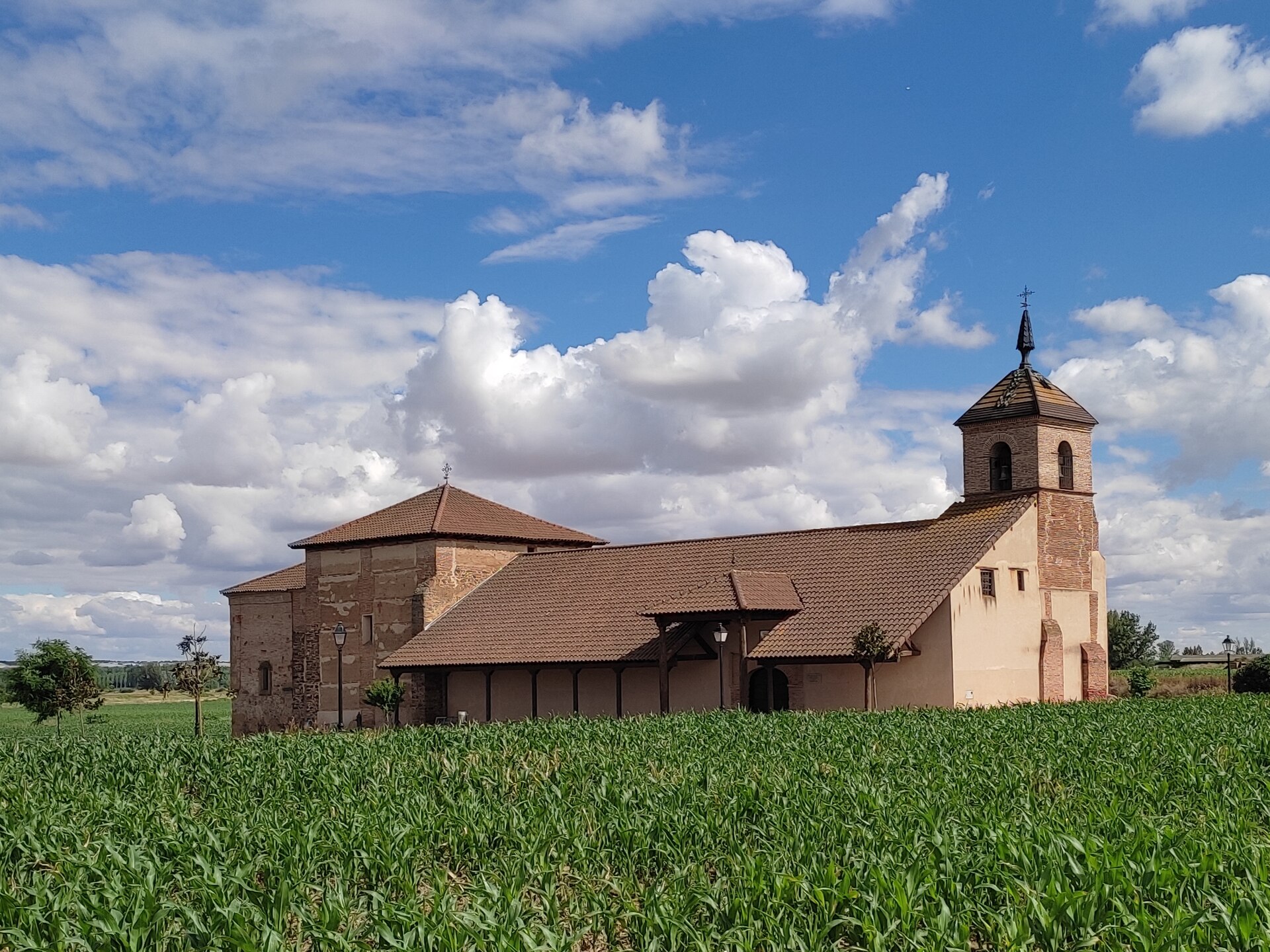
Ermita de la Piedad is a small chapel on the outskirts of Villademor de la Vega, a village on the right bank of the fertile Esla river valley, roughly 38 km from León. Modest from the outside, it holds one of the most cherished devotional sites in this corner of the region — the shrine of the town's patroness, the Virgen de la Piedad.
How do you get there?
Villademor de la Vega lies in the province of León, in Castile and León, within the Esla valley. The hermitage stands just outside the built-up village, on open farmland, so its bell tower and wooden colonnaded portico are visible from a distance across the flat plain. The easiest way in is by car along the local roads connecting Villademor with neighboring villages of the Esla valley; the chapel itself is only a short walk or drive from the village center.
What will you see?
The hermitage took its current form between 1690 and 1700, later enlarged and remodeled in 1759. The main entrance is closed by a brick segmental arch, sheltered by a three-sided portico resting on wooden posts finely carved with fluting — one of the building's most distinctive exterior features.
Inside, a single nave is covered by a plain, undecorated wooden coffered ceiling. Above it rises the main chapel (capilla mayor), topped by a plaster dome on pendentives painted with biblical figures, crowned at its keystone by a polychrome medallion depicting the Virgen de la Piedad. This section, expanded in 1759, has a Baroque plaster dome with ribs imitating Corinthian columns, richly decorated with paintings of floral motifs and angels — decoration that survives in its original colors, never restored.
The focal point of devotion is the image itself: a polychrome wood carving of the Virgen de la Piedad in Flemish Gothic style, by an unknown author, dated to the 15th–16th century. For security reasons it spends most of the year in the parish church in the village center, brought to the hermitage only occasionally, chiefly for the September observances.
Villademor's main parish church, the Iglesia de San Pedro Apóstol, is also worth a look — notable for its Mudéjar tower, locally known as the "torre galana," and its porticoed entrance, built over foundations tracing back to the 10th century. The village's other hermitage, the Ermita del Bendito Cristo, stands nearby.
When should you visit?
The best time to come is the first or second Sunday of September, when the romería takes place — a short, easy pilgrimage walk of only about 6 km leading to the hermitage. In the days before, from August 31 to September 8, a novena is held in the chapel in honor of the Virgin, culminating on September 8, the feast of the Nativity of Mary. During the romería, Mass is celebrated at the hermitage, after which the Brotherhood of the Virgen de la Piedad distributes blessed rye bread to those present, while the village square offers traditional rosquillas, hot chocolate with sponge cake, and dancing to close out the celebration. A second round of festivities in honor of the Virgin takes place on the second weekend of January.
Frequently asked questions
Is the hermitage always open to visitors? No — it is an active place of worship, generally opened for services, the September novena, and the annual romería. Outside these occasions, access to the interior can be limited.
Where is the image of the Virgen de la Piedad kept if not at the hermitage? For most of the year it is kept in the parish church of San Pedro Apóstol in the village center for security reasons, and is only moved to the hermitage on specific occasions.
How is the romería different from an ordinary visit? The romería is the annual festive pilgrimage, featuring a Mass, a procession, the distribution of blessed rye bread, and a village-wide celebration — a regular visit only allows you to see the exterior architecture and setting.
Is it worth combining the visit with other sights in Villademor? Yes — the village also has the Iglesia de San Pedro Apóstol with its Mudéjar tower and a second hermitage, the Ermita del Bendito Cristo, making it easy to see several sights in one short trip.
Nearby places

Earn badges for the places you visit
Download NextOnTrip, discover new places and check off your trails.