About this place
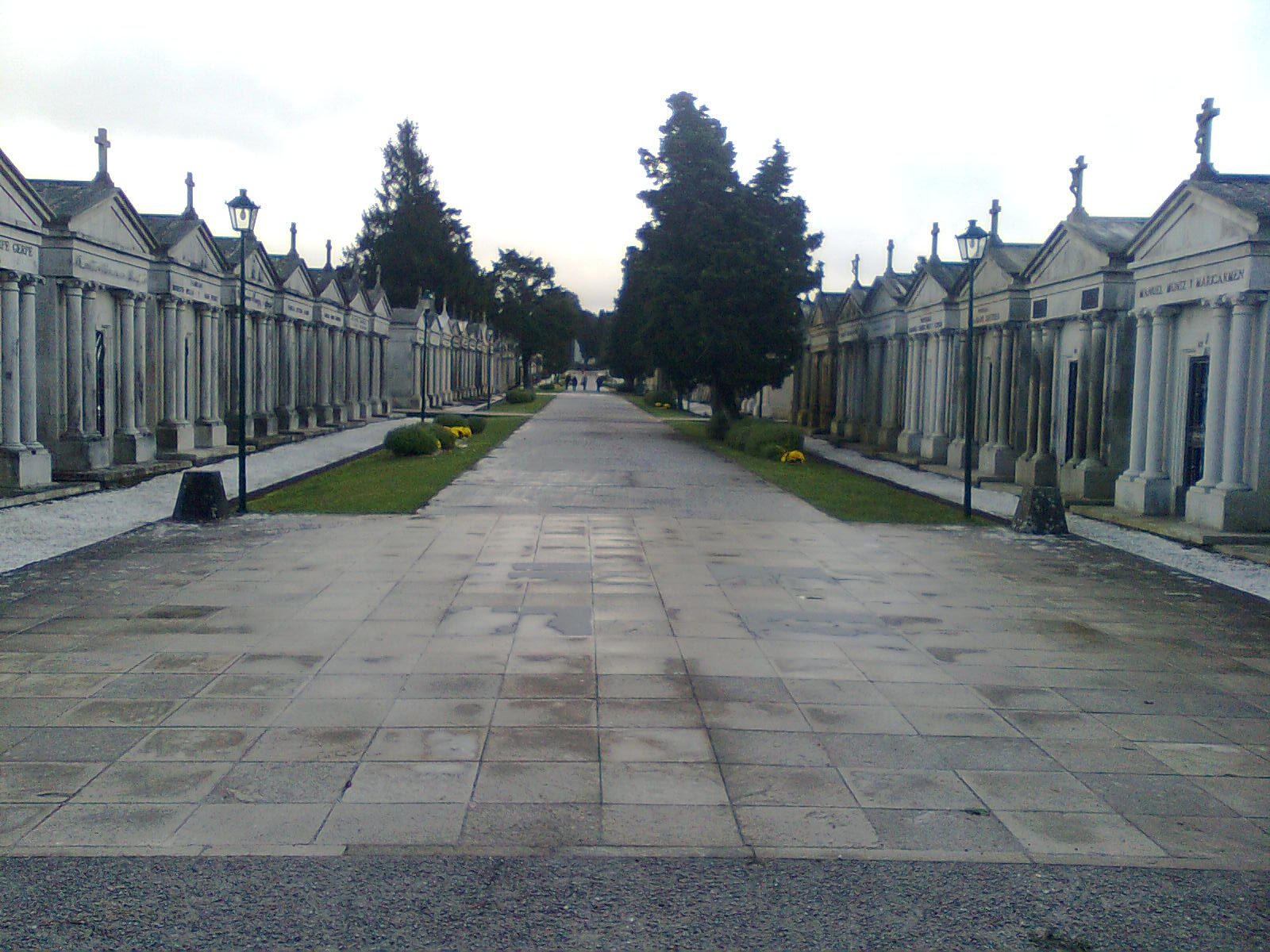
Boisaca Cemetery is the main municipal cemetery of Santiago de Compostela, located north of the historic centre near the Tambre industrial estate and the N-550 road. It covers roughly 66,000 square metres and holds close to 12,000 burial places, combining ground graves, columbarium niches, and family pantheons. Rather than a simple burial ground, it was laid out with a genuine urban plan, complete with a main avenue and side lanes organising the different sections.
Why was a new cemetery needed in the first place?
In the early 20th century, Santiago de Compostela was struggling with the consequences of the Spanish flu pandemic, which caused heavy casualties and exposed how little space remained in the city's existing burial grounds. That public health crisis was the direct trigger for planning a much larger cemetery outside the old town, in the area known as Boisaca.
Who designed it, and how long did construction take?
The project was commissioned to municipal architect Mariano Fernández Ragel, who drew up the design in 1919. Construction moved forward over the following years, and by 1923, coinciding with the start of the Primo de Rivera dictatorship, the cemetery was largely finished. Despite that, its formal inauguration didn't take place until much later — the site was officially opened in March 1939, under a very different political regime from the one in which it had first been conceived.
What happened at Boisaca during the Spanish Civil War?
The cemetery also carries a darker chapter of Spanish history. During the opening months of the Civil War, the grounds were used as a site of executions, where people targeted by the new authorities were shot. That history is now marked by a memorial plaque on one of the cemetery walls, dedicated to the victims of those reprisals. Because of this, Boisaca is not only a resting place for the city's dead, but also a point of reference for the historical memory of the Francoist period in Galicia.
How is the cemetery laid out?
One of the most distinctive features of Boisaca is its spatial composition, designed with the kind of ambition typical of larger European cemeteries from the early 20th century. A main avenue acts as the central axis, with side corridors branching off toward the different burial sections. This layout makes it easier to navigate such a large site and gives the cemetery an orderly, almost city-like character — which is why local descriptions sometimes refer to it as a small "city of the dead."
Is there anything architecturally notable on the grounds?
Beyond the burial plots themselves, the site includes a funerary chapel (tanatorio) that has been the subject of dedicated architectural studies examining how spaces of mourning and silence are shaped in buildings of this kind. This shows that, while Boisaca is first and foremost a working cemetery, it is also regarded as having architectural value and is discussed in the context of memorial-space design.
Frequently asked questions
Where exactly is Boisaca Cemetery located? It lies north of central Santiago de Compostela, in the Boisaca area, close to the Tambre industrial estate and the N-550 road.
When did the cemetery officially open? Although construction was largely complete by the 1920s, the formal inauguration only took place in March 1939.
Why was this particular site chosen for a new cemetery? The immediate reason was the Spanish flu epidemic in the early 20th century, which revealed that the city's existing cemeteries no longer had enough capacity.
Does Boisaca have historical significance beyond being a burial site? Yes — it was used as an execution site during the early months of the Spanish Civil War, a history now commemorated with a plaque on one of its walls.
Nearby places
-

Convento de Santa Clara de Santiago de Compostela
Santiago de Compostela
-
Convento do Carme
Santiago de Compostela
-
Church of Saint Dominic of Bonaval
Santiago de Compostela
-
Church of Sant Mary of the Way
Santiago de Compostela
-
Capela de Ánimas
Santiago de Compostela
-
Church of San Bieito do Campo
Santiago de Compostela
Earn badges for the places you visit
Download NextOnTrip, discover new places and check off your trails.