About this place
The Church of San Bieito do Campo stands in the historic old town of Santiago de Compostela, in Galicia, in northwestern Spain. Its Galician name honors Saint Benedict ("Bieito" being the local form of Benito/Benedict), while "do Campo" ("of the field") recalls that the church originally stood on open ground outside the medieval city's dense core.
What is the history behind this church?
The site's origins trace back to the episcopate of Pedro de Mezonzo, who led the diocese around the turn of the millennium (985–1003). In the second quarter of the 12th century, under Archbishop Diego Xelmírez, the building was entirely rebuilt in the Romanesque style, during the period when Santiago flourished as a pilgrimage destination and underwent intense construction activity.
A further significant change came in the second quarter of the 14th century, when the main doorway was reworked. From that period survives the tympanum depicting the Epiphany, which is preserved inside the church today.
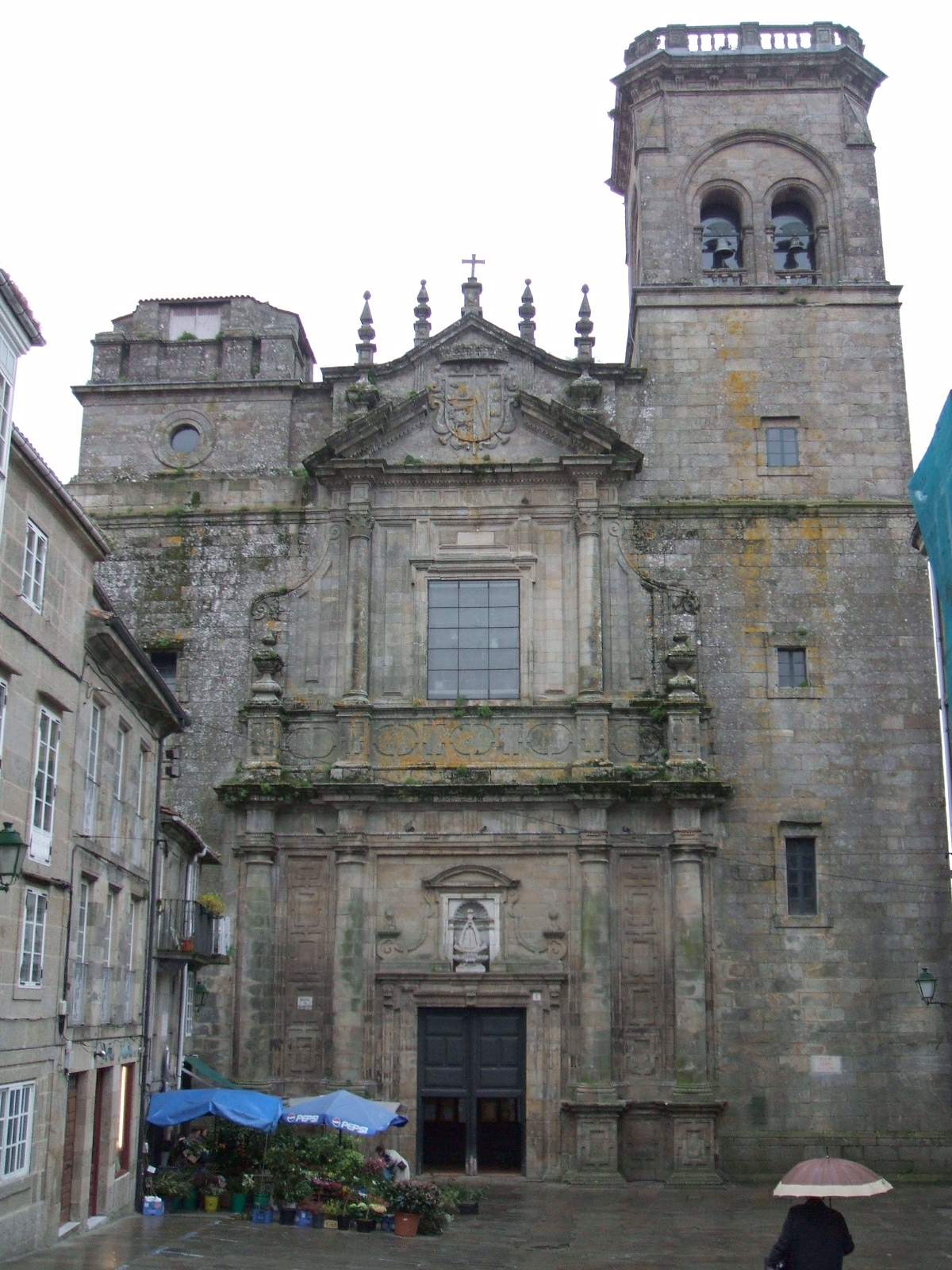
At the turn of the 18th and 19th centuries, the church underwent a second, thorough reconstruction. On the initiative of Archbishop Malvar, the earlier structure was demolished and a new building was raised to a design by Melchor de Prado, following Neoclassical principles. It is this Neoclassical form that defines the church's appearance today.
What does the church look like architecturally?
The building follows a rectangular plan with a single nave divided into four bays, covered by a barrel vault. The walls are built of granite ashlar, with a slate roof — both typical of Galician religious architecture in this region. Inside stands the main chapel, and from the earlier Romanesque-Gothic phase of the building, the Epiphany tympanum mentioned above still survives, now set within the interior as a trace of the site's oldest history.
The plain, restrained Neoclassical form contrasts with the richly decorated Baroque facades found on many other churches in Santiago, making San Bieito do Campo an interesting example of the city's architectural variety.
What can visitors see inside?
The interior houses an exhibition dedicated to religious art. The church forms part of a small museum circuit that also includes the General Chapel of Souls (Capilla General de Ánimas) and the Church of Santa María do Camiño — three sacred sites within the old town that together offer a compact but worthwhile route through Santiago's religious art.
Where is the church located, and how do you get there?
The church sits in the very heart of the historic center of Santiago de Compostela, within the old town fabric listed as a UNESCO World Heritage site. Its proximity to other religious monuments makes it easy to combine a visit with a short walk through the surrounding streets — a natural stop on a walking tour of the city, with no need for transport.
Frequently Asked Questions
What does the name "San Bieito do Campo" mean? "Bieito" is the Galician form of Benedict (Benito), and "do Campo" means "of the field" — a reference to the church's original location outside the dense medieval city core.
What architectural style is the church built in? The building's current form is Neoclassical, the result of a reconstruction completed at the end of the 18th century. A trace of the earlier 12th-century Romanesque phase survives, however: a 14th-century Epiphany tympanum, visible inside.
Can visitors go inside the church? Yes, the interior hosts an exhibition of religious art, forming part of a museum circuit that links this church with the Chapel of Souls and the Church of Santa María do Camiño.
Is the church close to the cathedral and the center of Santiago? Yes, it stands within the historic city center, near other religious monuments, making it easy to include on a walking tour of the old town.
Nearby places
-

Capela de Ánimas
Santiago de Compostela
-
Church and Convent of Saint Augustine
Santiago de Compostela
-
Church of Sant Mary of the Way
Santiago de Compostela
-
Monastery of Saint Pelagius of Antealtares
Santiago de Compostela
-
Capela Mondragón
Santiago de Compostela
-
Capela da Comuñón
Santiago de Compostela
Earn badges for the places you visit
Download NextOnTrip, discover new places and check off your trails.