- Sacred Monuments
- Religious monuments
Church and Convent of Saint Augustine
About this place
Church and Convent of Saint Augustine stands in the historic center of Santiago de Compostela, in the region of Galicia, Spain. Tucked into the old town's dense street grid not far from the pilgrim routes that converge on the cathedral, the complex has passed through several distinct chapters over four centuries — from an Augustinian friary, through decades under Jesuit stewardship, to its current life as a university residence.
Who built it, and when?
The building was commissioned by the Count of Altamira, with construction running from 1623 to 1648. The design is attributed to Bartolomé Fernández Lechuga, an architect active in Galicia during the first half of the seventeenth century. The community that first occupied the site belonged to the Calced Augustinians, a branch of the order that had previously been based in Arzúa, a small town on the French Way of the Camino de Santiago a few dozen kilometers away. Relocating to the city reflected a broader pattern of religious orders consolidating in larger urban centers during this period.
What does the church look like architecturally?
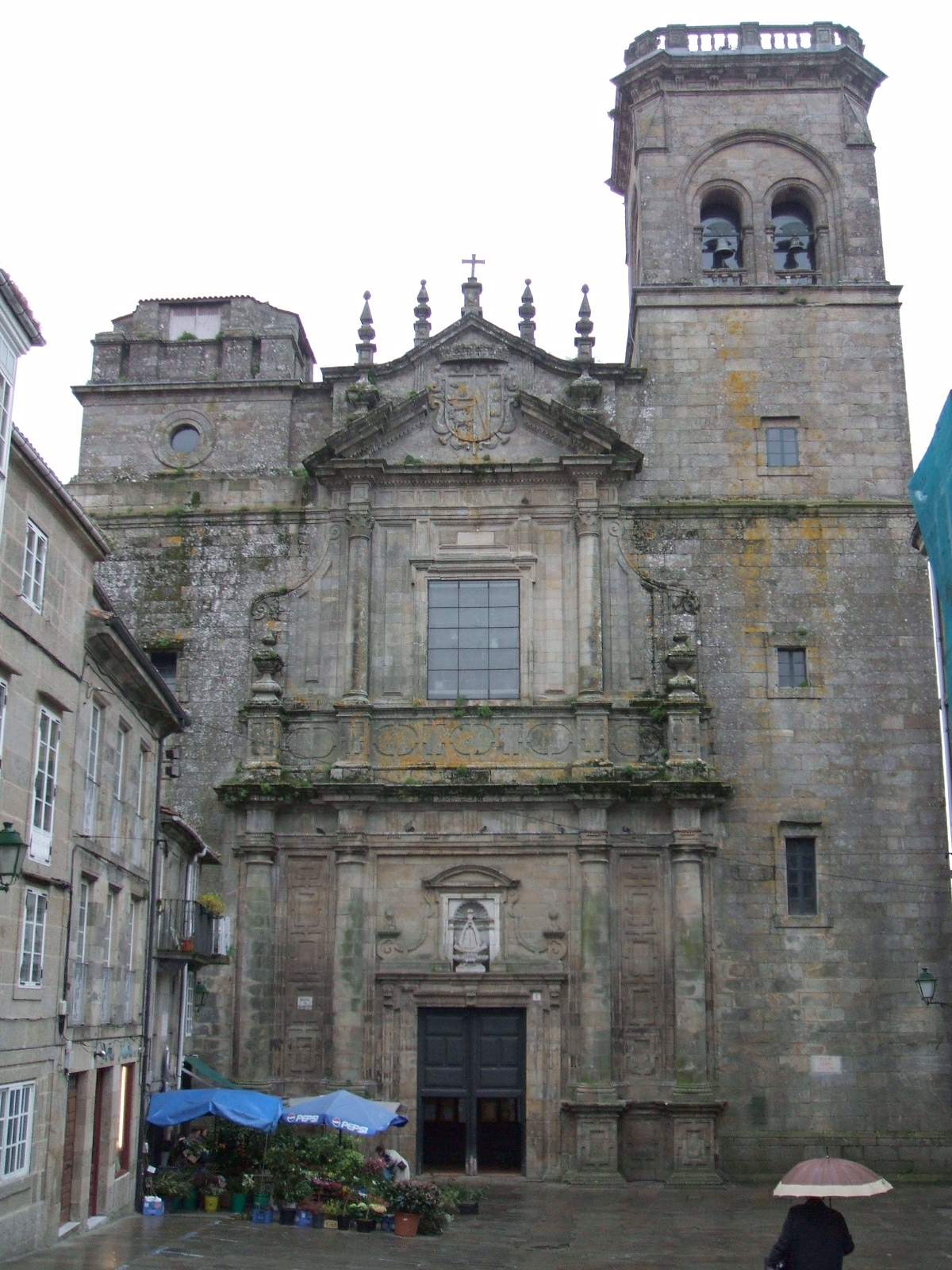
The church follows a rectangular plan with a single nave divided into three bays, covered by a barrel vault. A transept and side chapels complete the layout, along with a hemispherical dome built without a drum — meaning it lacks the tall cylindrical base that supports the dome in many other Baroque churches of the era. The result is a more compact, low-slung silhouette than in the region's more monumental Baroque interiors.
The facade was originally designed with two towers, but neither survives as planned: one was left unfinished, and the other collapsed after being struck by lightning in 1788. That episode is the reason the current facade reads as visibly asymmetrical compared to the original seventeenth-century project.
What happened to the convent after the religious orders were suppressed?
During the nineteenth-century wave of secularization that stripped Spanish religious communities of their properties, the Augustinian community left the building, and the complex passed through a series of uses unrelated to its original religious purpose. The situation began to change in the early twentieth century: between 1916 and 1917, the Society of Jesus took over the site's usufruct rights and reopened the church for worship. The Jesuits subsequently acquired the ruined portions of the complex and rebuilt them, converting the former convent into an educational institution.
What is the building used for today?
The former convent now houses the Colegio Mayor Universitario San Agustín, a university residence hall linked to Santiago de Compostela's academic community, while the church itself remains active for religious services. Despite centuries of structural damage, changes of ownership, and shifting purposes, the complex still reads clearly as a Baroque conventual church. For visitors exploring Santiago beyond the cathedral circuit, it offers a tangible example of how the city's older religious buildings found new institutional roles without losing their architectural identity.
Frequently Asked Questions
How old are the Church and Convent of Saint Augustine? The complex dates to the seventeenth century, built between 1623 and 1648 on a commission from the Count of Altamira.
Why does the church facade lack the two towers originally planned? One tower was never finished, and the other collapsed after a lightning strike in 1788, permanently altering the building's exterior.
Who took over the convent after the Augustinian order left? Following nineteenth-century secularization, the building changed hands several times until the Jesuits obtained usufruct rights in 1916–1917, rebuilt the ruined sections, and reopened the church.
What function does the building serve now? It currently operates as the Colegio Mayor Universitario San Agustín, a university residence, with the church remaining in active religious use.
Nearby places
-

Church of San Bieito do Campo
Santiago de Compostela
-
Church of Sant Mary of the Way
Santiago de Compostela
-
Capela de Ánimas
Santiago de Compostela
-
Monastery of Saint Pelagius of Antealtares
Santiago de Compostela
-
Capela Mondragón
Santiago de Compostela
-
Church of Saint Dominic of Bonaval
Santiago de Compostela
Earn badges for the places you visit
Download NextOnTrip, discover new places and check off your trails.