About this place
Church of Santa María do Camiño is a modest but historically significant church in the old town of Santiago de Compostela, standing at the junction of Travesa and Oliveira streets, right by the former city gate known as Porta do Camiño.
Why does this church matter to pilgrims?
The church occupies the spot where, for centuries, pilgrims walking the Camino Francés first entered the city. Passing through the Porta do Camiño gate, travelers encountered Compostela's sacred architecture here before they ever reached the cathedral itself. That detail of location gives the building a special place in the Jacobean tradition — it marks a symbolic threshold into the city's religious core.
The earliest written record of the church dates to 1279, appearing in the will of Lorenzo Domínguez, a cardinal of the Santiago cathedral, who listed it among the city's churches and chapels receiving a bequest from him. Nothing survives of that medieval building, which had been founded and sponsored by the Compostela nobleman Ruy Sánchez de Moscoso.
What can you see today?
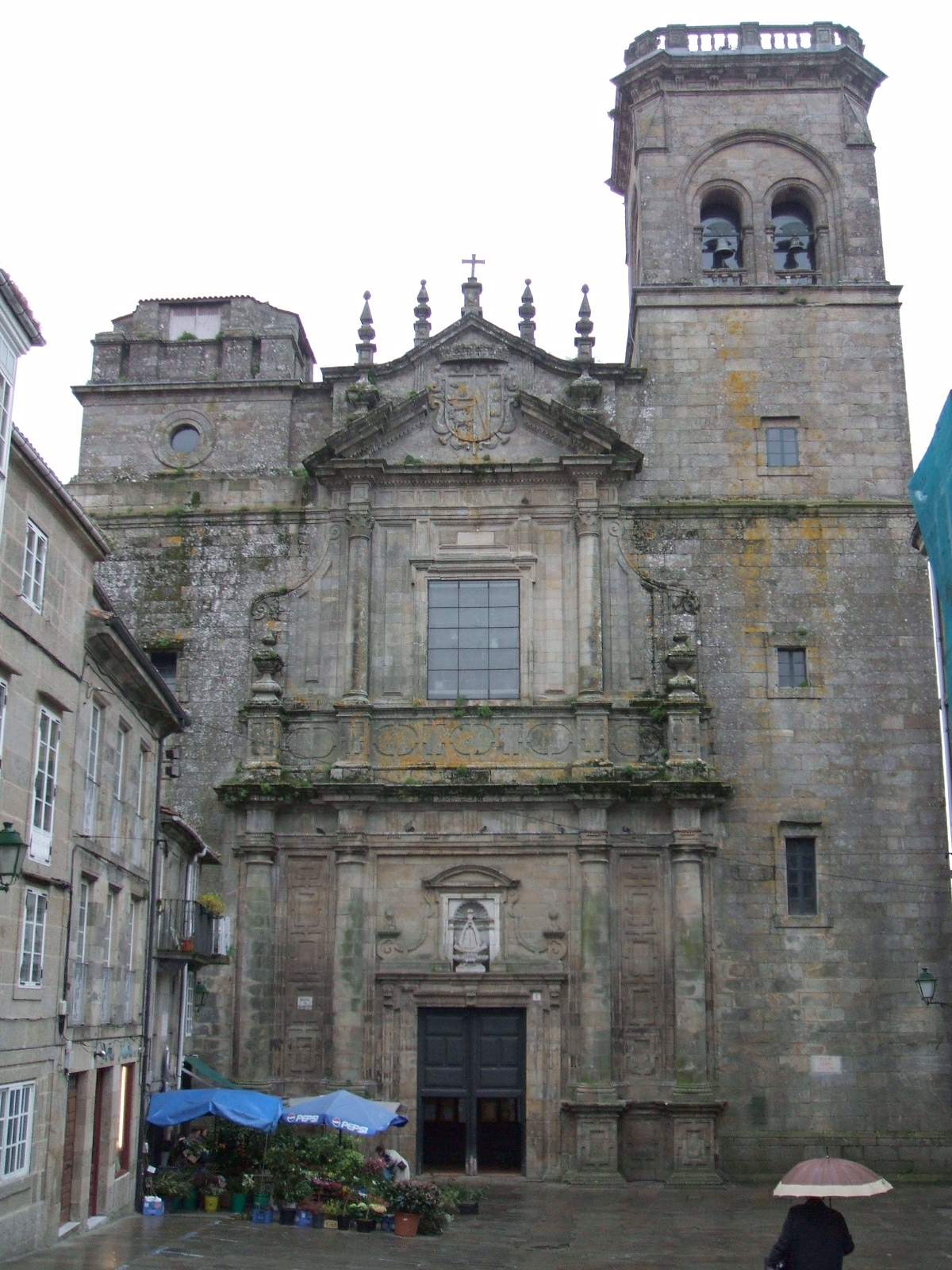
The present structure is the result of a major 18th-century rebuild. Work began in 1747 with the renovation of the main chapel, and construction of the nave started in 1751. The interior consists of a single rectangular nave divided into five sections by transverse arches and groin vaults, flanked by side chapels built in a more classicist style.
The façade blends Baroque and Neoclassical elements, its most distinctive feature being a large oculus crowned with a laurel wreath, topped by a small bell tower. It's a compact but coherent composition, typical of Compostela's religious architecture from that era.
The interior's main artistic highlight is the high altarpiece, a Baroque work by Manuel de Leis completed in 1748, featuring a Neoclassical image of the Immaculate Conception carved by Manuel Prado Mariño. The church also holds Rococo sculptures by Bieito Silveira — a mix of styles that reflects how long the finishing work on the building actually took.
What stood next to the church?
Adjacent to the church once stood a pilgrims' hospital, founded by the canon Ruy Sánchez de Moscoso — the same figure linked to the original medieval church. The complex included a chapel dedicated to Saint Michael and a library holding books on prayer, theology, canon law, medicine, and physics. This shows the site served pilgrims as more than a place of worship — it was also a hub of care and learning for travelers finishing a long journey.
How to get there and when to visit?
The church sits within Santiago de Compostela's historic center, an easy walk from the cathedral — simply follow the pilgrim route in from the Porta do Camiño side. Given its small size, a visit takes little time, making it easy to combine with a longer stroll through the old town. The best time to go is outside the peak pilgrimage season — spring or early autumn — when the city is noticeably quieter.
Frequently asked questions
Is the church part of the main pilgrimage route? Yes — it stands right on the route pilgrims walking the Camino Francés take when entering the city, next to the former Porta do Camiño gate.
How old is this church? The first record dates to 1279, but the current building is from the 18th century — reconstruction began in 1747.
Who created the main altarpiece? The high altarpiece is a Baroque work by Manuel de Leis from 1748, featuring an Immaculate Conception figure carved by Manuel Prado Mariño.
Was there anything else near the church besides the building itself? Yes, a pilgrims' hospital once stood alongside it, with a chapel dedicated to Saint Michael and a library, founded by the canon Ruy Sánchez de Moscoso.
Nearby places
-

Capela de Ánimas
Santiago de Compostela
-
Church of San Bieito do Campo
Santiago de Compostela
-
Church and Convent of Saint Augustine
Santiago de Compostela
-
Church of Saint Dominic of Bonaval
Santiago de Compostela
-
Monastery of Saint Pelagius of Antealtares
Santiago de Compostela
-
Capela Mondragón
Santiago de Compostela
Earn badges for the places you visit
Download NextOnTrip, discover new places and check off your trails.