About this place
Convento do Carme is an 18th-century convent of Discalced Carmelite nuns in Santiago de Compostela, one of the city's most distinctive religious buildings — and one that sees far fewer visitors than the cathedral area nearby.
The story behind the convent
The convent was founded in 1748 by Mother María Antonia de Jesús (1700–1760), a Galician mystic and religious writer, on land that belonged to the Counts of Priegue. It was the first community of Discalced Carmelite nuns established in Galicia, which gives Convento do Carme particular importance in the history of the order in the region. Construction was completed in 1758. The church and convent were built by two "tracista" friars — architect-monks of the Carmelite order — José de los Santos and José del Espíritu Santo, who gave the building the plain, solid character typical of Carmelite architecture.
What will you see there?
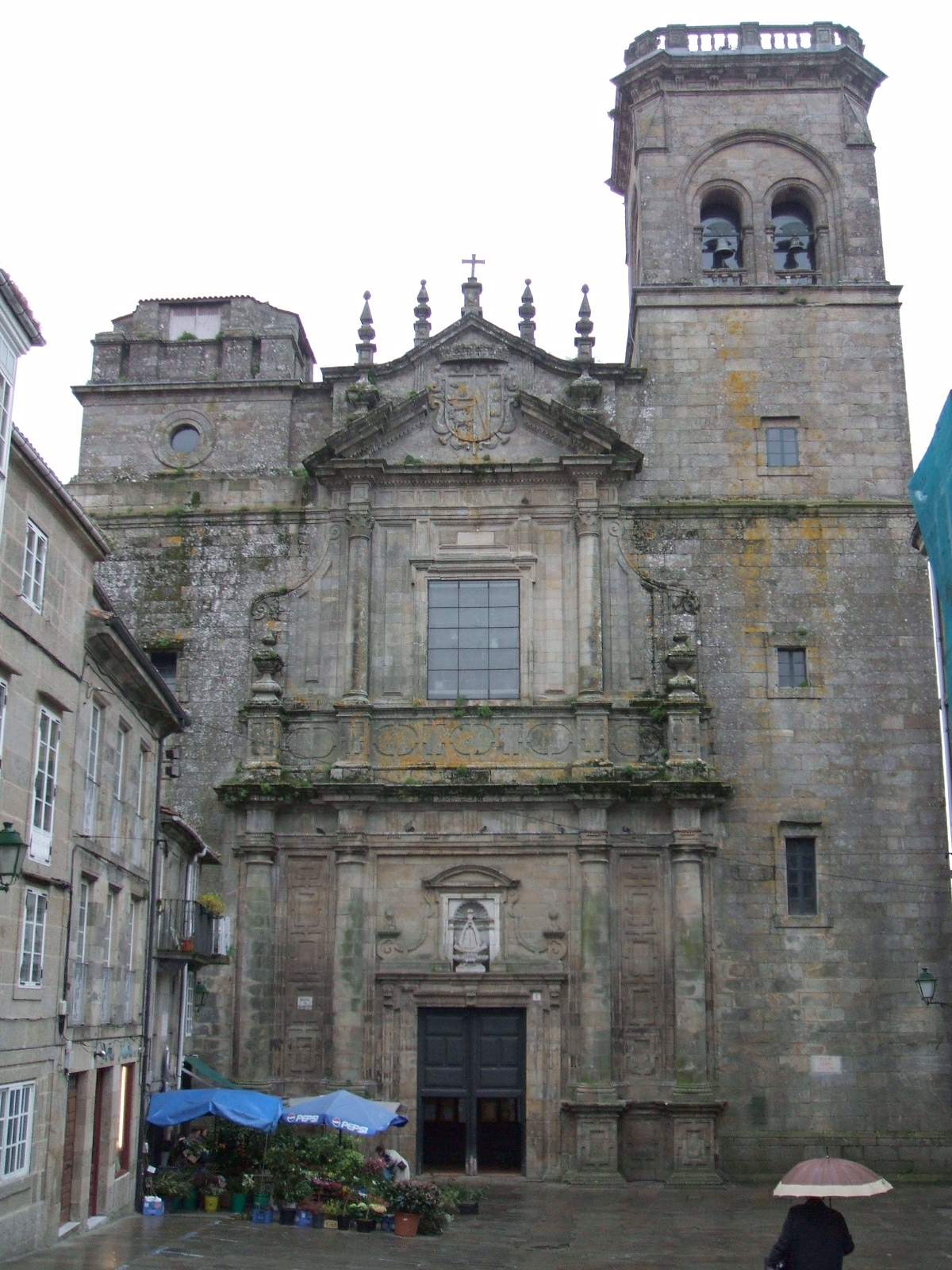
The church façade is striking for its simplicity and clean lines: built in dressed granite and topped with a triangular pediment. Architecturally, it closely echoes the façade of the church of San José in Ávila, underlining its place within the shared Carmelite building tradition. Beneath the pediment, set into a niche, stands a polychrome statue of the Virgin of Mount Carmel, attributed to the sculptor José Gambino (1719–1775), one of the leading figures of Baroque religious sculpture in Galicia. The building stands at the meeting point of Rúa dos Loureiros and Rúa de Santa Clara, in a quiet corner of Santiago's historic centre.
How do you get there?
The convent sits inside the old town, within easy walking distance of the cathedral and Praza do Obradoiro — usually no more than a ten-to-fifteen-minute stroll. Santiago's historic core is compact and pedestrian-friendly, so walking is the simplest way to reach it; just head toward the streets of Santa Clara and Loureiros. The city is served by an airport and a train station with national connections, from which the centre is reached by bus or taxi.
Religious life today
Convento do Carme remains an enclosed convent: Discalced Carmelite nuns live there following a contemplative life built around prayer and work. The sisters bake communion wafers supplied to churches across Santiago de Compostela and produce liturgical items. Because it is an enclosed community, the interior is not generally open to visitors — sightseeing is largely limited to the façade and the immediate surroundings of the church.
When should you visit?
Since Convento do Carme is essentially viewed from the outside, it can be visited year-round regardless of weather. Morning and late-afternoon light works best for photographing the granite façade, as the low angle brings out the carved detail of the pediment and the statue of the Virgin. It's worth pairing a visit with a walk through the surrounding old-town streets, which stay noticeably quieter than the lanes around the cathedral.
Frequently asked questions
Can you go inside the convent? No — as an enclosed community, Convento do Carme is not open to visitors in the usual sense. What you can see is the church façade and its immediate surroundings.
Who built the convent? It was built under the direction of Carmelite friars José de los Santos and José del Espíritu Santo, with construction finishing in 1758.
What do the nuns living there do today? The Discalced Carmelite nuns lead a contemplative life and bake communion wafers for churches throughout Santiago de Compostela, alongside making liturgical items.
How far is the convent from the cathedral? Convento do Carme lies in the historic centre, about a ten-to-fifteen-minute walk from the cathedral and Praza do Obradoiro.
Nearby places
-

Convento de Santa Clara de Santiago de Compostela
Santiago de Compostela
-
Capela de Ánimas
Santiago de Compostela
-
Church of Saint Dominic of Bonaval
Santiago de Compostela
-
Church of Sant Mary of the Way
Santiago de Compostela
-
Church of San Bieito do Campo
Santiago de Compostela
-
Church and Convent of Saint Augustine
Santiago de Compostela
Earn badges for the places you visit
Download NextOnTrip, discover new places and check off your trails.