About this place
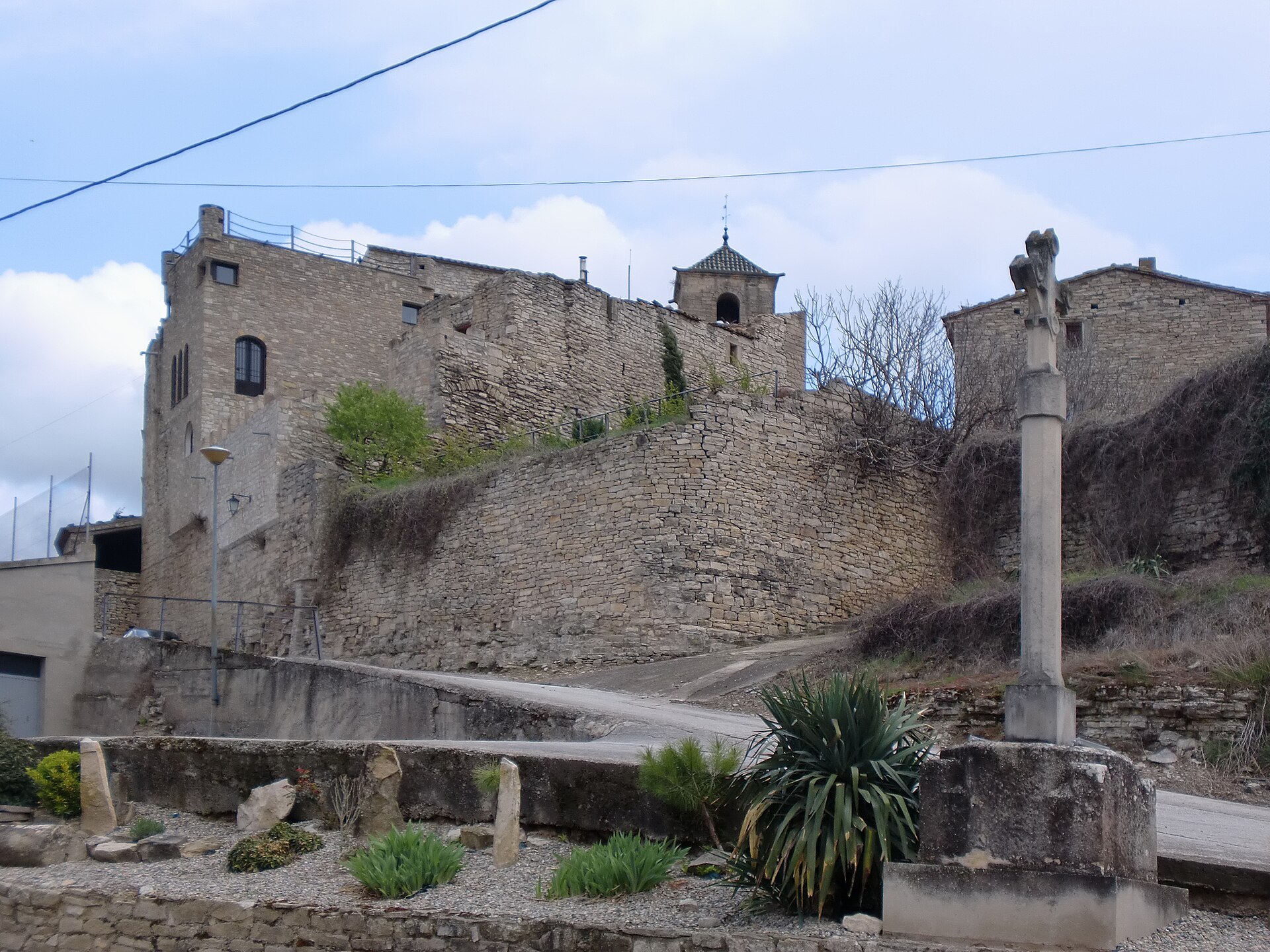
Castell de Savallà is the ruined lordly residence standing above the village of Savallà del Comtat, in the Conca de Barberà region of Catalonia. Only sections of the perimeter wall and two flanking towers survive today, yet the site's story stretches back nearly a thousand years and passes through several noble families who shaped this corner of Catalonia.
When was Savallà first mentioned in writing?
The place-name surfaces in written sources as early as 1043, in a donation document issued by the counts of Barcelona, Ramon Berenguer I and his wife Elisabet, granting land to Bernat Sunifred and his wife Amaltruda. In that record the area is listed as one of the boundary markers of the Conesa castle district, under a Latin form close to "Serra de Avellano" — a name rooted in the word for hazel tree, which later evolved into today's "Savallà."
Who controlled the castle in the medieval period?
By the late 11th century the stronghold belonged to the Cervera family. In 1172, Ramon de Cervera passed it to his daughter Elisenda, married to Berenguer d'Aguiló, and later to their son Guillem. It was around the mid-12th century that members of a lineage known as Avellà or Savallà first appear as castellans — the officials who administered the fortress on the owners' behalf. By the close of the 13th century the property had passed to the Timor family, and in the following century to the Boixadors, who would go on to shape the site's fate for generations.
How did a medieval fortress become a count's palace?
Nothing physical remains of the original medieval defensive castle — it was entirely rebuilt. Between the 15th and 16th centuries a fortified palatial residence rose on the same spot, becoming the seat of the counts of Savallà. The county title itself was created in 1599, granted to Bernat II de Boixadors i d'Erill. From that point the building combined defensive features with the representative grandeur typical of aristocratic residences in early modern Catalonia.
Why did the castle fall into ruin?
The building's decline began once the owning family abandoned it, and serious damage followed during the Carlist Wars that shook Catalonia in the 19th century. In the final quarter of that century the family itself dismantled much of the structure, choosing instead to invest in restoring another of their properties — the castle of Peralada. Numerous architectural elements taken from Savallà were transported there, sealing the fate of the original residence.
What survives at the site today?
Of the former palace-fortress complex, stretches of the enclosing wall and two flanking towers still stand. The ruins occupy high ground above the village of Savallà del Comtat, overlooking the surrounding hills of the Conca de Barberà — a region also known for the Poblet monastery and its winemaking tradition.
Frequently asked questions
Can visitors go inside Castell de Savallà? The site is a standing ruin — mainly the exterior wall sections and towers are accessible, without full indoor visitor facilities.
How old is this site's history? The area is first documented in 1043, though the current building — the fortified palace — was constructed only in the 15th and 16th centuries.
Why did the castle end up in ruins? Abandonment by its owners, damage during the 19th-century Carlist Wars, and the deliberate removal of architectural elements to Peralada Castle all contributed to its decline.
Which family raised the site to a county seat? The title of Count of Savallà was created in 1599 for Bernat II de Boixadors i d'Erill, from the family that had taken over the property in the 14th century.
Nearby places

Earn badges for the places you visit
Download NextOnTrip, discover new places and check off your trails.