About this place
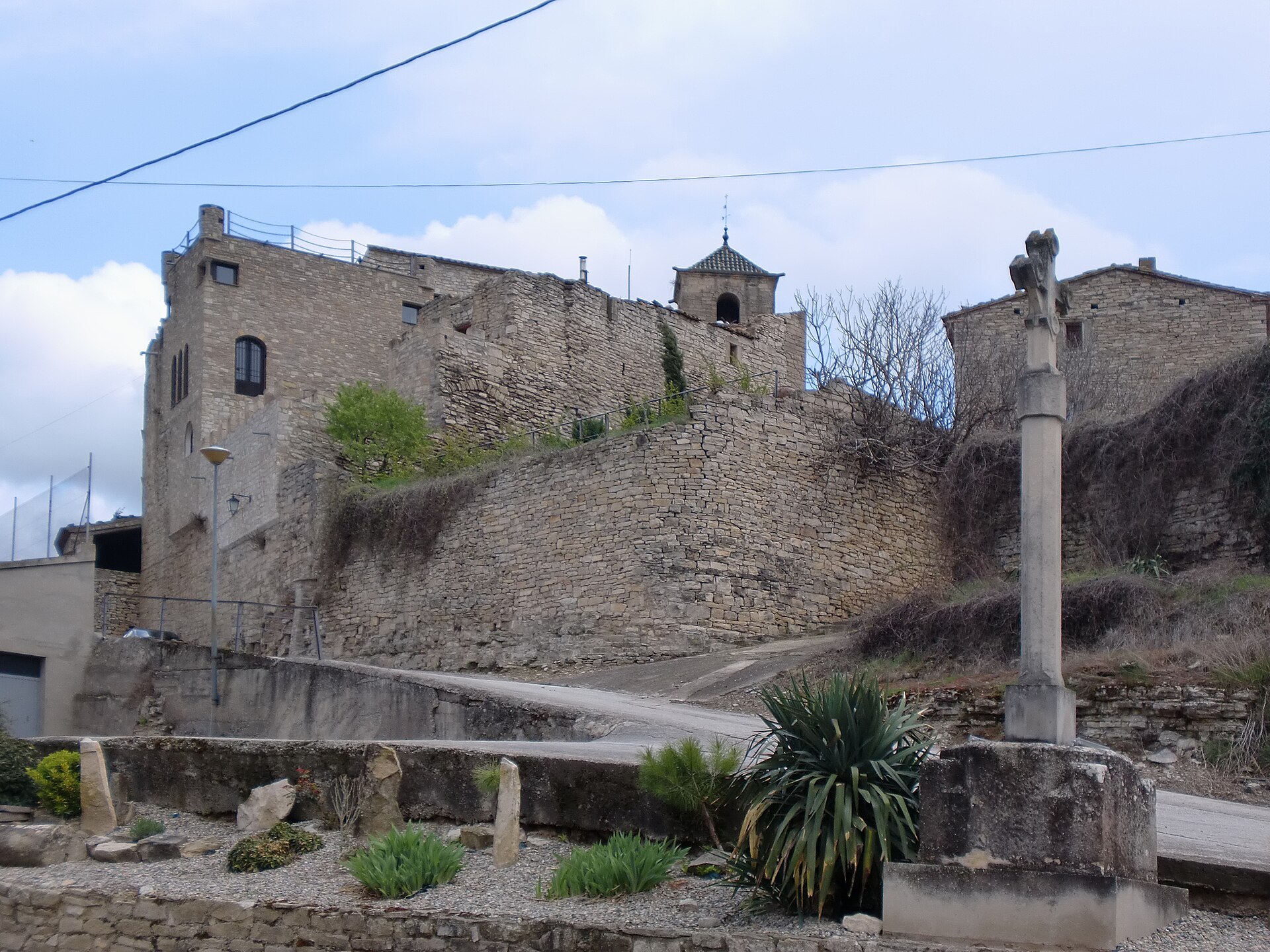
Castell de la Guàrdia Lada is a medieval fortress perched on a hilltop above the hamlet of La Guàrdia Lada, east of Montoliu de Segarra in Catalonia's Segarra region. Recognized as a cultural asset of national interest (Bé Cultural d'Interès Nacional), it stands just a short walk from the chapel of Mare de Déu del Coll and remains one of the most distinctive landmarks in this part of the countryside.
Where exactly is the castle?
The fortress occupies an isolated rise at the highest point of the village of La Guàrdia Lada, within the municipality of Montoliu de Segarra. Perched on the edge of the hill with views over the surrounding fields and valleys of the Segarra, its position was never accidental — for centuries it allowed control over routes and boundaries at the edge of the old Cervera territory.
How old is the fortress?
The earliest written trace linked to the site appears in the "Liber feudorum maior," a document from 1026 that mentions "Guardiam Grossam" while defining the boundaries of Cervera's territory — historians identify this reference with La Guàrdia Lada. From 1059 onward, documentary evidence about the place becomes far more solid. By 1076 the castle was listed among the possessions of Ramon Berenguer I, Count of Barcelona, confirming its standing within the feudal hierarchy of the time.
A year earlier, in 1075, Hug Dalmau de Cervera had entrusted the stronghold to Guifré Bonfill and his wife Ricarda, the earliest castellans known by name. In the following decades the castle passed to the Order of the Hospital (the Knights Hospitaller), a transfer later confirmed by King Pere el Gran in 1261. The Hospitallers retained the property until the 19th century, when the abolition of feudal lordships finally ended their control over the estate.
What does the architecture look like?
The original structure had a pentagonal layout, ringed by a defensive ditch and reinforced with a bastion — a design typical of feudal defensive residences of the era. Most of what survives today, however, dates from a later, late-medieval building phase.
The oldest identifiable element is the foundation of a circular tower measuring 6.25 metres in diameter, which architectural historians attribute to the primitive early-medieval construction of the 11th century. The rest of the present-day castle was raised on top of that same foundation in the 15th century, meaning the surviving structure quietly combines building phases separated by roughly four hundred years.
Why is it worth a visit?
For anyone interested in the feudal history of Catalonia and its defensive architecture, Castell de la Guàrdia Lada offers a rare chance to see 11th- and 15th-century building phases coexisting within a single, legible structure. Its proximity to the chapel of Mare de Déu del Coll makes it easy to pair a visit to the castle with a short walk through the quiet Segarra countryside, away from the busier tourist routes of the region's larger towns.
Frequently Asked Questions
Where is Castell de la Guàrdia Lada located? The castle sits on a hilltop above the village of La Guàrdia Lada, within the municipality of Montoliu de Segarra in Catalonia's Segarra region, right next to the chapel of Mare de Déu del Coll.
Who owned the castle throughout its history? Ownership passed from the Counts of Barcelona (including Ramon Berenguer I) to the Cervera lineage, and from the 13th century onward to the Knights Hospitaller, who administered it until feudal lordships were abolished in the 19th century.
Which part of the castle is the oldest? The oldest surviving element is the foundation of a circular tower 6.25 metres in diameter, dating from the 11th century. The rest of the current structure was built on top of it in the 15th century.
Is the castle a protected heritage site? Yes, Castell de la Guàrdia Lada is listed as a cultural asset of national interest (Bé Cultural d'Interès Nacional).
Nearby places

Earn badges for the places you visit
Download NextOnTrip, discover new places and check off your trails.