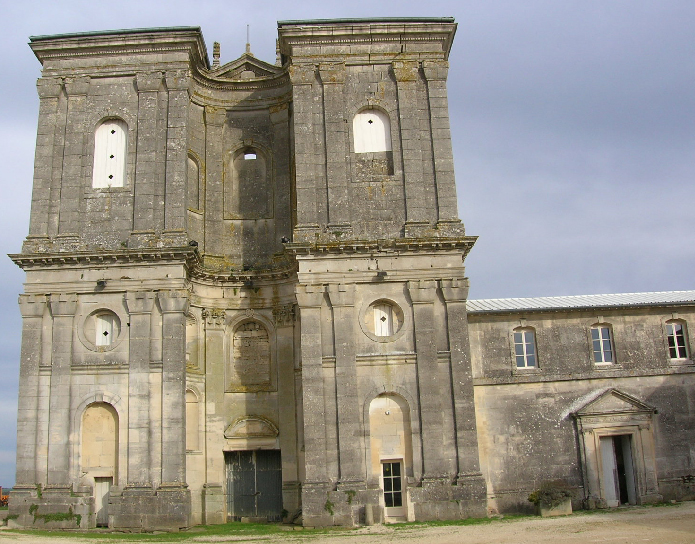
About this place
Abbaye de Jovilliers is a former Premonstratensian abbey standing in the commune of Stainville, in the Meuse department of northeastern France, between the villages of Ménil-sur-Saulx and Juvigny-en-Perthois. Though little known outside the region, the site has been protected as a Historic Monument since 1995 and remains one of the more evocative religious ruins of the Meuse countryside.
When was the abbey founded?
The abbey's origins go back to 1132, when Geoffroy III, seneschal of Champagne and lord of Joinville, granted the farm of Jovillaris to Herbert, abbot of Rieval, so that a monastic community could be established there. The bishop of Toul, Henri of Lorraine, confirmed the gift in 1141, and construction of the first monastery began the following year. The community followed the Premonstratensian rule, and its canons farmed the surrounding land they received as donations. The abbey church, dedicated to Saints Peter and Paul, doubled as the parish church for the farming families settled in the abbey's lower courtyard.
How did the Wars of Religion affect the abbey?
The community's fortunes turned during the Wars of Religion. In 1592, Huguenot forces set fire to the church nave and part of the monastic buildings. Recovery proved short-lived: renewed fighting and a second Huguenot incursion in 1611 undid what restoration had been achieved. The abbey only began to recover its standing from 1672 onward, first spiritually, through a return to the stricter Ancienne Rigueur observance, and then materially, once a full reconstruction of the buildings started in 1720 using stone quarried at nearby Savonnières-en-Perthois.
What happened after the French Revolution?
An inventory of the abbey's property was drawn up on 5 May 1790, and by October of that year the monks had left the site for good. The church was dismantled down to its facade, and the rest of the estate was converted into a working farm. Little has changed since: no trace of the original twelfth-century buildings survives today, and everything still standing dates from the classical-style rebuilding of 1720.
What can visitors see today?
The most striking survival is the church facade, framed by two massive square towers and decorated with Corinthian and Ionic pilasters in a restrained neoclassical style, along with a small cherub carved on a corbel. Beyond the facade, the site retains its farm outbuildings, a covered well, vaulted cellars, and sections of the monastic quarters, including the cloister and the former abbot's residence, with several handsomely proportioned rooms. The abbey's eastern range, which once held the sacristy, scriptorium, chapter room, refectory, large kitchen, and dormitory, has vanished entirely, replaced by farm sheds. A garden of medicinal and aromatic herbs has been laid out in the courtyard next to the cloister, echoing the plants once grown there by the canons.
How can the abbey be visited?
Since 1988, the association Jovilliers Échanges et Culture has worked to bring the site back to life, organizing cultural events on the grounds throughout the year. Guided tours, lasting about ninety minutes, are offered on the first Sundays of July and August.
Frequently asked questions
Where is the Abbaye de Jovilliers located? In the commune of Stainville, in the Meuse department, between Ménil-sur-Saulx and Juvigny-en-Perthois.
Which religious order lived at the abbey? Premonstratensian canons regular.
Do any medieval buildings survive? No — everything standing today dates from the 1720 classical reconstruction; nothing remains of the original twelfth-century abbey.
When was the abbey listed as a Historic Monument? On 17 November 1995.
When are guided tours available? On the first Sundays of July and August, in tours lasting around an hour and a half, organized by a local heritage association.
Nearby places

Earn badges for the places you visit
Download NextOnTrip, discover new places and check off your trails.