About this place
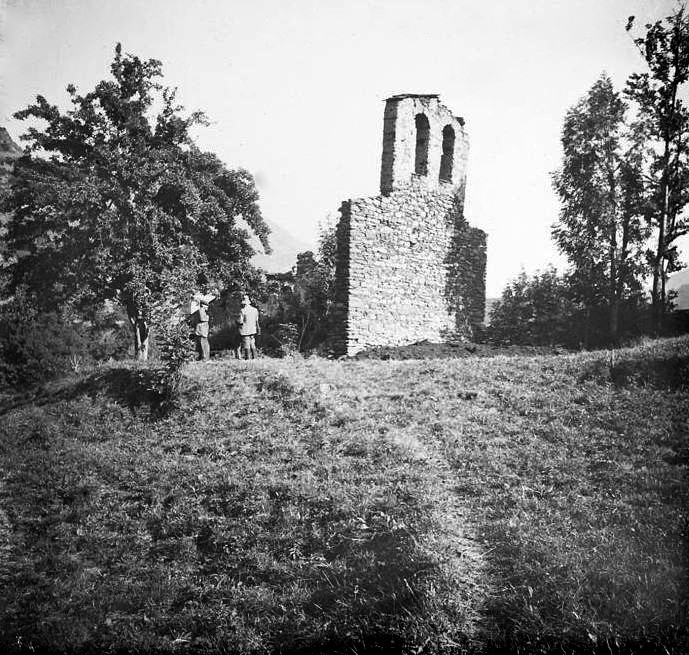
Sant Pere vell de Casa Carrera is a small, half-forgotten Romanesque ruin in Esterri d'Àneu, a village in the Pallars Sobirà district of the Catalan Pyrenees. The remains sit on the grounds of the private house Casa Carrera, in the highest part of the old town, above and to the west of the road leading toward the Isil valley. It is not the kind of site that makes it into standard guidebooks, yet it carries over a thousand years of local history.
Where is it and how do you get there?
Esterri d'Àneu lies in the Pallars Sobirà county, province of Lleida, at the gateway to the Vall d'Àneu valleys, not far from Aigüestortes i Estany de Sant Maurici National Park. The chapel stands in the upper part of the village's old quarter, on the grounds of Casa Carrera, above and west of the road to Isil. The easiest way to reach Esterri d'Àneu is by car via the N-260 or C-13 roads from Sort and Llavorsí; the nearest large city, Lleida, is roughly a two-hour drive away. Because the site sits on private property, visitors should be discreet and limit themselves to viewing it from outside.
What is there to see?
Of the original church of Sant Pere, only the western wall still stands today — the remnant of a single-nave building that was originally closed to the east by a semicircular apse. It is a modest but telling piece of Romanesque architecture, typical of the many small churches scattered across the valleys of Pallars. The surviving stone wall, incomplete as it is, still gives a sense of the proportions of a small medieval village church. The painted decoration that once covered the interior no longer remains on site — a surviving fragment is kept at the National Art Museum of Catalonia (MNAC) in Barcelona, catalogued under inventory number 4530, a sign of the artistic quality of the original interior.
What is the history behind it?
The first known documentary record of the church of Sant Pere dates to 1064. It appears there described as a monastery, named in a deed of exchange between Count Artau I of Pallars Sobirà and Ramon V of Pallars Jussà. The same document also mentions two other religious houses of the region, Sant Pere del Burgal and Sant Pere de les Maleses, which shows how densely the Àneu valley was dotted with small monastic communities and churches tied to the local counts in the 11th century. Over time the building lost its original religious function and survived only as a ruin absorbed into the private property of Casa Carrera — which is why it is now known as the "old" (vell) Sant Pere, to distinguish it from newer churches in the village bearing the same dedication.
When is the best time to visit?
The best months to explore Esterri d'Àneu and its surrounding heritage sites are late spring through summer (June to September), when the Pyrenean passes are open and long, warm days make walking around the old town comfortable. Autumn, especially October, brings striking foliage colors to the valleys, though nights can already turn cold. In winter the area mainly serves as a base for nearby ski resorts, and some mountain routes may be closed due to snow.
Frequently asked questions
Can you go inside the chapel? No — the site is on the private grounds of Casa Carrera and is not open for interior visits. Visitors can view the surviving wall from outside while respecting the private property.
How is "Sant Pere vell" different from other churches of the same name in the region? The word "vell" (old) distinguishes this ruin from newer churches carrying the same dedication, as well as from other Sant Pere sites in Pallars, such as Sant Pere del Burgal, mentioned in the same 1064 document.
Where can you see the church's painted decoration? A surviving fragment of the murals is held at the National Art Museum of Catalonia (MNAC) in Barcelona, under inventory number 4530.
What else is worth seeing in Esterri d'Àneu? The village is a good base for exploring the Vall d'Àneu valleys and the nearby Aigüestortes i Estany de Sant Maurici National Park, and its old quarter is compact enough for a short walking tour on its own.
Nearby places

Earn badges for the places you visit
Download NextOnTrip, discover new places and check off your trails.