About this place
Mare de Déu de Bellero is what remains of a small Romanesque hermitage located near the village of Son, in the municipality of Alt Àneu, in the Pallars Sobirà comarca (Lleida province, Catalonia). The site sits at roughly 1,404 metres above sea level, in the steep, mountainous landscape typical of this stretch of the Pyrenees, along the network of local roads linking the settlements of the Àneu valley.
What is the history behind this site?
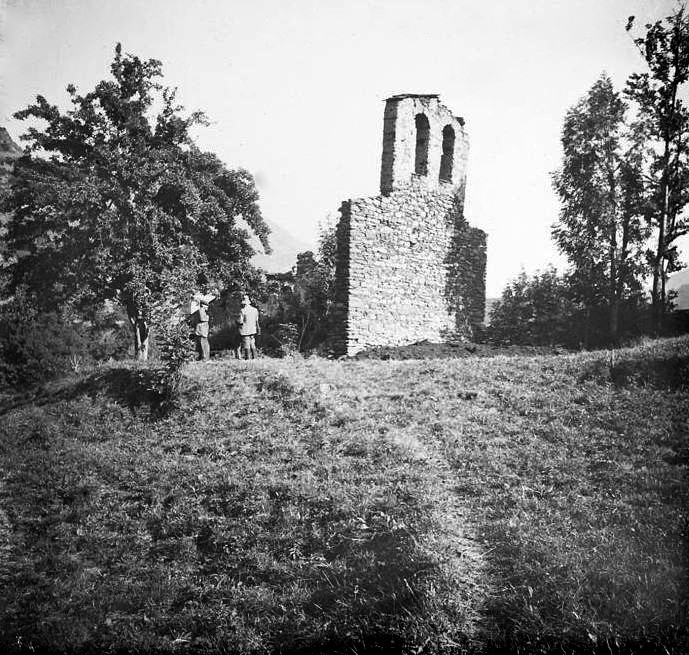
Bellero (also recorded under the variant spelling "Beiero") was a small hermitage of Romanesque origin. Surviving photographs show that the building originally had a single nave, later extended with two side aisles, resulting in a three-nave layout topped by a timber beam roof. On its eastern side stood two or three semicircular apses, a typical feature of Romanesque religious architecture in this part of the Pyrenees.
The 20th century was unkind to the hermitage. In 1936, during the unrest of the Spanish Civil War, its liturgical furnishings, including a Romanesque sculpture, were burned. The structure itself survived for another two decades before finally collapsing between 1958 and 1960. Its remaining ruins were then demolished in April 1974 to clear the way for the new road to Les Planes.
What can you actually see today?
It's worth being upfront: only minimal, fragmentary traces of the hermitage survive today — this is not a restored monument you can visit in its original architectural form. The value of the site is primarily historical. It documents how dense the network of Romanesque churches and chapels once was across the Àneu valley, and it illustrates how much of that heritage was lost over the last century to conflict, structural decay, and the modernisation of mountain infrastructure.
For visitors interested in the Romanesque architecture of Pallars Sobirà, Bellero works well as a point of reference — a reminder of the scale of loss the region's religious heritage suffered in the 20th century, and a reason to seek out better-preserved churches in nearby villages within Alt Àneu, such as Son or Isavarre.
How do you get to Bellero?
The starting point is the village of Son, from which a local road leads towards Les Planes — it was during the construction of this road in the 1970s that the remaining ruins of the hermitage were cleared away. Son itself is reached via the local road network of the Pallars Sobirà comarca, heading up the Àneu valley from Esterri d'Àneu. Given the mountainous terrain and the elevation above 1,400 metres, plan on driving and expect narrow, winding stretches of road.
When is the best time to visit?
Spring, summer and early autumn (roughly May to October) are the best months for exploring this part of the Pyrenees, when mountain roads are fully passable and temperatures are comfortable for walking around the area. In winter, snow can limit access to the more remote corners of the Alt Àneu municipality.
Frequently asked questions
Is there still anything to see at Bellero? Only minimal, fragmentary remains of the original hermitage survive — the building itself was demolished in 1974. Today the site is mainly of historical and symbolic interest.
Why doesn't the hermitage exist in its full form anymore? The building was already damaged in 1936, when its liturgical furnishings were burned, then collapsed between 1958 and 1960, and its ruins were finally cleared in April 1974 during construction of the new road to Les Planes.
What did the hermitage originally look like? It had a three-nave layout with a timber beam roof — originally a single nave later extended with two side aisles — and two or three semicircular apses facing east, features typical of Pyrenean Romanesque religious architecture.
Which village is the best starting point for visiting the area? The village of Son, part of the Alt Àneu municipality, is the natural starting point; from there a road heads towards Les Planes, passing close to where the hermitage once stood.
Nearby places

Earn badges for the places you visit
Download NextOnTrip, discover new places and check off your trails.