About this place
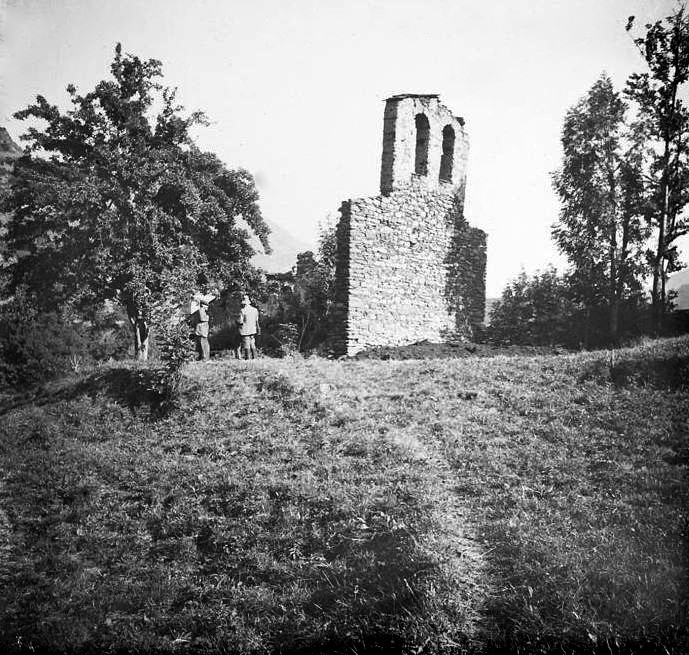
Santa Maria d'Espot is a Romanesque church standing on the edge of Espot, a mountain village in the Pallars Sobirà region (Lleida, Catalonia), right at the gateway to Aigüestortes i Estany de Sant Maurici National Park. Today it survives only as a ruin, but it remains a worthwhile stop for anyone interested in Pyrenean history and architecture while exploring the area.
What is the story behind Santa Maria d'Espot?
The church was built in the 12th century as a modest rural, single-nave building, closed off to the east by a semicircular apse. Its walls were raised from small granite stones gathered from the nearby river, laid in regular, even courses — a construction technique typical of local Romanesque rural buildings from that era. Only part of the apse's perimeter and a section of the south wall have survived to the present day. The interior is ruined and overgrown with vegetation, making it difficult to fully read the original layout.
The church once carried real administrative weight. The Espot valley formed part of an old comital domain, first documented in 1066 in an agreement between the Count of Pallars Sobirà and the Count of Pallars Jussà, who divided the territory of Pallars between them. Santa Maria d'Espot served as the parish church covering the valley's two historic settlement clusters, Solan and Obago.
How do you get to Espot?
Espot sits at the head of the Pallars Sobirà valley, on the access road leading to the entrance of Aigüestortes National Park. Driving is the most practical option — from Lleida or Barcelona, the route runs through Pobla de Segur and the Vall d'Àneu valley. Seasonal regional buses also serve the village, though a car gives more flexibility, especially if you plan further trips into the mountains. The ruined church stands within the village itself, so no mountain hike is needed — it's a short walk from the centre of Espot.
What will you actually see there?
The ruin itself is small and best appreciated as a piece of the region's sacred architectural history rather than a dramatic sight. Look for the masonry technique — small river stones laid in uniform rows — and the outline of the apse, which still lets you trace the church's original plan. Espot itself makes up for the modest scale of the ruin: the village sits at roughly 1,320 metres above sea level and is a natural base for hiking toward the national park's lakes and peaks, while a local ski resort operates here in winter.
When is the best time to visit?
Summer and early autumn (June to September) are the best months, when the trails through Aigüestortes are fully accessible and mountain temperatures are comfortable for walking. In winter (December to March), Espot switches to a ski-resort character, which suits travellers combining the visit with skiing — the church ruins can technically be seen year-round, but expect snow and a harder approach in the cold season.
Frequently asked questions
Is the Santa Maria d'Espot ruin free to visit? Yes. The ruins sit in open ground on the edge of the village, with no fence or entry fee — you can see them simply by walking through Espot.
How old is the church? It dates from the 12th century and represents the Romanesque style typical of rural Pyrenean chapels of that period.
Is it worth a special trip just to see this site? On its own, it's a small ruin, but combined with a visit to Espot and Aigüestortes National Park it becomes a worthwhile extra stop rather than a destination in itself.
Are there other Romanesque churches nearby? Yes. The Pallars Sobirà region and the Vall d'Àneu are known for a cluster of Romanesque churches — Santa Maria d'Espot is one of the lesser-known but representative examples of that architecture.
Nearby places

Earn badges for the places you visit
Download NextOnTrip, discover new places and check off your trails.