About this place
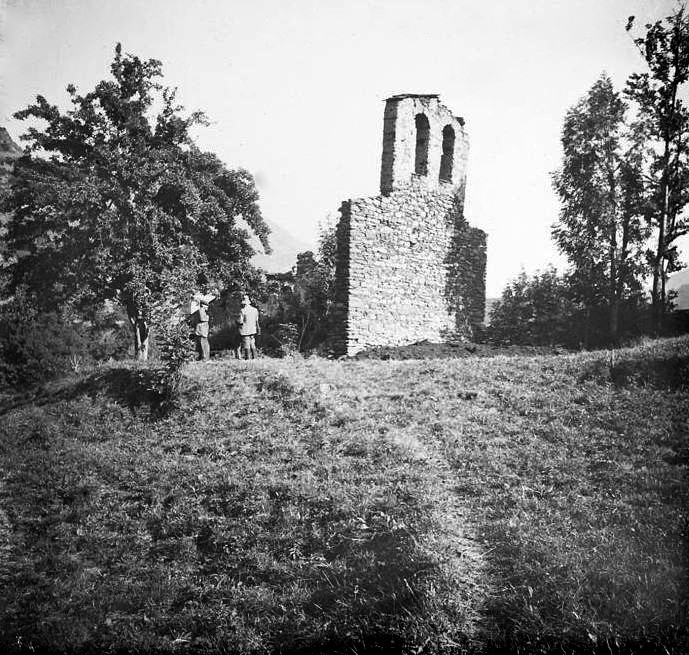
Sant Jaume de Jou is a former hermitage standing beside the village of Jou, in the municipality of la Guingueta d'Àneu, in the Pallars Sobirà region (Lleida province, Catalonia). The building is now a ruin, but it remains a point of interest for travellers tracing the old mountain settlements of the Vall d'Àneu.
What will you actually find there?
Sant Jaume de Jou was a small hermitage chapel, of which only ruins survive today. It is not a grand structure — rather a modest religious building, typical of Pyrenean mountain villages, where such hermitages served scattered communities as a place of worship closer to home than the parish church. The setting is rugged and mountainous: Jou sits on the slope of Coma de Jou, at an altitude above 1,300 metres, in a landscape typical of Pallars Sobirà — stone houses, terraced fields, and views over the surrounding peaks.
It's worth knowing that the village of Jou holds several other religious buildings that are easy to confuse with Sant Jaume: the parish church of Sant Pere (with a ribbed vault and two 18th-century Baroque altarpieces), the ruins of the Romanesque church of Sant Martí de Roma, and the newer hermitage of Santa Caterina with its Renaissance altarpiece. Sant Jaume is therefore just one of several traces of this small village's religious past, not the only one.
How do you get to Sant Jaume de Jou?
Jou is a small village administratively part of la Guingueta d'Àneu, one of the municipalities of the Vall d'Àneu in Pallars Sobirà. A local road branching off the main Àneu valley route leads to the village itself; reaching the ruined hermitage beyond that requires walking — there is no marked, drivable access all the way to the site. A hiking route known as the "ruta dels tres municipis" (route of the three municipalities), organised by the county council (Consell Comarcal), passes through the area, offering a good way to combine a visit to Jou with a longer walk through neighbouring villages.
Given the altitude and terrain, it's best to treat a visit as part of a broader hike through the Àneu valley rather than a standalone stop — the area has no developed tourist infrastructure.
When is the best time to visit?
Late spring through early autumn (May to October) is the best window, when mountain trails in Pallars Sobirà are passable and weather is stable. In winter, a village above 1,300 metres can be harder to reach because of snow, and the hermitage ruins themselves offer no shelter.
Who is this for?
Sant Jaume de Jou suits travellers interested in Pyrenean settlement history and religious architecture in ruined form, rather than those looking for a striking monument. It works best as a stop on a walking tour of the Vall d'Àneu, paired with the other historic buildings in Jou.
Frequently asked questions
Is Sant Jaume de Jou still an active church? No. It is a former hermitage, now in ruins, and no services are held there.
Can you drive right up to the ruins? You can drive as far as the village of Jou, but the final stretch to the hermitage itself has to be walked.
How is Sant Jaume de Jou different from Sant Martí de Roma? They are two separate religious sites in the same municipality of la Guingueta d'Àneu. Sant Jaume de Jou stands in the village of Jou, while Sant Martí de Roma is a different, separate Romanesque church ruin — the two should not be confused.
Are there other historic sites nearby worth seeing? Yes — the village of Jou itself also has the parish church of Sant Pere and the hermitage of Santa Caterina, making it easy to combine into one short visit.
Nearby places

Earn badges for the places you visit
Download NextOnTrip, discover new places and check off your trails.