About this place
Ros de Saint-Crod is a cave in the commune of Les Eyzies, in the Dordogne department, part of the chain of prehistoric sites strung along the Vézère valley. The name is an older spelling variant of the site more commonly known today as Roc de Saint-Cirq — or, to locals and guides, the Grotte du Sorcier, the Sorcerer's Cave. It sits in a rock face above the former village of Saint-Cirq, between Les Eyzies and Le Bugue, right in the stretch of valley inscribed by UNESCO as the "Prehistoric Sites and Decorated Caves of the Vézère Valley."
Where exactly is this cave?
Until 31 December 2018, the site administratively belonged to the independent commune of Saint-Cirq. On 1 January 2019, following a merger of several communes, the village of Saint-Cirq became part of the larger commune of Les Eyzies. That distinction matters: Ros de Saint-Crod has nothing to do with other well-known sites in the same area, such as the Laugerie-Basse shelter or the Grotte du Grand Roc, both closer to the center of Les Eyzies town. These are separate, physically distant locations that simply share a commune and the same valley setting.
What has been found here?
A small, partly collapsed rock shelter at the site was excavated in 1935–1936 by archaeologists led by Kidder, revealing a stratigraphic sequence of Middle Magdalenian levels notably lacking the bone harpoons typical of later phases. Among the finds is a round-sculpted turtle figure — an unusual subject for Upper Paleolithic art — now held in the collections of the Musée National de Préhistoire in Les Eyzies.
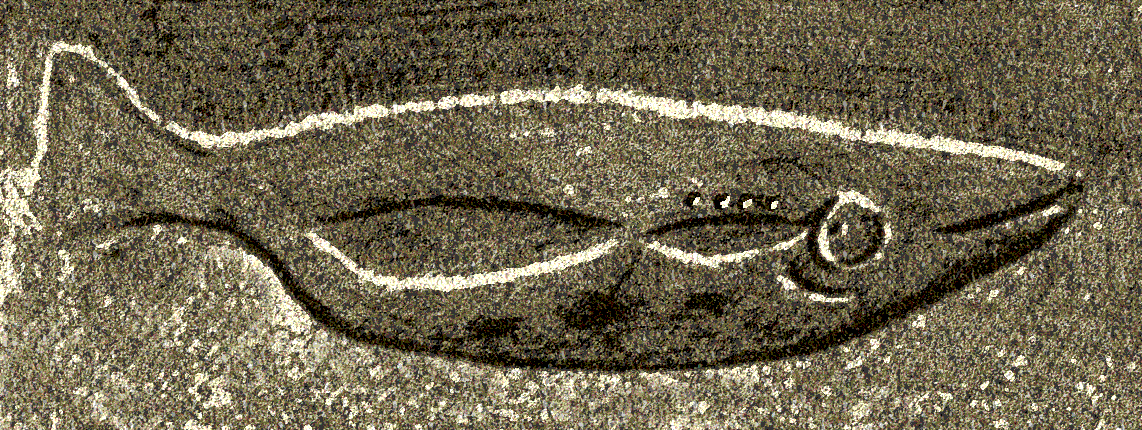
The site's wider fame, though, rests on a separate discovery. In 1952, engravings were uncovered on the cave walls, dated to the Solutrean and Magdalenian periods. They depict bison, horses, and ibex alongside geometric signs, but the best-known figure is a human form nicknamed "the Sorcerer" (le Sorcier), which gave the cave its popular name. The engravings are estimated to be around 17,000 years old.
Can visitors go inside?
The site has been listed as a historic monument since 19 November 1958, and since 1979 it has formed part of the UNESCO inscription covering the prehistoric sites of the Vézère valley. In November 2024, it was acquired by the French state (Ministry of Culture), and the cave has since been closed to the public for an indefinite period, with no reopening date announced. Anyone planning a visit to the region should check current access directly with local tourist offices before including this site in an itinerary.
Frequently asked questions
Are Ros de Saint-Crod and Roc de Saint-Cirq the same place? Yes. Ros de Saint-Crod is an older name variant for the same site, also known as Grotte de Saint-Cirq or Grotte du Sorcier.
Is the cave currently open to tourists? No. Since 2024, following its acquisition by the French Ministry of Culture, the site has been closed for an indefinite period.
How does this site differ from Laugerie-Basse and Grotte du Grand Roc? These are three distinct sites within the commune of Les Eyzies. Ros de Saint-Crod lies a few kilometers away in Saint-Cirq and is defined by its engravings of the Sorcerer figure, while Laugerie-Basse and Grand Roc are different shelters and caves closer to the Les Eyzies town center.
Why does this site matter archaeologically? Between its Middle Magdalenian occupation layers, the rare sculpted turtle figure, and above all the Sorcerer engravings, the site ranks among the key research points of the Vézère valley and the wider UNESCO World Heritage area it belongs to.
Nearby places

Earn badges for the places you visit
Download NextOnTrip, discover new places and check off your trails.