About this place
La Mouthe cave (Grotte de la Mouthe) is a modest archaeological site near the hamlet of the same name, on the outskirts of Les Eyzies-de-Tayac in the Dordogne's Périgord region. It rarely appears on visitor itineraries the way Font-de-Gaume or Les Combarelles do, but few caves in the Vézère valley matter more to science: it was here, in 1902, that scholars finally accepted Ice Age wall art as genuine rather than a modern hoax.
Where is La Mouthe located?
The entrance sits roughly 3 km from the center of Les Eyzies-de-Tayac, tucked into a small valley slope above the Vézère river. The surrounding area holds the densest concentration of documented Paleolithic sites in Europe, collectively inscribed by UNESCO as the "Prehistoric Sites and Decorated Caves of the Vézère Valley."
How was the decorated gallery found?
Locals had long known of a cave opening here, but its inner passages stayed choked with debris. In 1894 the prehistorian Émile Rivière began looking into the site, and in spring 1895 clearing work — carried out with help from the landowner's son and friends — broke through a narrow, low passage deeper into the hillside. By April 1895 the first engraved animals had come to light, and Rivière spent several following years excavating methodically, recording both the carved walls and the sediment sealing the gallery.
Why did this cave change the study of prehistory?
The decisive detail was geological rather than artistic. Material that had accumulated over millennia in front of the decorated chamber contained tools clearly belonging to the Paleolithic. Because the engravings lay buried beneath an undisturbed prehistoric layer, they could not have been carved recently — a hard, stratigraphic proof of age that earlier discoveries had lacked. Spain's Altamira cave, found in 1879, had been dismissed by most of the scientific establishment as an elaborate forgery for over two decades, precisely because no one could prove its paintings predated the deposits around them.
In 1902, delegates at the congress of the French Association for the Advancement of Science, meeting in Montauban, toured the caves around Les Eyzies, La Mouthe among them, and formally recognized Paleolithic parietal art as authentic. Émile Cartailhac, one of Altamira's most prominent skeptics, published his now-famous "Mea culpa of a skeptic," publicly reversing his earlier position. The recognition triggered by La Mouthe's stratigraphy quickly extended to Altamira itself, along with Pair-non-Pair and the Chabot cave.
What can be seen inside?
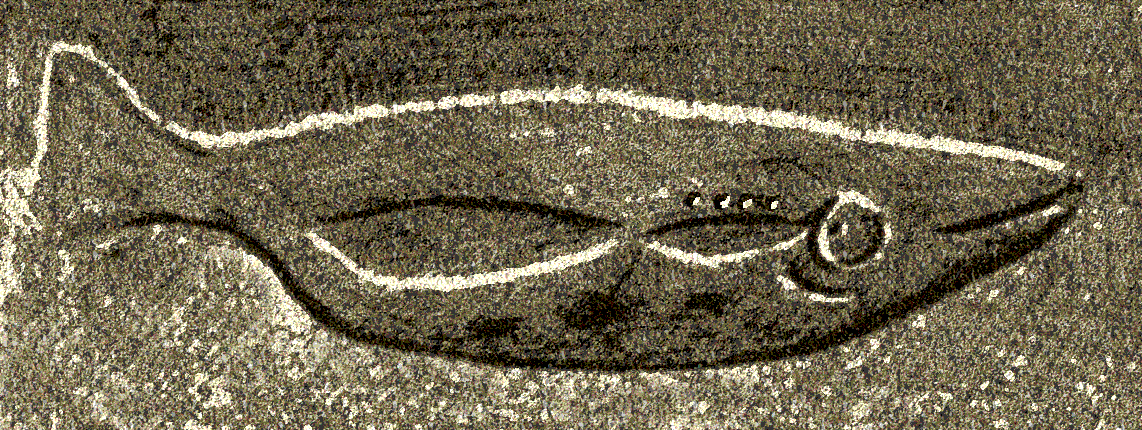
The gallery runs for more than 180 meters, though the decorated sections only begin around 90 meters in, across several successive chambers. More than 200 engravings and a handful of paintings have been recorded: bison, horses, mammoths, reindeer, ibex, cattle, and deer, alongside hand stencils and abstract geometric signs. A bison with an exaggerated humped back and a set of large, finely carved reindeer figures stand out. The cave also produced one of prehistory's best-known lighting tools: a small sandstone lamp carved with an ibex head, used by Magdalenian visitors to find their way through the dark passages. It is now held at the Musée d'Archéologie nationale in Saint-Germain-en-Laye.
Can visitors go inside?
No — La Mouthe sits on private land and is not open for public tours, unlike nearby Font-de-Gaume or Les Combarelles, which can be visited with a guide by reservation. Those interested in the discovery can instead visit the Musée national de Préhistoire in Les Eyzies, or see the engraved lamp itself at Saint-Germain-en-Laye.
FAQ
Is La Mouthe the same as Font-de-Gaume or Les Combarelles? No, it is a separate cave a few kilometers from those sites. Its significance lies less in the scale of its art than in its role in scientific history — it supplied the proof that validated Paleolithic cave art as genuine.
How old is the art in La Mouthe? It dates to different phases of the Upper Paleolithic; sediment layers sealing the gallery allowed archaeologists to establish that age stratigraphically.
Can you visit the cave today? No, it remains private property and is closed to the public.
Where can the cave's finds be seen? The carved lamp is displayed at the Musée d'Archéologie nationale in Saint-Germain-en-Laye; the Musée national de Préhistoire in Les Eyzies covers the discovery itself.
Nearby places

Earn badges for the places you visit
Download NextOnTrip, discover new places and check off your trails.