About this place
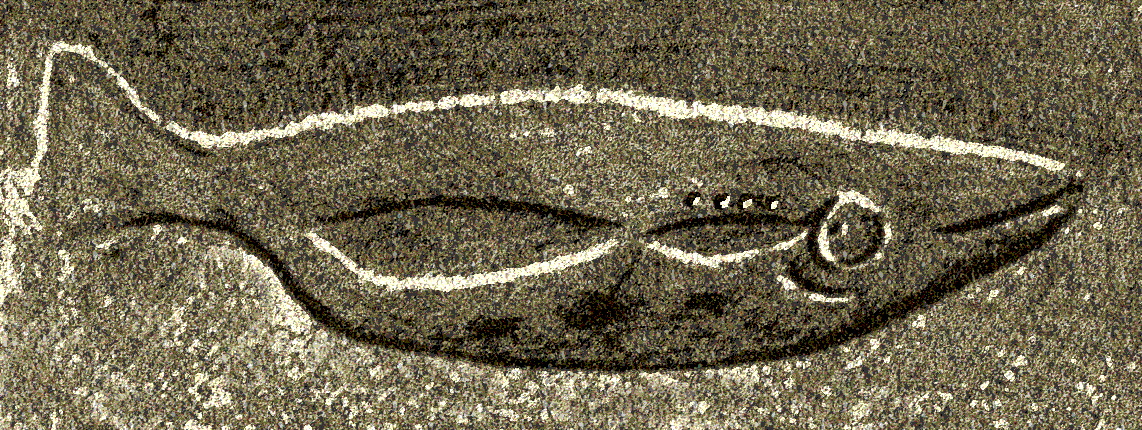
Abri du Poisson is a modest rock shelter in the Gorge d'Enfer valley, on the right bank of the Vézère river, in the commune of Les Eyzies-de-Tayac-Sireuil, Dordogne, in the Périgord region of France. The site owes its renown to a single carving: a life-size salmon sculpted into the shelter's ceiling near the close of the Upper Palaeolithic.
Where exactly is the shelter located?
The shelter sits in a narrow side valley fed by a small stream that joins the Vézère close to an old ford. Like most rock shelters around Les Eyzies, it is a shallow overhang cut into the limestone cliff rather than a deep cave system – dozens of similar shelters dot the same stretch of the valley.
What does the ceiling carving show?
A fish measuring roughly 105 centimetres runs across the vault, worked in low relief and engraved detail. It depicts a male salmon in the exhausted state that follows spawning, marked by the hooked lower jaw known as a kype. Traces of ochre survive on both the fish and the surrounding rock, evidence that the carving was originally highlighted in red.
Why does this carving matter so much?
The relief dates to the Gravettian, roughly 25,000 to 27,000 years ago, making it one of the oldest known fish depictions in rock art anywhere. Fish are rare subjects in Franco-Cantabrian art – only around a dozen comparable examples are documented across the whole tradition. That scarcity, combined with the technical skill of the carving and the surviving pigment, gives Abri du Poisson a singular place among the decorated sites of the Vézère valley.
How was the shelter discovered?
Paul Girod first noted the shelter in 1892, but the fish itself went unrecognised for another two decades, since cave art was not yet widely accepted as genuinely prehistoric in the Dordogne. Jean Marsan identified the salmon in 1912. Soon afterward the block bearing the carving was nearly cut out of the cliff and removed – pick marks around the figure still testify to the attempt. Timely intervention kept the relief in place, and in 1913 Abri du Poisson, together with the neighbouring Abri Lartet, was listed as a Monument Historique.
What is the hand print found at the site?
In 1975, Alain Roussot and Christian Archambeau discovered a left hand stencil in the shelter, produced by spraying or blowing manganese oxide pigment around a hand pressed against the rock. The stencil dates from roughly the same period as the salmon carving, about 27,000 years ago.
FAQ
Is Abri du Poisson a cave or a rock shelter? It is a shallow rock shelter (abri), an open overhang in a cliff face, not an enclosed cave with passages.
How is it different from Font-de-Gaume or Les Combarelles nearby? Font-de-Gaume and Les Combarelles are known for painted and engraved galleries showing mostly land animals. Abri du Poisson instead centres on a single large fish carved in relief, a subject found nowhere else in the region.
How old is the salmon carving? About 25,000 to 27,000 years old, placing it in the Gravettian phase of the Upper Palaeolithic.
Is Abri du Poisson part of the Vézère Valley UNESCO World Heritage listing? Yes. It was inscribed in 1979 together with fifteen other decorated sites of the Vézère valley.
Is the carving on site the original or a replica? The relief is the original work, still in the shelter where it was carved millennia ago, unlike some regional sites presented only through facsimiles.
Nearby places

Earn badges for the places you visit
Download NextOnTrip, discover new places and check off your trails.