About this place
Laugerie-Basse is a rock shelter in the commune of Les Eyzies-de-Tayac-Sireuil, in the Dordogne department of southwestern France, set within the Vézère valley. It ranks among the most important Upper Paleolithic sites in Europe, celebrated above all for its exceptional collection of Magdalenian portable art.
Where is Laugerie-Basse located?
The shelter sits beneath a limestone cliff overlooking the Vézère river, a short walk from the center of Les Eyzies — a town often called the world capital of prehistory thanks to the extraordinary concentration of decorated caves and rock shelters nearby. The site's coordinates are roughly 44.951°N, 0.999°E.
How long was the site occupied?
Laugerie-Basse shows traces of use spanning an unusually long stretch of time: from the late Magdalenian, the era of Cro-Magnon humans some 15,000 years ago, through to the Middle Ages. That continuity turns the shelter into a layered record of how life along the Vézère changed over many millennia, long after its Ice Age inhabitants had moved on.
What was discovered here?
The site was first excavated in 1863 by the French paleontologist Édouard Lartet together with the English archaeologist and banker Henry Christy, whose joint fieldwork across the Vézère valley helped found the modern study of the Paleolithic. Excavations at Laugerie-Basse eventually yielded roughly 600 pieces of portable art, placing it among the richest Magdalenian sites known in France.
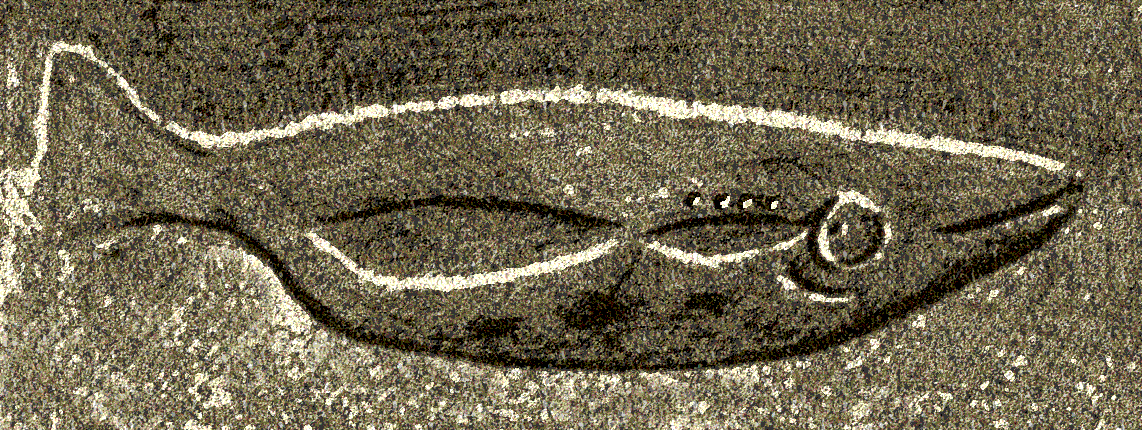
The best-known find is the so-called Vénus impudique, a small figurine carved from mammoth ivory, missing its head, feet, and arms but carrying clearly marked sexual features. Found in 1863 by the Marquis Paul de Vibraye, it is generally regarded as the first Paleolithic "Venus" figurine recovered in modern times. Other notable objects include an engraved composition known as the Woman with a Reindeer, a bone or stone disc decorated with chamois figures, and several perforated antler batons thought to have served as tools for straightening spear shafts. Excavators also recovered a carved horse-head figurine and a bone harpoon point.
Most of the original finds are now held at the Musée National de Préhistoire in Les Eyzies and the Musée d'Art et d'Archéologie du Périgord in Périgueux; replicas can be seen at the shelter itself.
What protection status does the site have?
Laugerie-Basse has been listed as a monument historique (classé) in France since 1940, the country's highest level of heritage protection. In 1979 it was included, together with more than a dozen other caves and shelters of the Vézère valley — among them Lascaux and Font-de-Gaume — in the UNESCO World Heritage inscription "Prehistoric Sites and Decorated Caves of the Vézère Valley."
Can visitors tour Laugerie-Basse?
The shelter is open to visitors as part of the wider prehistoric heritage circuit around Les Eyzies. Unlike painted caves, its main draw is the archaeological story and the history of its excavation rather than surviving cave art on the walls, so a visit pairs well with a stop at the Musée National de Préhistoire, which displays much of what was recovered from the site.
FAQ
What is Laugerie-Basse? A rock shelter in the Vézère valley of Dordogne, France, one of the key Upper Paleolithic sites, known for its rich Magdalenian portable art.
When was it discovered? Systematic excavation began in 1863, led by Édouard Lartet and Henry Christy.
What is the Vénus impudique? A mammoth-ivory female figurine found at Laugerie-Basse, widely considered the first Paleolithic "Venus" figurine recovered in modern times.
Is Laugerie-Basse part of a UNESCO site? Yes — since 1979 it has been part of the "Prehistoric Sites and Decorated Caves of the Vézère Valley" World Heritage inscription.
Where can the finds from Laugerie-Basse be seen? Most originals are kept at the Musée National de Préhistoire in Les Eyzies and the Musée d'Art et d'Archéologie du Périgord in Périgueux.
Nearby places

Earn badges for the places you visit
Download NextOnTrip, discover new places and check off your trails.