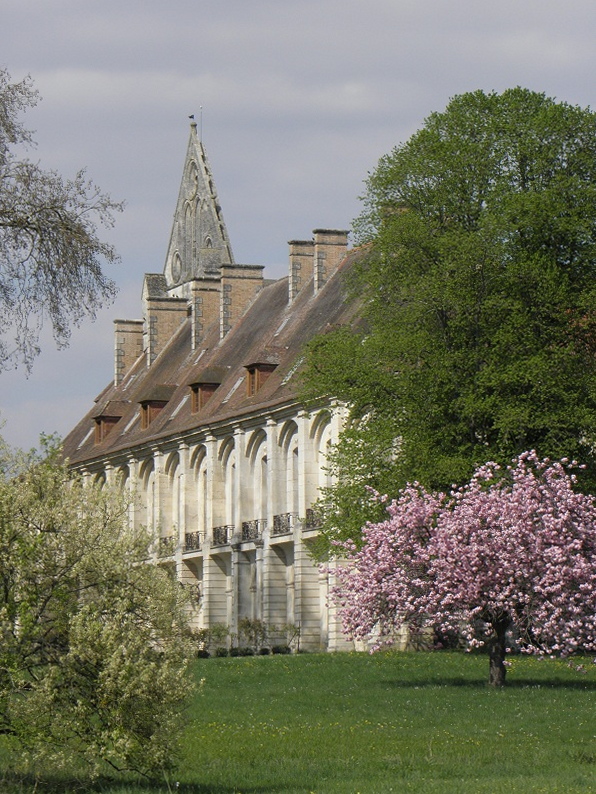
About this place
Longpont Abbey is the ruin of a former Cistercian monastery standing at the heart of the small village of Longpont, on the edge of the Retz Forest in the Aisne department, halfway between Soissons and Villers-Cotterêts. Its Gothic facade, rising forty meters with an empty rose window framed by the surrounding park trees, is one of the most photographed sights in the Hauts-de-France region.
Who founded the abbey?
The monastery was established in 1131 at the initiative of Bernard of Clairvaux, who sent twelve monks to the valley of the Savière river under the leadership of a prior from Clairvaux. The foundation came at the request of Josselin de Vierzy, the bishop of Soissons, who wanted a Cistercian community settled in this marshy valley on the edge of his diocese. The first mass was celebrated at Easter 1132, though the earliest buildings were modest and provisional, later replaced by permanent stone construction.
Why is the abbey a Gothic ruin today?
Stone building work began in earnest toward the end of the twelfth century. The centerpiece was the Gothic abbey church, raised over roughly thirty years in the early thirteenth century to a scale comparable with Soissons Cathedral. It was consecrated in 1227 in the presence of the young King Louis IX, who stopped at Longpont on his way back from his coronation at Reims. For the following five and a half centuries, the abbey remained an active religious community at the heart of the region.
What happened during the French Revolution?
The Revolution brought the monastic community to an end. Its property was confiscated, and the abbey church, seen as a symbol of the old religious order, was marked for demolition and quarried for its stone. Ironically, tearing the church down took nearly forty years, longer than it had taken to build in the Middle Ages. What survived is the main facade with its empty rose window, along with sections of outer walls and buttresses — the striking silhouette visitors see today.
Who owns the abbey now?
The surviving buildings were bought in 1804 by Count Henri de Montesquiou, and his descendants have maintained the property ever since. Longpont Abbey therefore remains privately owned, a status that has not stopped it from welcoming visitors and hosting private events, including weddings, in its historic setting.
What can visitors see on site?
A visit takes in the ruined Gothic abbey church and its rose window, the former monks' cellar with its cross-ribbed vaulting and large hearth, an eighteenth-century vestibule with a wrought-iron staircase, the cloister courtyard, and an English-style landscaped park. The abbey opens seasonally, typically on weekends from mid-March to late October, so checking opening times before a visit is worthwhile since hours shift with the season.
Is the village of Longpont worth exploring too?
Home to just over two hundred residents, the village that grew up around the abbey has its own charm, including a surviving medieval fortified gate, an old wash house, and an ice house. In 2025, Longpont was named a finalist in a national television competition for France's favorite village, bringing fresh attention to this quiet corner of Aisne.
Frequently asked questions
When was Longpont Abbey founded? In 1131, on the initiative of Bernard of Clairvaux and at the request of Josselin de Vierzy, bishop of Soissons.
Why is the abbey in ruins? The abbey church was demolished after the French Revolution, treated as a religious symbol and used as a stone quarry; the demolition itself took nearly forty years.
Can the abbey be visited? Yes, it is open to the public seasonally, mainly on weekends from spring through autumn.
Who owns the abbey today? The Montesquiou family, who purchased it in 1804 and still maintain it.
What else is there to see besides the abbey? The village of Longpont itself, with its medieval gate, plus the surrounding Retz Forest.
Nearby places

Earn badges for the places you visit
Download NextOnTrip, discover new places and check off your trails.