About this place
Saint-Jean-des-Vignes Abbey rises on a hill above Soissons, in the Hauts-de-France region of northern France, its two soaring Gothic towers still visible from far across the surrounding countryside. Of the once-powerful community of Augustinian canons, only the monumental west front and a handful of outbuildings remain, but they are enough to make this one of the most recognisable landmarks in the city. The ruins sit in a public park and are open to visitors most days of the week.
How old is the abbey?
The community was founded in 1076 by Hugues le Blanc under the name Saint-Jean-au-Mont. It only became Saint-Jean-des-Vignes in 1088, a name recalling the vineyards that once covered the surrounding slopes. Over the following centuries it grew into one of the more important houses of regular canons in the region, a status reflected in the ambitious building campaigns that reshaped the site from the 13th century onward.
Where does the famous Gothic façade come from?
Work to replace the original Romanesque church with a much larger Gothic building began in the 13th century, and the decoration of the west front took considerably longer to finish. The taller and heavier north tower was built between 1488 and 1495, while the slenderer south tower followed between 1516 and 1520. Both rise several dozen metres and display the hallmarks of Flamboyant Gothic — openwork spires, dense stone tracery and carved figures typical of church architecture in northern France at the close of the Middle Ages.
Why is only the façade still standing?
The French Revolution changed everything. The canons were expelled in 1789, the church's furnishings were auctioned off as national property, and the buildings were left to decay for years. In 1805, under a decision backed by the Napoleonic administration, most of the abbey church was pulled down for building stone — only the west front with its two towers was spared, reportedly thanks to protests from figures concerned with preserving the monument, Victor Hugo among them.
Later conflicts added further damage. During the Franco-Prussian War in 1870, the surviving buildings, then used to store military supplies, came under bombardment: the rose window and the tympanum above the main portal were destroyed, and a fire in a hay store beneath the portal scorched and cracked the stonework. Repairs followed between 1871 and 1873, and in 1875 the towers and cloister were given historic-monument protection, later extended in 1913 and 1947. World War One brought fresh destruction — Soissons sat in the middle of heavy fighting, and the façade, towering over the town and visible for miles, again drew German artillery fire. The eastern section of the north tower was destroyed, and the south tower lost the top of its spire.
What can visitors see there today?
Despite centuries of destruction, the surviving façade still impresses with its scale and the richness of its carved decoration. The grounds of the former abbey now serve as a public and cultural space, hosting exhibitions, concerts and open-air events, and the area around the ruins doubles as a viewpoint over Soissons and the Aisne valley.
Frequently asked questions
Where exactly is the abbey located? The ruins stand on a hill in Soissons, in the Aisne department of the Hauts-de-France region, at roughly 49.3756°N, 3.3239°E.
What are the opening hours? Monday to Friday the site is open from 10:00 to 12:15 and 13:30 to 18:00; on Saturdays and Sundays the hours extend to 10:00–12:15 and 13:30–19:00.
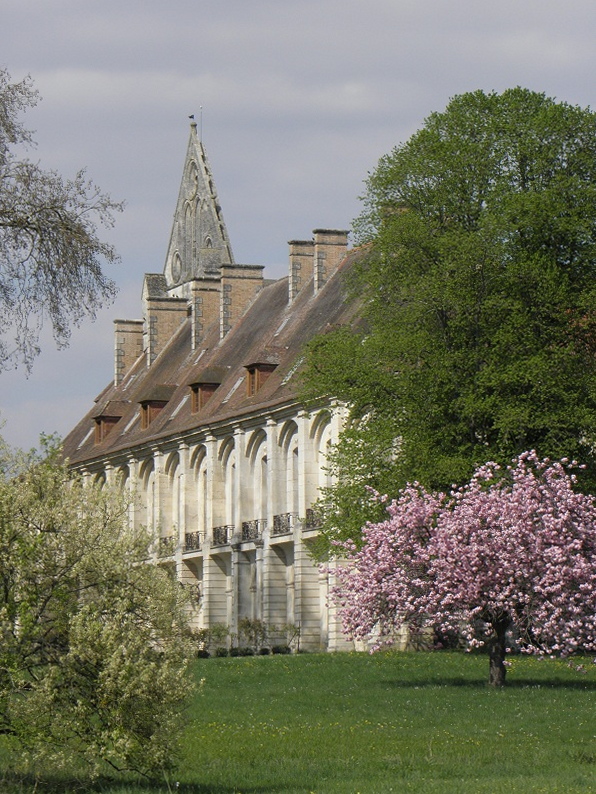
Is anything left of the abbey besides the façade? Alongside the two towers, some fragments of the former claustral buildings and cloister survive, but the main body of the abbey church was demolished in the early 19th century.
Why do the two towers differ in height and style? They were built decades apart — the north tower in the late 15th century, the south tower in the early 16th — which explains the differences in proportion and architectural detail between them.
Nearby places

Earn badges for the places you visit
Download NextOnTrip, discover new places and check off your trails.