About this place
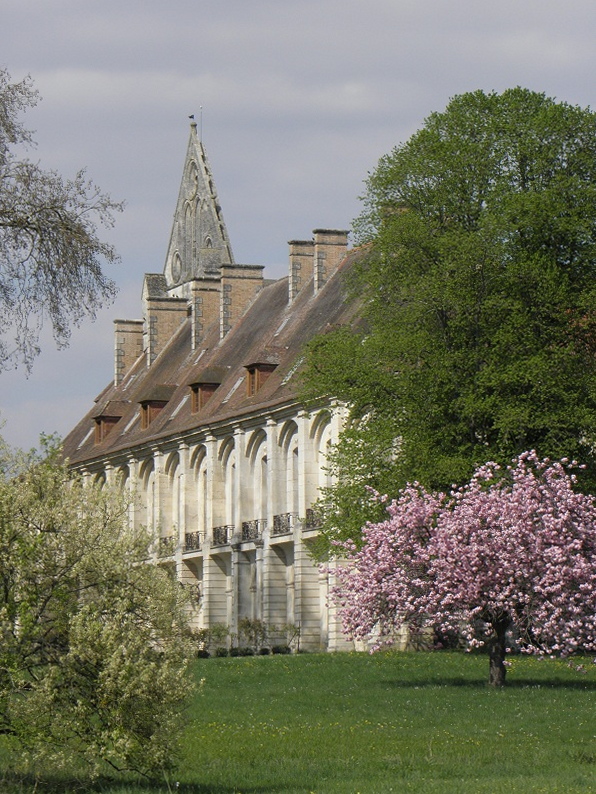
Valsery Abbey (Abbaye Notre-Dame de Valsery) is a former Premonstratensian monastery in the commune of Cœuvres-et-Valsery, in the Aisne department of northern France, right on the edge of the Forest of Retz. What remains today is a mix of medieval ruins and a nineteenth-century manor house built over the old monastic foundations — the result of nearly nine centuries of destruction, rebuilding and, more recently, patient restoration by local volunteers.
How old is Valsery Abbey?
The Premonstratensian community was established around 1124-1125, making Valsery one of the earliest houses of the order in France. The canons did not settle immediately on the present site: construction of the monastery buildings at the edge of the Forest of Retz only began around 1153. As was common practice for Premonstratensian foundations, the canons are believed to have cleared surrounding woodland over the following decades to make way for farmland and outbuildings.
What happened to the abbey over the centuries?
Valsery's history is largely one of repeated damage and reconstruction. The monastic buildings were damaged or destroyed several times over the centuries by the conflicts that repeatedly swept through this part of northern France, and each time they were rebuilt in a style reflecting the period. By the time of the French Revolution the abbey had already passed through Romanesque, Gothic and later architectural phases. The Revolution ended monastic life at Valsery for good: the community was suppressed in 1790 and the property sold off as national land. At that point the buildings were already in a ruined state.
Why is there a manor house on the abbey grounds?
In 1804 the ruins were bought by Baron Charles Estave, who had them converted into a private residence. The result was a two-storey house with an attic level, built partly on and around the surviving monastic walls. This adaptive reuse preserved some of the old stonework from total disappearance, but it also permanently altered the original layout of the abbey.
What role did the First World War play?
Cœuvres-et-Valsery lay close to the front lines during the First World War, and in June and July of 1918 the property came under artillery fire. The walls of the nineteenth-century house, raised on the older monastic foundations, still bear the scars of that bombardment — pockmarked and pierced by shell fragments. After the war the site sat abandoned for decades, exposed to the weather with no one to maintain it.
What survives on site today?
The oldest and architecturally most significant surviving element is the chapter house, built at the end of the twelfth century. It forms the core of the later eighteenth-century structure, of which mainly the walls remain, partly in ruins. Sections of the walls of the canons' former dormitory also survive. Inside the chapter house, visitors can still make out traces of polychrome decoration and the original floor paving — rare surviving details that hint at how the monastery once looked.
Can visitors tour Valsery Abbey?
A local association dedicated to preserving and promoting the site was formed in 1996, and since April 2013 a group of volunteers has met twice a month on Saturdays to carry out clearing and conservation work on the ruins. Thanks to their efforts, the abbey is now open to visitors for guided tours held on weekends from April through the end of October.
Frequently asked questions
Where exactly is Valsery Abbey located? In the commune of Cœuvres-et-Valsery, in the Aisne department, on the edge of the Forest of Retz.
Who founded the abbey? Premonstratensian canons, around 1124-1125.
Can the ruins be visited? Yes, guided tours run on Saturdays and Sundays from April to the end of October, organized by the local preservation association.
Why are the walls damaged? Most of the visible damage comes from artillery bombardment in June and July 1918, during the First World War.
Is the medieval monastery still standing? Not in its original form. The oldest surviving part is the medieval chapter house, now embedded within the walls of the nineteenth-century manor house built over the abbey's foundations.
Nearby places

Earn badges for the places you visit
Download NextOnTrip, discover new places and check off your trails.