About this place
Notre-Dame d'Aunay Abbey is a former Cistercian monastery standing about a kilometer west of the town of Aunay-sur-Odon, within the commune of Les Monts d'Aunay in the Calvados department of Normandy. Set beside the Odon river, the abbey has passed through farming, industrial and religious uses over nine centuries, and its surviving stonework still tells that layered story to visitors today.
Who founded the abbey, and when?
The monastic community at Aunay traces back to 1131. The land for the first monastery, on a hillside known as mont des Lenques, was donated by Jourdain de Say, lord of Aunay, and his wife Luce. The house belonged to the Savigny congregation and was counted as its ninth daughter foundation. Soon afterward, Richard du Hommet, hereditary constable of Normandy under the English crown, arranged for the community to move to a new site on the banks of the Odon, not far from where the monks had first settled — the same spot the abbey occupies today.
Why did it become a Cistercian house?
In 1147 the monks of Aunay switched allegiance and joined the Cistercian order, placing themselves under the authority of Clairvaux. Work on a new abbey church continued for decades afterward, and the building was finally consecrated in 1190. The precinct was substantial: an enclosure wall roughly 1.4 kilometers long ran around a site of about 6.6 hectares, with the monastic buildings themselves covering close to 6,000 square meters.
What survives of the medieval church?
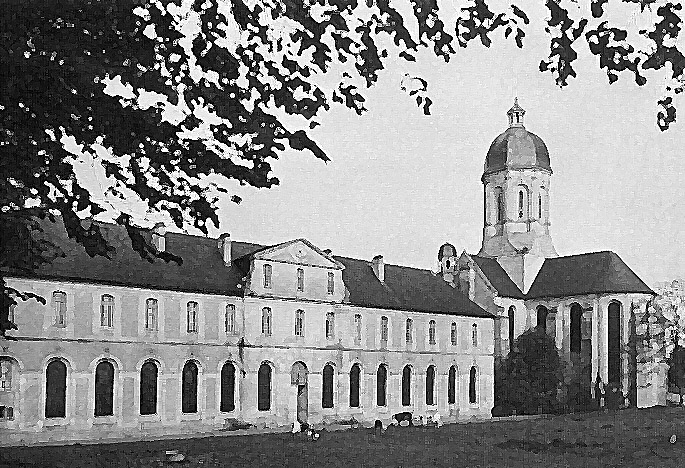
Portions of the walls and several carved capitals remain from the 1190 church. The surviving fabric shows a building caught between two styles: the lower arcades are pointed in the Gothic manner, while the window openings still use the rounded Romanesque arch. The west facade repeats this mix — a round-arched entrance portal sits below pointed window openings. The east range of the monastic buildings was rebuilt much later, in 1723, under the tenure of Abbot Dom Raucour, and shows a plain classical facade combining limestone and sandstone in alternating courses.
What happened to the abbey over the centuries?
Aunay's history was far from peaceful. The community was pillaged twice, in 1528 and again in 1540, and recovery from those raids was slow and difficult. Afterward the abbey came under the commendam system, with an appointed abbot drawing its revenues rather than a resident religious leader, which weakened the community's independence. The Wars of Religion in the later sixteenth century brought further damage. At the French Revolution the abbey's property was confiscated and sold into private hands. Its buildings then found new industrial life: a cotton spinning mill operated there during the nineteenth century, and a cheese-making works occupied the site in the twentieth — a striking change of purpose for a place built for monastic prayer.
What can visitors see there now?
Today visitors can walk around the exteriors of the former conventual buildings, view the ruins of the abbey church, and see a surviving staircase dating from the seventeenth century. Taken together, the site offers a compact record of how a Norman religious house evolved architecturally, from its Romanesque and early Gothic beginnings through later classical additions, and how such buildings often survived by being repurposed rather than simply abandoned.
Frequently asked questions
Where exactly is Notre-Dame d'Aunay Abbey located? The abbey stands about a kilometer west of Aunay-sur-Odon, on the banks of the Odon river, within the commune of Les Monts d'Aunay in Calvados.
Which monastic order was the abbey associated with? It began in 1131 as a house of the Savigny congregation and switched to the Cistercian order in 1147, coming under the authority of Clairvaux.
Can the abbey buildings be visited today? Yes — visitors can see the exteriors of the former monastic buildings, the ruins of the abbey church, and a seventeenth-century staircase.
What was the abbey used for after the French Revolution? After being sold as private property, the site served as a cotton spinning mill in the nineteenth century and later housed a cheese factory in the twentieth.
Nearby places

Earn badges for the places you visit
Download NextOnTrip, discover new places and check off your trails.