About this place
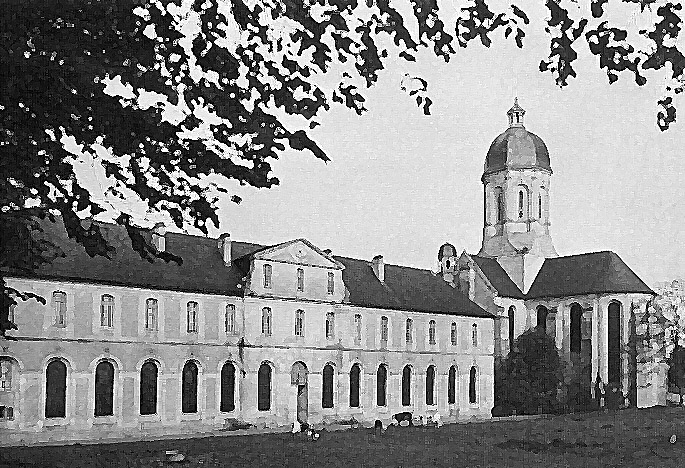
Abbaye Saint-Vigor-le-Grand marks the site of a former Benedictine monastery just outside Bayeux, in the Calvados countryside of Normandy. Little of the original complex still stands, but the surviving gatehouse and the layered history behind it make this a worthwhile stop for anyone exploring the Bayeux area.
Who founded the monastery here?
The foundation is traditionally credited to Saint Vigor, who served as bishop of Bayeux in the first third of the 6th century. He is said to have chosen a former pagan cult site for his new community, turning it into a Christian foundation. When Vigor died, he was buried there, and the monastery eventually took his name — a link that still defines the village of Saint-Vigor-le-Grand today.
Why was the abbey destroyed, and how did it come back?
The early community did not survive the Viking raids that swept through Normandy, and the monastery was destroyed toward the end of the 10th century, leaving the site abandoned for a long stretch. Revival attempts came only at the close of the 11th century, led by Odo, bishop of Bayeux and half-brother of William the Conqueror. Odo hoped to re-establish it as a fully independent abbey, but the effort ultimately failed. By the 1090s the community had instead been folded in as a dependent priory of the powerful abbey of Saint-Bénigne in Dijon, a subordinate status it kept for centuries.
How did the monastery's story end?
The formal break with Dijon came in 1702, when Saint-Bénigne abbey gave up its rights over the priory. Ten years later, in 1712, the reform-minded Congregation of Saint-Maur — known for its scholarly rigor and careful record-keeping — took charge of the community. That chapter proved short-lived: the French Revolution swept away monastic life across the country, and the priory was formally suppressed in 1790. The following year its houses, church, courtyard and farm were sold off as national property.
What survives on the site today?
Rather than a church or cloister, what remains at Saint-Vigor-le-Grand today are mainly the monastery's practical and defensive structures. The standout is a 13th-century gatehouse, combining a wide, low-arched carriage entrance with a smaller, rounded pedestrian doorway topped by an arcaded, quatrefoil-decorated frieze. Together with an adjoining barn, this gatehouse was listed as a historic monument in 1908. The rest of the former abbey grounds passed into private hands and no longer serves any religious purpose.
How do you get there?
Saint-Vigor-le-Grand sits only about 2 kilometers from central Bayeux, making it an easy addition to a day spent visiting the town's famous cathedral or the nearby D-Day landing beaches. The former abbey grounds can be viewed from the surrounding streets while walking through the village.
Frequently asked questions
Can you go inside the abbey? The former complex is now privately owned, so visits are mostly limited to viewing the historic gatehouse and its surroundings from outside.
What is the main thing to see? The 13th-century gatehouse, a listed historic monument, along with the barn that stands beside it.
How far is it from Bayeux? Roughly 2 kilometers, so it pairs easily with a visit to Bayeux itself.
Is it still an active monastery? No — monastic life ended with the French Revolution in 1790, and the buildings have served secular purposes ever since.
Nearby places

Earn badges for the places you visit
Download NextOnTrip, discover new places and check off your trails.