About this place
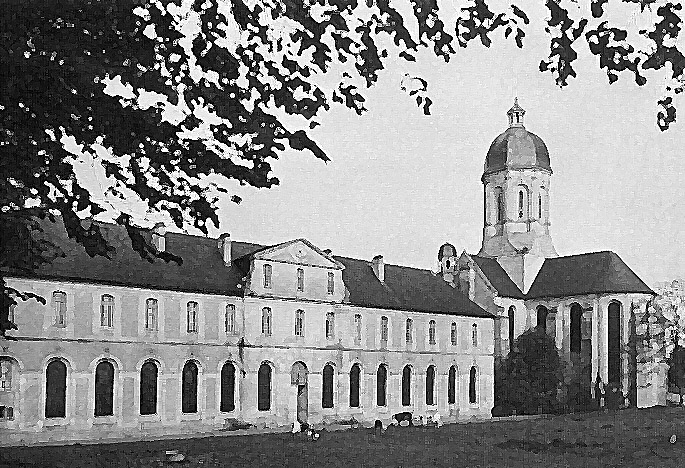
Abbaye des Deux-Jumeaux is a former Benedictine abbey standing in the village of Deux-Jumeaux, in the Calvados department of Normandy. Behind its modest present-day appearance lies more than a thousand years of monastic history, marked by Viking destruction, medieval reconstruction, and a long dependency on a larger neighboring abbey.
Where does the unusual name come from?
Tradition credits the founding of the abbey to Saint Martin of Vertou, a monk associated with the Nantes region, at the turn of the 6th and 7th centuries. According to the legend, Martin, returning from a journey to England, restored his own twin children to life before they could be baptized, and the twins then went on to take religious vows themselves. This story is the origin of the village name — Deux-Jumeaux, literally "two twins." The exact founding date is unrecorded, but the existence of an abbot at Deux-Jumeaux is already confirmed in sources from the reign of Dagobert I.
How did the abbey develop through the early Middle Ages?
Under Pepin the Short, in the 8th century, Herlemont, bishop of Le Mans, took refuge at the abbey together with his brother, who served as its abbot. By the 9th century, under Charles the Bald, the community had grown influential enough to mint its own coinage, and in 833 it appears in the will of Ansegisus of Fontenelle. This period of relative prosperity ended when Scandinavian raiders destroyed the abbey buildings. Reconstruction was completed before 1138, and the community regained landholdings on both sides of the Channel, in Normandy and in England.
When did the abbey lose its independence?
Around 1190, Robert de Villiers donated the monastery to the Abbey of Cerisy, and from that point Deux-Jumeaux ceased to be an independent house, continuing instead as a dependent priory. The donation was formally confirmed in 1278. The priory remained under Cerisy's authority right up to the French Revolution, by which time Cerisy itself had adopted the stricter Maurist reform observed by many Benedictine houses in France.
What can visitors see today?
The main surviving feature is the 12th-century priory church, which was classified as a historic monument by decree on March 24, 1914. The remaining former priory buildings as a whole were listed as a historic monument by decree on July 2, 1927. Visitors can appreciate the plain Romanesque massing of the church, a rare surviving example of early medieval religious architecture in this part of Normandy, having outlasted raids, rebuilding campaigns, and centuries of agricultural reuse around it.
How do you get to Deux-Jumeaux?
The village lies in the Calvados department, in the Normandy region, close to the English Channel coastline. The abbey's approximate coordinates are 49.348333°N, 0.962222°W. The site works well as part of a route combining rural Norman religious heritage with the region's better-known coastal attractions, including the 1944 D-Day landing beaches nearby.
Frequently asked questions
Is Abbaye des Deux-Jumeaux still an active monastery? No. From around 1190 it functioned as a priory dependent on the Abbey of Cerisy, and monastic life there ended with the French Revolution.
Why is the village called "Deux-Jumeaux"? The name comes from the legend of Saint Martin of Vertou, who is said to have brought his twin children back to life; the story has been tied to the site's identity for centuries.
What exactly is protected as a historic monument? The 12th-century church has held historic monument status since 1914, and the former priory complex as a whole has held it since 1927.
Was the abbey linked to other religious houses in the region? Yes — from around 1190 it was a dependency of the Abbey of Cerisy, one of the more prominent Benedictine houses in Normandy.
Nearby places

Earn badges for the places you visit
Download NextOnTrip, discover new places and check off your trails.