About this place
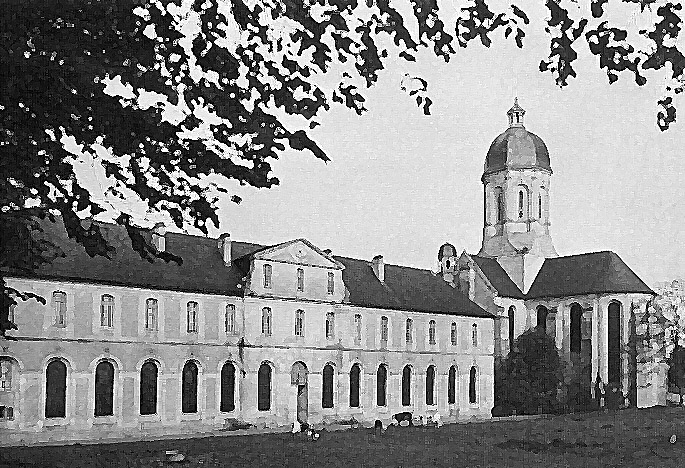
Mondaye Abbey is a working Premonstratensian monastery in Juaye-Mondaye, in the Bessin countryside of Calvados, roughly nine miles south of Bayeux. It is the only Norbertine house still active anywhere in Normandy, and behind its calm 18th-century facade lies a story of hermits, revolution, and exile.
Why was an abbey built here?
The site's monastic story begins in the mid-12th century, when a priest named Turstin withdrew to a hill in the Norman bocage to live as a hermit. Followers soon gathered around him. After his death, the Bishop of Bayeux gave the small community the Rule of Saint Augustine, while Turstin's brother-in-law, Raoul de Percy, granted the land they were already occupying. The abbey's formal foundation is dated to 1200.
Monastic life did not continue uninterrupted, however. The community was dispersed after the French Revolution, and the buildings passed out of religious use for decades. It was only on 13 June 1859 that the Bishop of Bayeux formally handed the keys back to Premonstratensian canons, who arrived from Grimbergen Abbey in Belgium to re-establish the community. Mondaye remains the mother house of two dependent priories, at Conques and at Tarbes.
Where does the baroque architecture come from?
What visitors see today is not medieval. The entire abbey was rebuilt from the ground up between 1706 and 1743, with work completed by 1745. The project was led by Father Eustache Restout, a canon from a celebrated Norman family of painters, who designed the complex's overall composition and painted most of its interior decoration, including the dome of the abbey church.
Restout combined a restrained, classical monumentality with a handful of richer baroque touches. The church facade follows what is often described as a "Jesuit" style, while inside, the Virgin's chapel holds a group of terracotta sculptures made nearby in Noron-la-Poterie by Melchior Verly, and the north transept features a large Assumption altarpiece. The church also houses an 18th-century Parisot organ, restored in 2004, which is still played during Sunday services.
What can visitors expect to see?
Because Mondaye remains a living religious community, tours are conducted in small groups led by one of the resident brothers rather than left to self-guided wandering. The route takes in the monastic buildings completed in 1745 - cloister, chapter house, refectory and cells - as well as the abbey church itself. Guided visits run daily in the afternoon during July and August, and on Sunday afternoons for the rest of the year.
Frequently asked questions
Where exactly is Mondaye Abbey? In the commune of Juaye-Mondaye, in the Bessin area of Calvados, a short drive south of Bayeux.
Are monks still living there? Yes. Premonstratensian canons have lived at Mondaye continuously since 1859, making it the only active Norbertine house in Normandy.
Is the abbey medieval? No - its present appearance dates from the major 18th-century rebuilding directed by Father Eustache Restout between 1706 and 1743.
How do you visit the abbey? Only with a guide, one of the community's brothers; tours run daily in summer and on Sunday afternoons the rest of the year.
Nearby places

Earn badges for the places you visit
Download NextOnTrip, discover new places and check off your trails.