About this place
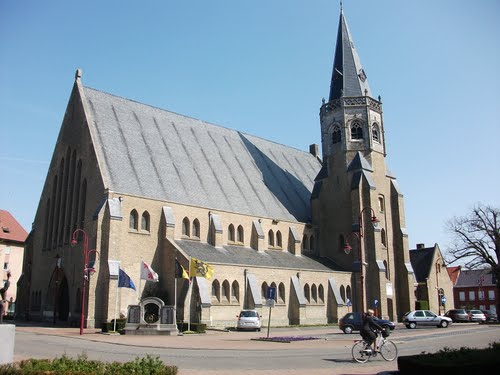
Ginstegrot is a Marian grotto in De Ginste, a small hamlet within the Belgian municipality of Oostrozebeke in West Flanders, standing right next to the Sint-Jozefskerk (St. Joseph's Church). It rarely appears in mainstream travel guides, yet for over a century it has served as a quiet pilgrimage site woven into the everyday life of the local community.
Where did the grotto come from?
The story begins right after the First World War. Assistant priest Jozef Cosyn (also recorded as L. Cosijn in some sources) wanted to build a monument of gratitude to the Virgin Mary because Oostrozebeke had been spared the worst of the fighting. Construction began in the summer of 1920, using rubble that local farmers hauled back from the front near Zonnebeke — one of the deadliest battlegrounds of the Western Front. In effect, the grotto was literally built from the wreckage of war, repurposed into a monument of thanks and hope.
How did the pilgrimage tradition start?
The first pilgrimage to Ginstegrot took place on the first Sunday of May 1921, and the site quickly grew in popularity. A year later, in 1922, seven small chapels representing the Seven Sorrows of Mary were added around the grotto — a devotional theme common in Flemish Catholic tradition. These chapels were built from red brick, with barrel vaults and segmental-arch niches holding bas-relief sculptures on Marian themes.
What happened to the grotto over the decades?
The site didn't have an entirely peaceful history. In 1926 it was damaged by vandals, but repaired that same year — a fact still commemorated today by two limestone inscription plaques. A far bigger change came in 1946, when the grotto was relocated and rebuilt about 30 meters further back on the plot, redesigned by architect Albert Impe of Tielt. The renovation proved a genuine success: in the first month after reopening alone, the site drew 1,200 visitors.
What does Ginstegrot look like today?
Today's grotto sits on a rectangular, enclosed plot of just over a thousand square meters, covered in gravel. A central path of concrete tiles leads straight to the grotto, framed by wrought-iron gates and natural stone elements. The main niche holds a painted statue of Our Lady of Lourdes, while a kneeling statue of Bernadette Soubirous — the visionary of the Lourdes apparitions — stands in front of the grotto. A stone pulpit completes the setting. The grounds are shaded by carefully chosen greenery: wild chestnut trees, cypresses and beeches form a natural border, while two linden trees and two horse chestnuts grow near the chapels.
Why is it worth a visit?
Ginstegrot carries real historical and emotional weight — it ties the memory of the First World War to local folk devotion and to twentieth-century religious architecture. It's also simply a peaceful spot, away from the crowds, making it a fitting short stop while exploring the wider Leiestreek region.
Frequently asked questions
Where exactly is Ginstegrot located? On Grotstraat in De Ginste, a hamlet of Oostrozebeke, right beside the Sint-Jozefskerk.
When was the grotto built? Construction started in the summer of 1920, and the first pilgrimage took place in May 1921.
What is the grotto made of? Rubble from buildings destroyed near Zonnebeke, later complemented with brick, natural stone, and wrought-iron elements.
Has the grotto ever been rebuilt? Yes — it was repaired after vandalism in 1926, then relocated and redesigned in 1946 by architect Albert Impe.
Nearby places

Earn badges for the places you visit
Download NextOnTrip, discover new places and check off your trails.