About this place
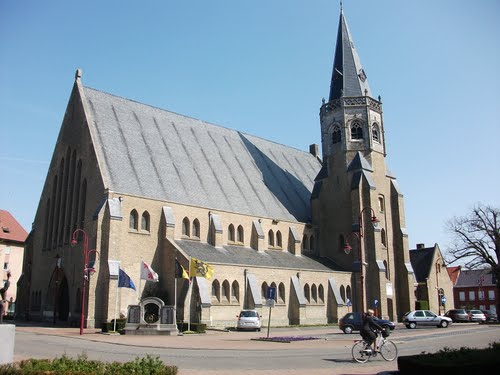
Sint-Niklaaskapel is a small chapel on Voorstraat in Kortrijk, part of a former convent complex belonging to the Sisters of Sint-Niklaas and closely tied to the history of the local almshouse for travelers and the poor.
Where did this chapel come from?
The building grew out of the grounds of the Gasthuis van Sint-Niklaas, a charitable institution that for centuries sheltered needy travelers passing through this part of Flanders. The chapel served as the spiritual heart of that complex, used both by the residents of the almshouse and by the surrounding religious community.
What happened inside the chapel over the centuries?
The building's history is far from a straight line. Between 1514 and 1558 its rooms were occupied by a fraternity known as the "gilde van den Cruuce" (Guild of the Cross), showing that the chapel long served as a meeting place for local religious associations, not just as a liturgical space for the nuns.
The building underwent repairs at key points in its history — the first recorded in 1544, another in 1617–1618. That second round of work was particularly significant: the city government of Kortrijk provided funds for work on the vaulted ceiling and wood paneling of the interior, a sign that the chapel was regarded as important to the whole town, not merely to the religious community that occupied it.
How did the chapel survive the revolutionary era?
The turn of the 18th to the 19th century was a period when many religious institutions in the region were closed or restricted due to political upheaval. Sint-Niklaaskapel made it through this difficult stretch — on 1 May 1801, five nuns were able to return to their buildings on Voorstraat. Two years later, in 1803, restrictions on chapels were lifted, allowing Sint-Niklaaskapel to reopen to worshippers. The returning sisters then leased the convent from the city's charitable institution (Burgerlijke Godshuizen) and set up a boarding school for girls there — making the chapel part of the area's educational life as well.
Why so little of the original complex remains
The 19th and 20th centuries brought the gradual demolition of most of the medieval buildings on this site. Only the structures along Voorstraat survive today: the chapel itself, the convent, and the former wing of the boarding school. The rest of the complex disappeared for good with the construction of the Sint-Niklaasziekenhuis hospital in 1958, a project that required tearing down the remaining historic structures.
When was the chapel recognized as a heritage monument?
Belgium's Royal Commission for Monuments and Landscapes (KCML) assessed that the chapel's current form most likely dates from the 17th century. Restoration work began in November 1978, and the completed building was reconsecrated by Bishop De Smedt on 6 December 1979. Sint-Niklaaskapel received formal legal protection as a heritage monument in 1983.
Frequently asked questions
Where exactly is Sint-Niklaaskapel located? On Voorstraat in Kortrijk, in West Flanders, Belgium.
Is the chapel part of a larger complex? Yes — it historically belonged to the convent of the Sisters of Sint-Niklaas and the adjoining almshouse for the poor and traveling passersby.
What century does the current building date from? According to the Royal Commission for Monuments, the present structure most likely dates from the 17th century.
Is the chapel legally protected? Yes, it has held heritage monument status since 1983.
Is the chapel still in use? Following its restoration, completed in 1979, and reconsecration by Bishop De Smedt, it functions as a place of worship.
Nearby places

Earn badges for the places you visit
Download NextOnTrip, discover new places and check off your trails.