About this place
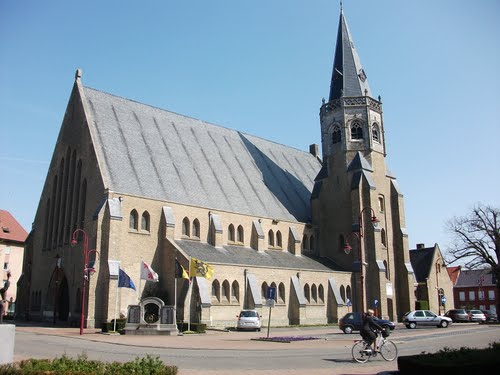
Sint-Martinuskerk is the parish church standing at the heart of Ardooie, a small town in West Flanders, right on the local Marktplein. The building pairs a Gothic tower with a rebuilt post-war nave and has been listed as part of Belgium's protected national heritage since 1939.
Where did the parish of Ardooie come from?
The land on which Ardooie now stands was granted in 821 to the Sint-Amands Abbey in Saint-Amand-les-Eaux. Monks from that abbey raised a simple fieldstone church here — the earliest known form of a place of worship on this spot. The first documented parish priest appears in the records in 1218, showing that a settled parish community already existed here in the high Middle Ages. In the 17th century, oversight of the church passed from the abbey in Saint-Amand to the Deanery of Sint-Amands in Kortrijk.
How did the church survive the religious wars?
The second half of the 16th century brought serious damage to Sint-Martinuskerk, tied to the religious conflicts sweeping the Low Countries at the time. The destruction was severe enough that the altar had to be reconsecrated in 1571. The following year, in 1572, a band of iconoclasts had to be driven out of the church after attacking its religious furnishings. Even so, by around 1580 the building was still found to be badly damaged. Rebuilding and restoration only got underway after 1600, and the respite did not last: in 1638 the church was struck again, this time by lightning.
Why was the church enlarged in the 19th century?
A growing population in 19th-century Ardooie meant the existing building could no longer serve the parish. In 1889 the church was enlarged to plans drawn up by the architect Antonius Verbeke. That expansion gave the church the form that would serve its expanding congregation until a far more destructive event struck decades later — one considerably worse than the fires or lightning strikes of centuries before.
What happened to the church during the Second World War?
In 1940 Sint-Martinuskerk burned down as a result of German bombardment. The destruction was extensive — only the tower survived, while the rest of the structure was consumed by fire. The nave was rebuilt between 1947 and 1949 to a design by the architect Albert Impe, who planned the new section beneath a large gabled roof. The tower standing today dates from 1923, with a square brick base rising into an octagonal upper section built in natural stone — the one part of the church that still recalls the years before wartime disaster struck.
What does Sint-Martinuskerk look like today?
The church's present form is the result of several overlapping building periods: medieval origins reaching back to the 13th century, a 19th-century enlargement, and a post-war rebuild of the nave alongside a tower that predates the war. Together, these layers make Sint-Martinuskerk not just an active parish church but a record of the region's turbulent history — from medieval monastic foundations, through the destruction of the era of religious wars, to the devastation and reconstruction of the 20th century. Since 1939 the building has held protected heritage status in Belgium, underlining its historical and architectural value to the local community of Ardooie.
Frequently asked questions
Where is Sint-Martinuskerk located? The church stands at Marktplein 28 in the center of Ardooie, in the province of West Flanders, Belgium.
Which part of the church is oldest? The oldest surviving element is the tower, dating from 1923 — though the parish itself traces its roots back to the Middle Ages, with the first known parish priest recorded in 1218.
Why does the church look different from its pre-war appearance? The nave was rebuilt from scratch between 1947 and 1949 after the original building burned down in 1940 during German bombardment — only the tower survived.
Is the church legally protected? Yes, Sint-Martinuskerk has been listed as part of Belgium's national heritage since 1939.
Nearby places

Earn badges for the places you visit
Download NextOnTrip, discover new places and check off your trails.