About this place
Klooster van de Zusters der Arme Klaren is a former monastery of the Poor Clares (Coletine branch) in Roeselare, a city in the West Flanders province of Belgium. Founded in 1867 by five sisters who arrived from Tongeren, the community was known as Maria der Engelen (Mary of the Angels) and remained a contemplative religious house for more than a century.
Getting there
The monastery stands at Arme-Klarenstraat 36, right in the heart of Roeselare — a city well connected by rail to Bruges, Kortrijk and Ghent, and historically shaped by the textile industry and a dense concentration of religious institutions. The building is within easy walking distance of the town's central market square, making it a convenient stop for anyone exploring Roeselare's historic core on foot.
What you'll find
The complex was built on a rectangular ground plan, with its wings arranged around two internal courtyards. The section facing the street held the public-facing spaces — visiting rooms and the chapel — while the buildings around the second, inner courtyard formed the enclosure where the sisters lived their daily cloistered life, separated from the outside world in line with the order's rule.
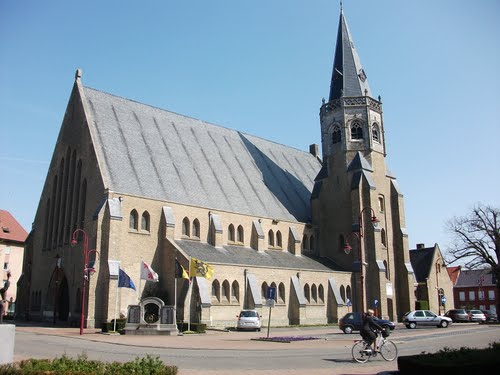
The chapel itself was built in Neo-Gothic style as a hall church, covered by a characteristic Neo-Gothic pointed barrel vault. In 1872 a tower was added next to the chapel — originally conceived as part of the roof structure rather than a freestanding element — and it remains one of the most recognisable features of the whole complex today. The plain, brick-built exterior, typical of nineteenth-century convent architecture in the region, contrasts with the more decorative treatment of the chapel's interior.
The community belonged to the Coletine Poor Clares, a strictly enclosed branch of the Franciscan family devoted to prayer and manual work. The sisters lived on this site continuously from 1867 until 2013, making it one of the longer-lived contemplative communities in the Roeselare area.
Heritage and significance
Since the religious community's departure in 2013, the building remains an important record of the city's religious and architectural history. The convent buildings, together with the chapel and tower, are recognised as part of the local built heritage, documenting a way of contemplative religious life that was a fixture of Roeselare's social fabric for well over a century.
The site sits within a wider network of former religious houses in the city, alongside institutions such as the Sisters of Divine Providence convent, reflecting the strong presence of different religious congregations in Roeselare throughout the nineteenth and twentieth centuries. For visitors interested in the history of sacred architecture and religious life, the area offers a chance to trace how such foundations evolved in form and function over more than a hundred years.
When to visit
Because this is a former enclosed convent rather than an active community, a visit makes most sense as part of a wider walk through Roeselare's historic centre, and is possible at any time of year. It is worth combining a stop here with other landmarks in the city, and checking current access arrangements in advance, since former monastic buildings are often only partially open to the public.
Frequently asked questions
When was the monastery founded? The community was established in 1867, when five Poor Clare sisters arrived in Roeselare from Tongeren.
How long did the sisters live there? The community lived and worked at this site continuously from 1867 until 2013.
What architectural style is the chapel built in? The chapel is a Neo-Gothic hall church, covered by a pointed Neo-Gothic barrel vault.
What is the complex's most distinctive feature? The tower added next to the chapel in 1872, originally planned as part of the roof, which today serves as the complex's main visual landmark.
Nearby places

Earn badges for the places you visit
Download NextOnTrip, discover new places and check off your trails.