About this place
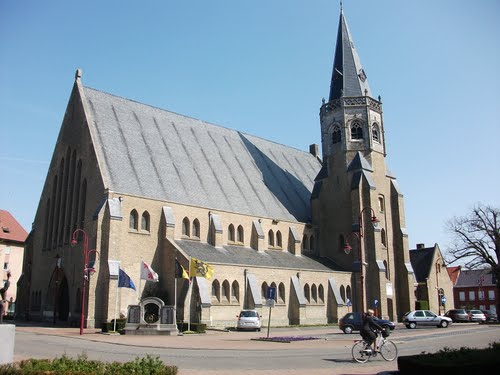
Heilige Kruisverheffingskerk is the parish church of Beveren, a village that forms part of the city of Roeselare in West Flanders, Belgium. Behind its yellow sandstone facade lies a story of destruction and rebuilding that spans more than four centuries.
How did the church come to look the way it does?
The original building fell victim to the 16th-century Beeldenstorm, the wave of iconoclastic destruction that swept through the Low Countries during the Reformation. Reconstruction took place between 1608 and 1628, producing a late Gothic pseudo-hall church with a tower — a design typical of Flemish religious architecture of the period, where the nave and side aisles rise to a similar height, giving the interior an open, spacious feel. The building was not left untouched afterward: between 1786 and 1788 it was enlarged, and in 1830 round-arched windows were added, lending the facade a somewhat more classical appearance.
Why does the church look so different from its centuries-old predecessor?
The answer lies in the tragedy of the First World War. In July 1918, near the very end of the conflict, the church was destroyed by German aerial bombing. Only the tower survived, and even that lost its spire in the process — the rest of the building was reduced to ruins. The reconstruction undertaken in the early 1920s took a markedly different architectural direction from the earlier versions of the church: the new structure was built in yellow sandstone as a Gothic hall church, a style distinct from the pseudo-hall design that had stood there before. Construction was finished in 1923, yet the solemn consecration of the rebuilt church did not take place until 1933 — a full decade after the building work itself was completed.
Where does the dedication to the Exaltation of the Holy Cross come from?
This is one of the more interesting threads in the church's history. It was originally dedicated to Saint Germanus, but in 1928 — before the postwar rebuilding process had even reached its formal conclusion with consecration — the dedication was changed. The reason was the long-standing local veneration of the Miraculous Cross associated with the parish, a devotion so deeply rooted in the community of Beveren that church authorities chose to rename the building to reflect it. That is how the church came to bear its present name, referencing the Exaltation of the Holy Cross, a feast in the Catholic calendar commemorating the finding and elevation of the relic of Christ's cross.
What is worth knowing about the church today?
After decades of continued use, the building underwent a thorough restoration in 1990, which helped preserve it in good condition as an active place of worship and a landmark within Beveren's built environment. The tower, as the only surviving element from before the wartime destruction, remains the oldest visible trace of the church's centuries-long presence on this site, even though the rest of the structure is a product of the interwar rebuilding.
Frequently asked questions
Is this the same building that stood before the First World War? Only partly — just the tower survived the 1918 bombing. The nave and the remainder of the church were rebuilt from scratch in the 1920s, in a different architectural style from the earlier structure.
Why is the church no longer dedicated to Saint Germanus? The dedication changed in 1928 because of the strong local devotion to the Miraculous Cross, a tradition that had grown to define the parish's identity more than its earlier patron saint.
Where exactly is the church located? In Beveren, a village that is part of the city of Roeselare in the West Flanders province of Belgium.
Nearby places

Earn badges for the places you visit
Download NextOnTrip, discover new places and check off your trails.