About this place
Saint-André-de-Gouffern Abbey is a former Cistercian abbey whose remains stand in the commune of La Hoguette, in the Calvados department of Normandy, France. Although only fragments of the original monastic buildings survive, the site remains one of the more evocative traces of medieval monastic settlement in this part of Normandy.
When was the abbey founded?
The history of the monastery goes back to the early 12th century. Construction work was first begun around 1127 by Robert of Bellême, a powerful Norman lord. His son, Guillaume III Talvas, count of Alençon and Ponthieu, completed his father's project and formally founded the abbey in 1131. The new community was established as a daughter house of the Abbey of Savigny, which at the time belonged to its own, separate Anglo-Norman congregation.
Which monastic order did the abbey belong to?
The situation changed in 1147, when the entire Savigny congregation — together with all of its daughter houses, including Saint-André-de-Gouffern — joined the Cistercian order of Cîteaux. From that point on, the monastery operated as a fully-fledged Cistercian abbey, following the order's characteristic way of life built around prayer, manual labour, and farming, sustained by the surrounding land and woodland.
What happened to the abbey buildings?
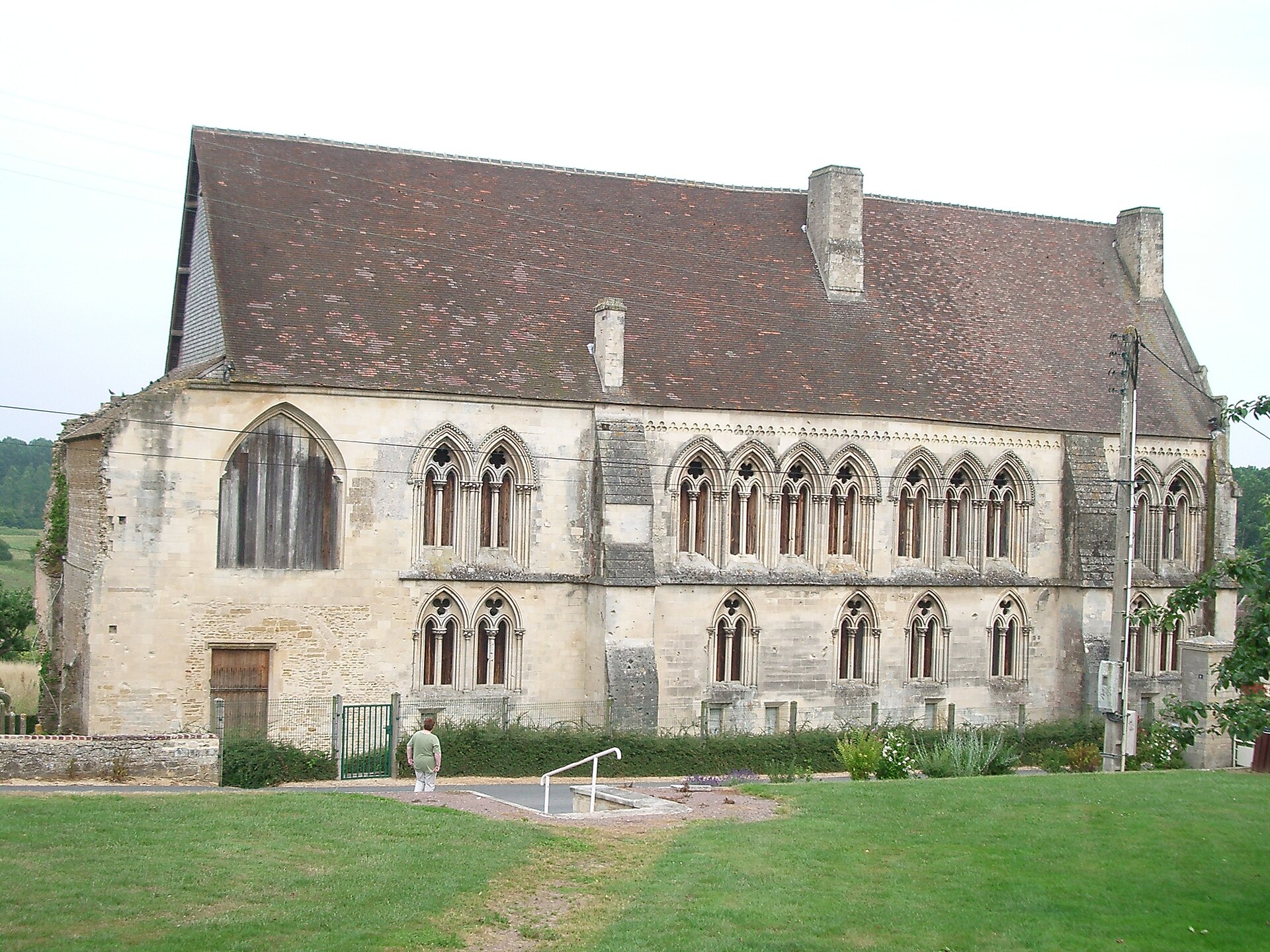
The abbey church, originally built in the first half of the 12th century, was rebuilt in 1241 and given a larger, more elaborate form. The monastic complex survived several further centuries of community life, but it did not survive the French Revolution at the end of the 18th century, when most of the buildings were destroyed or dismantled. Of the former church, only a fragment of wall with arcading, a buttress, and a mullioned window remain standing today.
What can visitors see on the site today?
Besides the remnants of the church, several outbuildings from the 12th and 13th centuries still stand on the former abbey grounds — among them former stables, cattle sheds, and a granary, separated by a small inner courtyard. One of these buildings was altered in the 17th century, which is visible in its changed shape and architectural details. In the south-western part of the site, an old monastic press from the 15th century has also been preserved, resting on two bays covered by groin vaulting — a reminder of the monks' agricultural activity, likely used for pressing apples or grapes for the community's own use.
What protection status does the abbey have today?
Because of its historical and architectural value, the remains of Saint-André-de-Gouffern Abbey were listed as a French historic monument (monument historique) by a decision dated 22 September 1932. The ruins lie in a quiet, rural setting within the commune of La Hoguette, close to the extensive Gouffern forest, making the site an appealing destination for travellers looking for lesser-known historical corners of Normandy, away from the region's more crowded attractions.
Frequently asked questions
When was Saint-André-de-Gouffern Abbey founded? Construction began around 1127, and the formal founding of the monastery is dated to 1131.
Which religious order did the abbey belong to? It started as a daughter house of the Abbey of Savigny, and from 1147, along with the whole Savigny congregation, it became part of the Cistercian order.
What led to the abbey's destruction? Most of the monastic buildings were destroyed during the French Revolution at the end of the 18th century.
What remains standing today? A fragment of the church wall with arcading, a mullioned window, a buttress, several 12th–13th century outbuildings, and a 15th-century monastic press have all survived.
Where exactly are the abbey ruins located? They lie in the commune of La Hoguette, in the Calvados department of Normandy, France, near the Gouffern forest.
Nearby places

Earn badges for the places you visit
Download NextOnTrip, discover new places and check off your trails.