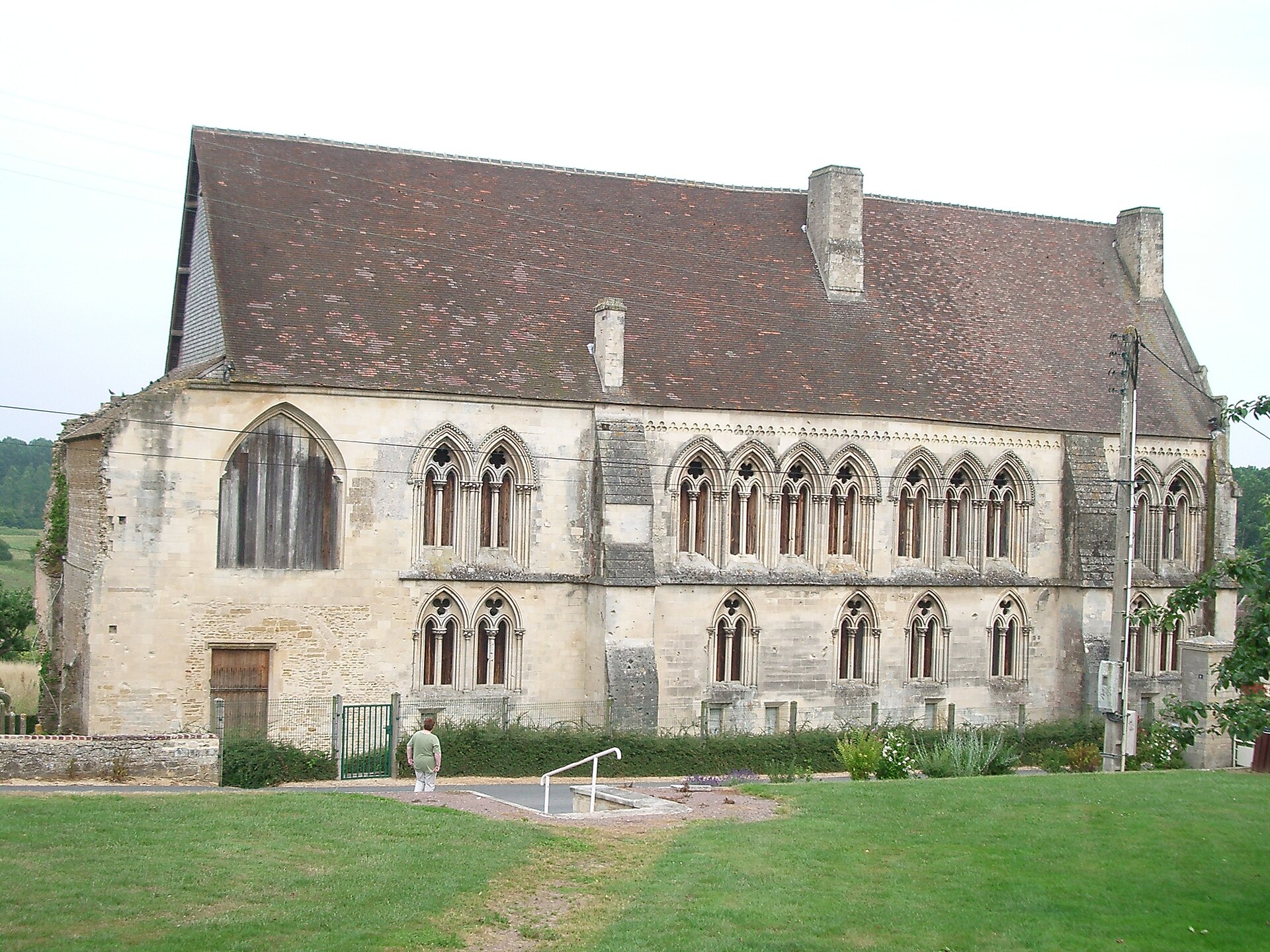
About this place
Troarn Abbey (French: Abbaye Saint-Martin de Troarn) is the surviving remnant of a medieval Benedictine monastery in the village of Troarn, in the Calvados department of Lower Normandy, a short distance east of Caen. Little of the original complex still stands, but the site remains a notable marker of Normandy's pre-Conquest monastic history.
Who founded the abbey, and when?
The story begins in 1022, when Roger I de Montgomery, head of one of Normandy's most powerful noble families, brought twelve monks from the abbey of Fécamp to Troarn and set up a dependent priory there. The arrangement changed around 1050, when his son Roger II de Montgommery turned the priory into a fully independent Benedictine house dedicated to Saint Martin of Tours. Its first church was consecrated in 1059. Roger II endowed the new abbey generously, granting it land around Troarn — including marshland — along with several parish churches. His wife, Mabille de Bellême, added further parish churches around Séez, and William the Conqueror himself confirmed and extended these grants to include estates in England, a sign of how quickly the house built up wealth and standing on both sides of the Channel.
How important did the abbey become?
Backed by this level of patronage, Troarn grew into one of the leading monasteries of the diocese of Bayeux, ranking just behind the abbey of Saint-Étienne in Caen in prestige. Its scattered network of parishes and estates in Normandy and England gave the community a durable source of income that carried it through the medieval period.
What damage did the abbey suffer over the centuries?
The abbey's later history is largely a record of destruction. In 1450, the year the French retook Normandy from the English, retreating English troops set fire to the buildings. Worse came during the Wars of Religion: in the spring of 1562, Protestant forces inflicted serious damage on the monastery. The final blow arrived after the French Revolution — in 1792 the abbey's property was put up for sale, and the buyers who took it over demolished the church and the cloister.
What happened to the abbey during the 1944 Battle of Normandy?
Troarn found itself on the front line from the very first hours of D-Day. Overnight on 5–6 June 1944, British paratroopers of the 3rd Parachute Brigade, part of the 6th Airborne Division, pushed through the town to blow up the bridge over the River Dives and secure the left flank of the invasion beachhead. In the weeks that followed, the town came under repeated British artillery bombardment while remaining in German hands, a situation that only shifted with the launch of Operation Goodwood on 18 July 1944. Troarn itself was not liberated until August 1944, as German forces made their general retreat from Normandy. The fighting and shelling of that summer added fresh damage to a monastic complex already reduced by centuries of earlier destruction.
What remains of the abbey today?
Of the once-extensive monastic complex, only a small portion survives. The most significant surviving structure is the building that once formed the south-west range of the old cloister — it stands today as the principal physical trace of the medieval abbey and the main point of reference for anyone exploring the site's history.
Frequently asked questions
Where exactly is Troarn Abbey located? The ruins sit in the centre of the village of Troarn, in Calvados, Lower Normandy (approximately 49.1816 N, 0.1775 W).
Who founded the abbey? Roger I de Montgomery began the foundation in 1022 as a priory dependent on Fécamp; his son Roger II turned it into an independent Benedictine abbey around 1050.
Why is so little of the abbey left standing? The buildings were damaged repeatedly across the centuries — burned in 1450, badly hit during the Wars of Religion in 1562, demolished after the 1792 sale of church property, and further damaged during the fighting of the 1944 Battle of Normandy.
What can visitors see at the site today? The surviving fragment of the old cloister's south-west wing gives a sense of the abbey's original scale, even though the church and most other monastic buildings no longer exist.
Nearby places

Earn badges for the places you visit
Download NextOnTrip, discover new places and check off your trails.