About this place
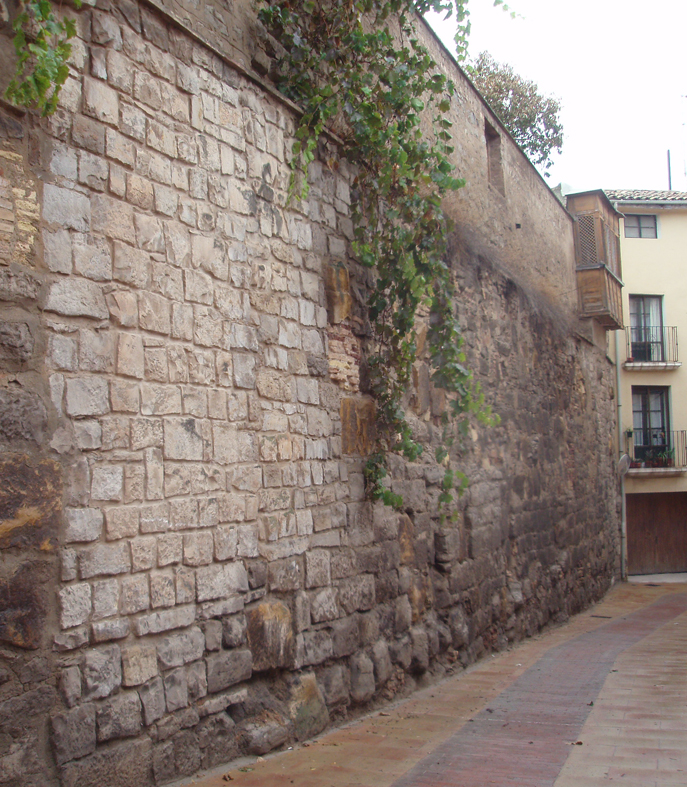
The Walls of Tudela are the remains of a Muslim-era fortification that once enclosed the old town of Tudela, in Navarre. Surviving stretches, towers and gates can still be traced on foot around the historic centre, close to the Cathedral of Santa María and the Monastery of Santa Clara.
When were the walls of Tudela built?
The city's first defensive ring dates to the early 9th century. Arab chroniclers credit Amrus ibn Yusuf, acting on the order of the Cordoban emir al-Hakam I, with fortifying the hill on which Tudela stood around the year 802. That early wall extended as far as the Mediavilla ravine, which functioned as a natural moat on one side of the settlement. Over the following centuries of Muslim rule the fortification grew, and by the 11th and 12th centuries it had taken on a fully developed form, with semicircular towers and features typical of Islamic military architecture, including crenellations and arrow slits.
What changed after the Christian reconquest?
Everything shifted once Christian forces took the city in 1119. The Muslim population was moved outside the original walled perimeter into a new quarter known as the Morería, and this new district was quickly given its own protective wall, built specifically to defend it even though it sat beyond the original city boundary. Defenses kept evolving into the 14th century, when additional towers were raised and existing sections reinforced — among them the Monreal Tower, a 13th-century structure tied to the defensive ring whose earliest roots go back to the Arab period.
Why did most of the walls disappear?
The turning point came in 1521. Following another uprising in Navarre, King Charles I ordered the destruction of castles and walls across the former kingdom to prevent further rebellion, and Tudela lost its status as a fortified stronghold. The dismantling was gradual rather than immediate: residents spent years pulling stone from the walls to build their own houses, and the central stretches of the perimeter reportedly kept their walled appearance until as late as the 18th century, even though the city had formally ceased to be a fortress two hundred years earlier.
What is left to see today?
Of the original defensive circuit — roughly 1.5 kilometres long and once fronted by a water-filled moat — around eight towers still stand, some retaining much of their original fabric. Visible stretches of curtain wall preserve details typical of Islamic building, such as horseshoe arches, crenellations and arrow slits. Other sections have been absorbed into later houses or have vanished from the townscape altogether. The surviving parts have been restored and are open to visit free of charge.
Where are the walls and how do you get there?
Remaining fragments trace the edge of the old town, with a notable stretch along Calle Ronda del Carmen. The best-preserved sections are within easy walking distance of central Tudela, on a route that passes close to the Cathedral of Santa María and the Monastery of Santa Clara, making it simple to combine the walls with the rest of a walk through the historic quarter.
Frequently Asked Questions
Who built the walls of Tudela? The first defensive line was raised in the early 9th century by Amrus ibn Yusuf on the order of the emir of Córdoba, with further sections added under later Muslim rule and after the Christian reconquest of 1119.
How many towers have survived? Around eight towers from the original fortification still stand today, some close to their original condition.
Why were the walls torn down? In 1521, King Charles I ordered the walls and castles of Navarre destroyed in response to a local uprising, and residents spent the following centuries removing stone from the ruins to build their homes.
Is it free to visit the walls? Yes, the restored sections of the walls are open to the public at no cost and can be visited as part of a walk through Tudela's old town.
Nearby places


Earn badges for the places you visit
Download NextOnTrip, discover new places and check off your trails.