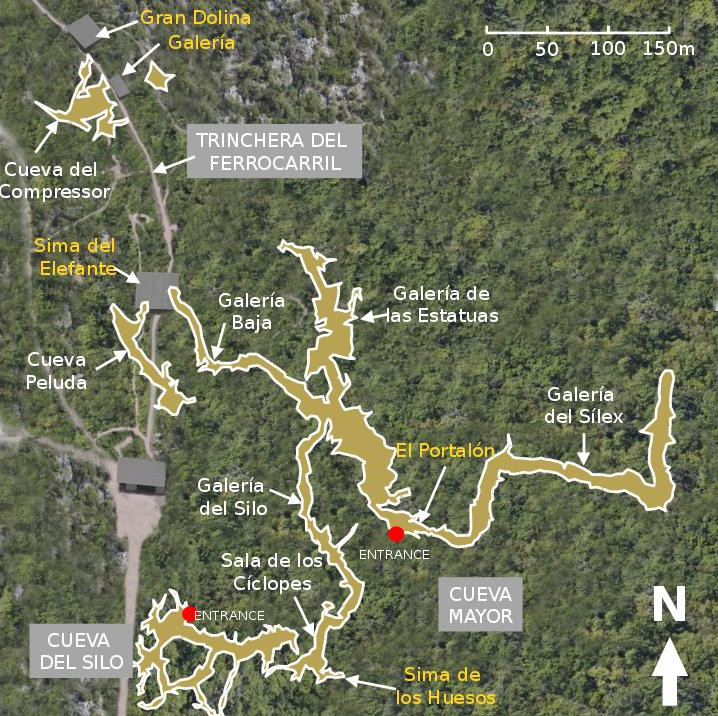
About this place
Sima del Elefante ("Pit of the Elephant") is one of the main excavation sites of the Atapuerca archaeological complex, located near the town of Ibeas de Juarros in the province of Burgos, northern Spain.
Why is this cave significant?
Sima del Elefante holds some of the earliest confirmed evidence of human presence in Western Europe. Jaw and tooth fragments recovered from the site have been dated to roughly 1.1-1.2 million years old. In 2022, researchers uncovered a partial facial bone, catalogued as ATE7-1, dated between 1.1 and 1.4 million years and attributed to Homo affinis erectus - making it the oldest human face ever found in Western Europe. The find predates the roughly 800,000 to 860,000-year-old Homo antecessor remains discovered at the nearby Gran Dolina cave, another Atapuerca site. Excavators also recovered stone tools and animal bones bearing cut marks, evidence that these early humans processed meat with simple lithic technology.
Together with Gran Dolina and Sima de los Huesos, Sima del Elefante forms part of the Atapuerca archaeological sites, inscribed on the UNESCO World Heritage List.
How do you get there and visit the site?
Visits start at the Centro de Acceso a los Yacimientos de Atapuerca (CAYAC), on the road out of Ibeas de Juarros toward Logroño. From there, a shuttle bus takes visitors to the excavation area; the same route also serves visitors coming from CAREX, the visitor centre in the neighboring village of Atapuerca. Independent access to the excavations is not permitted - the sites are protected and can only be visited on a guided tour.
The guided walk lasts around one hour and fifteen minutes and covers roughly 600 metres round trip, with three stops, including Sima del Elefante itself, the oldest of the sites on the route. Tickets must be booked in advance, by phone, email, or at the ticket desks of the Museo de la Evolución Humana, CAREX, or CAYAC.
When is the best time to visit?
Excavation work usually takes place during the summer, when archaeologists are on site - a good time to see fieldwork in progress. Outside the digging season, guided tours still run year-round, but booking ahead is recommended since each tour has a limited number of spots.
What else to see nearby?
A visit to Sima del Elefante pairs well with the Museo de la Evolución Humana (Museum of Human Evolution) in Burgos, which displays finds from Atapuerca, and with the other sites on the same route, Gran Dolina and Sima de los Huesos.
Frequently Asked Questions
What does the name Sima del Elefante mean? It translates to "Pit of the Elephant," a name that comes from elephant bones found in the cave during earlier research.
Can you visit the cave on your own? No. The site is protected and only accessible on guided tours departing from the CAYAC or CAREX visitor centres, which require advance booking.
What has been found at the site? Jaw and tooth fragments dated to 1.1-1.2 million years, a facial bone fragment (ATE7-1) dated to 1.1-1.4 million years and attributed to Homo affinis erectus, plus stone tools and cut-marked animal bones.
Is Sima del Elefante part of a UNESCO site? Yes, it belongs to the Archaeological Site of Atapuerca, inscribed on the UNESCO World Heritage List.
Nearby places

Earn badges for the places you visit
Download NextOnTrip, discover new places and check off your trails.