About this place
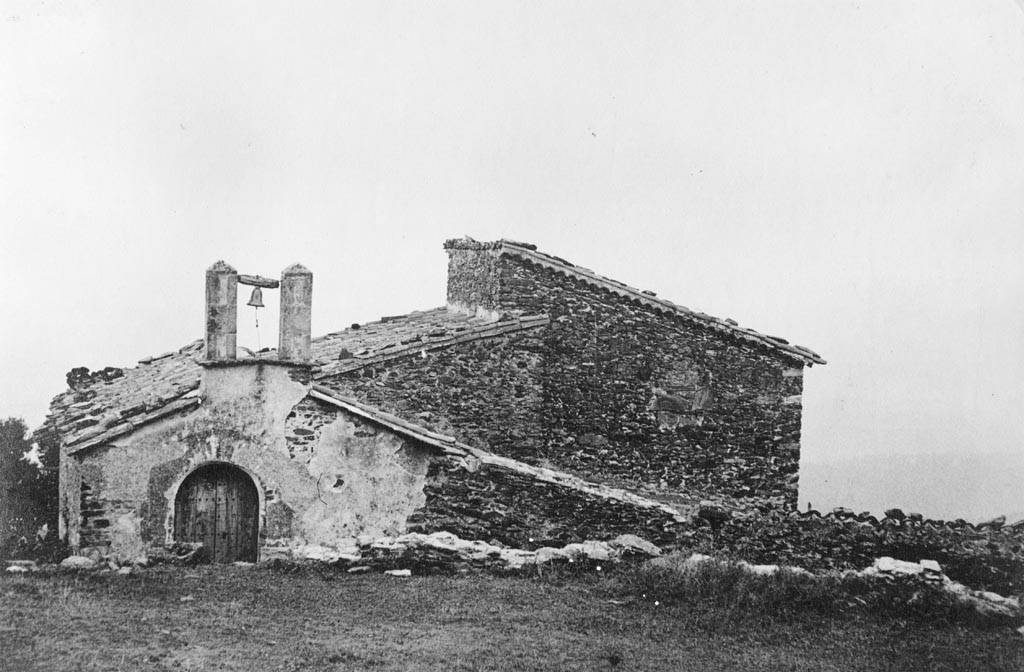
Santa Anastàsia is a Romanesque hermitage in the municipality of Montseny, in the Vallès Oriental county near Barcelona, now preserved as consolidated ruins on a hilltop above the former Vila-seca hamlet. The site lies within the Montseny Natural Park and is listed in Catalonia's Inventory of Architectural Heritage.
How do you get to Santa Anastàsia?
The ruins sit along a walking route that starts from the village of Montseny and links up with nearby landmarks such as Pla del Coll and Serra del Navall. Access is on foot through the natural park's trail network, passing through the mixed Mediterranean-mountain vegetation typical of the Montseny massif. There's no direct road access to the site itself, so the practical approach is to park in Montseny village and continue on foot.
What will you actually see there?
What survives of the original building is a set of foundations that clearly trace a rectangular nave ending in a semicircular apse — a floor plan typical of the small Romanesque rural chapels built across this region between the 12th and 13th centuries. There's no roof or vaulting left standing, but the remains have been consolidated and kept in a condition that still lets visitors read the original shape of the building. This is a contemplative stop rather than a monumental one: the appeal lies in the hilltop setting and the history, not architectural scale.
What happened to the chapel's furnishings?
The original stone altar slab didn't stay on site — it was moved to the altar of the church of Sant Julià del Montseny, where it can still be seen today. That same church also holds a predella with three panels depicting Saint Helen, Saint Peter, and Saint Stephen, plus a separate Baroque-era predella from the Santa Anastàsia altarpiece, dating from the 16th–17th centuries. Anyone wanting to see the chapel's movable furnishings needs to visit Sant Julià, not Santa Anastàsia itself.
The chapel's history
Santa Anastàsia is a Romanesque building likely dating from the 12th century, though the earliest surviving documents mentioning it only go back to the 17th. For centuries the chapel served the neighboring hamlet of Vila-seca, perched on a hill at the end of the Serra del Navall ridge. Its fate turned in the 20th century: abandoned in 1936, the chapel was desecrated in 1940 and then demolished by the landowner, who used the act to take possession of the plot. Today only the consolidated foundations remain, registered in Catalonia's catalogue of architectural heritage.
When is the best time to visit?
Montseny is a UNESCO biosphere reserve, and its trails are most comfortable in spring and autumn, when temperatures suit longer walks and the vegetation is at its most colorful. Summer can turn the higher stretches quite hot, while winter routes get wet and slippery after rain. It's worth pairing a stop at Santa Anastàsia with the wider loop past Pla del Coll and Serra del Navall, so the walk covers more than just the ruins themselves.
Frequently asked questions
Can you visit the ruins of Santa Anastàsia freely? Yes — it's an open-air site with no fence and no fixed opening hours, reached as part of a walk along the Montseny Natural Park trail network.
Is any of the chapel's roof or interior still standing? No. Only the foundations and the outline of the walls remain, showing a rectangular nave with a semicircular apse — the rest of the structure did not survive.
Where can you see the chapel's original furnishings? At the church of Sant Julià del Montseny, which holds the relocated altar slab and two predellas connected to Santa Anastàsia.
Is it worth combining the visit with other nearby stops? Yes — Santa Anastàsia sits on a route that also passes Pla del Coll and Serra del Navall, so it fits naturally into a longer walk through Montseny.
Nearby places

Earn badges for the places you visit
Download NextOnTrip, discover new places and check off your trails.