About this place
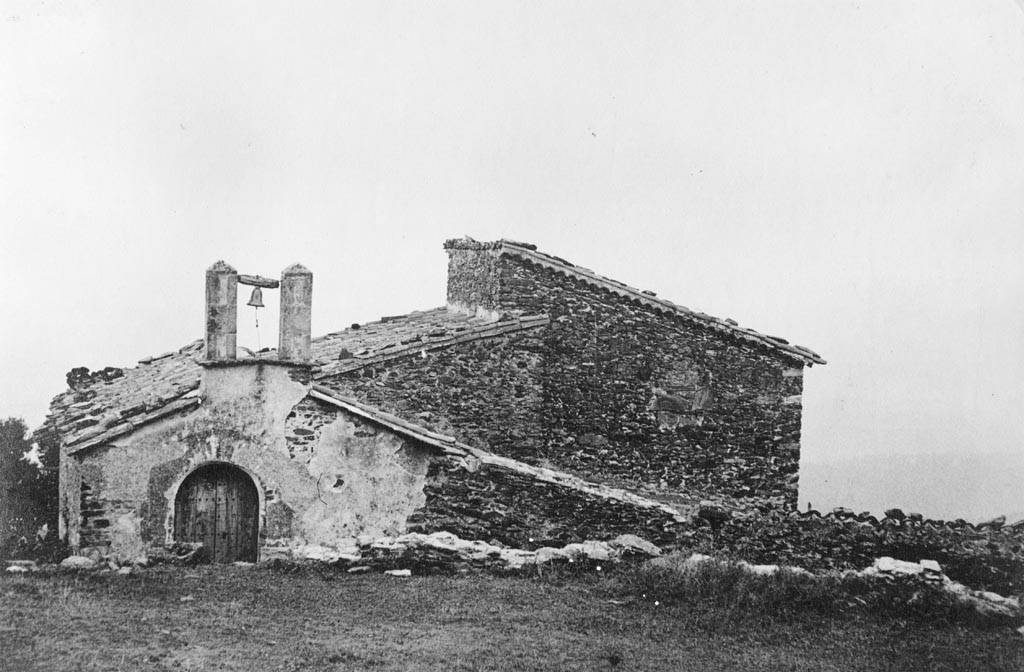
Sant Martí de Tagamanent is the ruin of a small Romanesque church perched on the northern slope of Tagamanent hill, within the municipality of the same name in the Vallès Oriental county, Barcelona province, Catalonia.
Where are the ruins located?
The remains stand a few metres from the footpath that crosses the mountain pass known as Coll de Sant Martí, on the north side at the foot of Tagamanent hill. Hikers climbing toward the Tagamanent summit, close to 1,000 metres above sea level, pass right by the site, which offers wide views over the surrounding Vallès Oriental countryside.
What is the history behind the church?
The earliest written record dates to 1009, when the building appears in a document under the Latin name "Sancti Martini supra via" - literally "Saint Martin above the road" - a name that reflects its position beside a well-used route.
A turning point came in 1098. When the neighbouring church of Santa Maria de Tagamanent was donated to the monastery of Conques, Sant Martí was raised to parish status, apparently rebuilt or enlarged around that time. The promotion did not last.
By 1357, a bishop's visitor found the surrounding cemetery in a state of severe neglect and ordered the remains buried there transferred to Santa Maria de Tagamanent. From that point the building's standing declined, shifting from a full parish church to a subordinate wayside chapel.
After 1570, references to the church disappear from ecclesiastical records altogether. It is notably absent from the detailed pastoral visitation reports compiled by Bishop Antoni Pasqual in 1686 and 1702, suggesting the building had already been abandoned and left to decay before the close of the sixteenth century.
How was it built, and what survives today?
Builders used small dressed blocks of reddish sandstone bonded with lime mortar, a technique typical of eleventh-century Catalan Romanesque construction. Curiously, the exterior stonework was finished more carefully than the interior faces. The original church featured a semicircular apse covered by a quarter-sphere vault and a triumphal arch separating the sanctuary from the nave.
Today only one wall survives, incorporating fragments of the apse, including traces of blind window decoration. A row of square openings runs along the wall at roughly two metres above ground - likely sockets for structural beams or scaffolding. Beneath the surrounding vegetation, the foundation line of the full perimeter can still be traced, although ongoing soil erosion and ground subsidence continue to damage what remains. The site is listed in Catalonia's Inventory of Architectural Heritage.
Frequently Asked Questions
Can visitors reach the Sant Martí de Tagamanent ruins? Yes. The remains sit right beside the hiking path through the Coll de Sant Martí pass, at the base of Tagamanent hill, with open access typical of an abandoned rural site rather than an active place of worship.
Why did the church fall into ruin? After losing its parish status in the fourteenth century and being effectively abandoned after 1570, the building received no further upkeep. Centuries of erosion and ground subsidence eventually brought down most of its walls.
How does Sant Martí relate to Santa Maria de Tagamanent? Santa Maria is the municipality's active parish church, while Sant Martí briefly rivalled it administratively between the 11th and 14th centuries before being demoted to a chapel and finally abandoned.
Nearby places

Earn badges for the places you visit
Download NextOnTrip, discover new places and check off your trails.