About this place
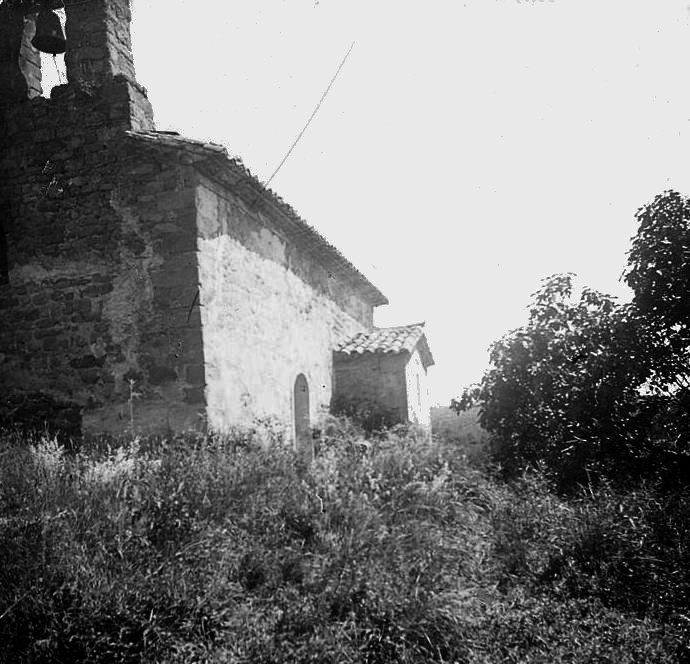
Sant Salvador de Mata is the ruin of a pre-Romanesque church and former small Benedictine monastery, standing at the top of a mountain ridge in the municipality of Capolat, in the Berguedà comarca of Catalonia, Spain.
Where exactly are the ruins?
The site sits on the Serrat de Sant Salvador ridge, whose summit reaches roughly 1,157 metres and forms a natural boundary between the municipalities of Capolat, Avià and L'Espunyola. This is classic pre-Pyrenean terrain: steep hillsides, scattered farmsteads (masies), and isolated chapels far from any administrative centre. The coordinates are 42.0616°N, 1.78186°E. The usual approach is from the road linking Berga with Sant Llorenç de Morunys, near a spot locally known as Tombes, from where the summit is reached on foot.
What is known about its history?
The story goes back to the late 9th century. A document preserved in the cathedral archive of Urgell records that the monastic church was consecrated on 13 December 899 by Bishop Nantigís, at the request of Abbot Sunila. Throughout the 10th century the community operated as an independent Benedictine monastery that also carried out parish duties for the surrounding population. From the 11th century onward, though, it lost that independence and became a priory dependent on the monastery of Sant Sadurní de Tavèrnoles. Its trail in church records fades in the early 14th century — it no longer appears in the bishopric's visitation registers of 1312-1314, suggesting it had stopped functioning as a separate parish by then.
What does the building look like today?
What remains is a modest single-nave, pre-Romanesque church with a square-ended apse on its eastern side and no triumphal arch marking off the sanctuary from the nave — a layout typical of the earliest phase of religious building in this region. Two different masonry styles are visible in the walls: carefully dressed stone blocks from the original construction, and cruder, later repair work. In places, fragments of an opus spicatum (herringbone) floor survive, and the roof originally rested on wooden beams. Today the structure is in an advanced state of ruin: mainly the north and south walls still stand, heavily overgrown with vegetation, and the roof has long since disappeared.
What can be seen from the summit of Serrat de Sant Salvador?
Even though the church itself is a ruin, the hilltop remains a popular walking destination. It offers a wide panorama over the lower Berguedà plain, stretching as far as the silhouette of Montserrat. A geodetic survey marker sits at the summit alongside a large Catalan flag (senyera), visible from a distance. The route up is considered easy and suitable for families with children.
Frequently asked questions
What is Sant Salvador de Mata? It is the ruin of a pre-Romanesque church and former Benedictine monastery, standing at the top of the Serrat de Sant Salvador ridge in the municipality of Capolat, Berguedà.
When was the church built? Its consecration document records the date of 13 December 899, when Bishop Nantigís of Urgell consecrated it at the request of Abbot Sunila.
Why is only a ruin left of it? From the 11th century the community lost its independence to the monastery of Sant Sadurní de Tavèrnoles, and after disappearing from parish records in the early 14th century, the building gradually fell into ruin, like many small, isolated rural churches across Berguedà.
What views does the summit offer? The viewpoint overlooks the plain of the lower Berguedà all the way to Montserrat, and the summit itself has a geodetic marker and a large senyera flag.
Are there other similar heritage sites in Capolat? Yes — the same municipality is also home to Sant Serni de Terrers, another small rural Romanesque church, reflecting how many scattered parish chapels have survived in this part of Berguedà.
Nearby places

Earn badges for the places you visit
Download NextOnTrip, discover new places and check off your trails.