About this place
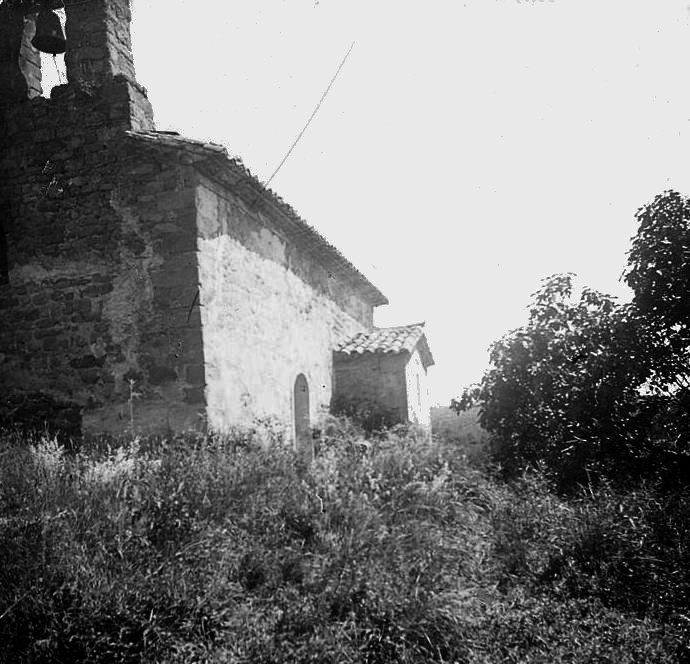
Església de Sant Quintí de Montclar is a Romanesque church in the municipality of Montclar, in the Berguedà region of Catalonia. Today it stands partly in ruins, but its surviving walls still trace the outline of the original 12th-century building.
Where is it located?
The church sits within the municipality of Montclar, in the northern part of the Berguedà comarca, Barcelona province. Its coordinates are 42.044161, 1.807066. The surrounding landscape belongs to the Pyrenean foothills, an area dotted with small medieval chapels and churches historically tied to nearby defensive castles.
What can you see on site?
The building follows a single-nave plan typical of rural Romanesque architecture in the region. The nave is covered by a barrel vault and closed off by a semicircular apse roofed with a quarter-sphere vault. The entrance sits on the south side, framed by a voussoired semicircular arch cut from dressed stone. At the west end, a damaged espadanya — a thin bell wall with openings for bells, common to Catalan rural churches — still stands. The roof, originally double-pitched, was covered with Arab-style tiles.
In 1982, the vault over the nave collapsed, and the building has not been used for worship since. What remains today are mostly the perimeter walls; the church is listed in the Inventory of Architectural Heritage of Catalonia as a site in a semi-ruined state.
What is known about its history?
Researchers date the building to around the 12th century. Because of its proximity to the former Montclar castle, a connection between the two is often assumed, but no surviving documents confirm any administrative or founding link. Until the 18th century, the church was subordinate to the parish of Sant Martí de Montclar, functioning as its dependency rather than as an independent parish.
A small, rather plainly made reliquary, known as a lipsanoteca, originating from Sant Quintí is kept today at the Diocesan Museum of Solsona, under inventory number 295 — one of the few portable objects that can be directly linked to this place of worship.
When is the best time to visit?
Since the church is an open-air ruin without ongoing conservation staff on site, spring and early autumn are the best times to visit, when the weather in the Pyrenean foothills is well suited to walking the surrounding hills. A visit pairs well with other Romanesque sites in Berguedà, as well as a stop at the Diocesan Museum of Solsona to see the reliquary mentioned above.
Frequently asked questions
Can visitors go inside the church? The building has been partly ruined since its vault collapsed in 1982 and no longer hosts services — mainly the perimeter walls remain standing.
How old is the church? It is dated to around the 12th century and represents the Romanesque style typical of rural churches in Berguedà.
Was the church linked to Montclar castle? Its proximity to the castle suggests a connection, but no documents confirm one; until the 18th century the church was a dependency of the parish of Sant Martí de Montclar.
Where can related artifacts be seen? A reliquary (lipsanoteca) from this church is held at the Diocesan Museum of Solsona.
Nearby places

Earn badges for the places you visit
Download NextOnTrip, discover new places and check off your trails.