About this place
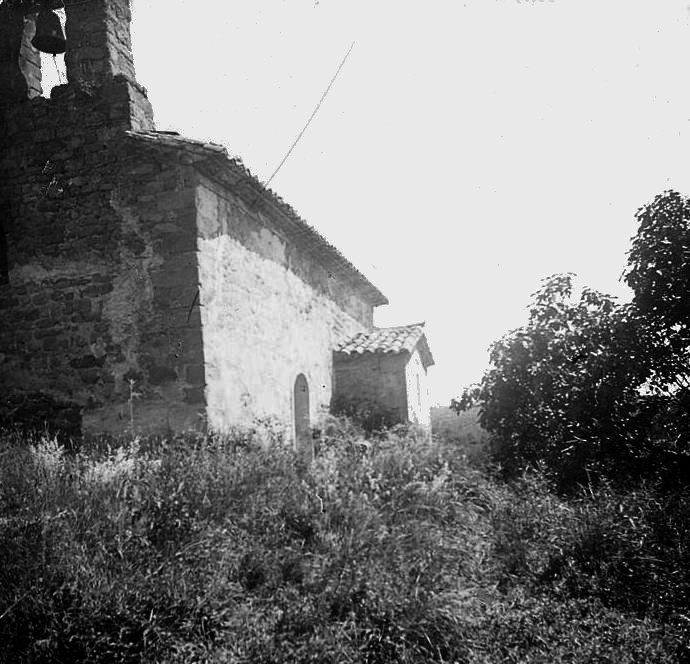
Sant Martí de Minoves is a ruined medieval church in the municipality of Olvan, in the Berguedà region of Catalonia. Standing among the remains of a long-abandoned village, it offers a quieter, less-visited stop for anyone interested in the area's Romanesque past.
Where exactly is it?
The ruins sit on a low hilltop above the Riera del Gol stream, close to the former industrial settlement of Colònia Rosal and the Minoves farmhouse that gave the site its name. A small village once spread across this hill; over the centuries it was gradually abandoned and reclaimed by the surrounding woodland.
How do you get there?
Coming from Manresa toward Berga, watch for Colònia Rosal along the way. Just before the road crosses the Llobregat onto its bridge, a turnoff leads onto a forestry track that follows the route of a long-closed rail line. From there, the final approach to the church ruins and settlement remains is on foot, uphill. Sturdy footwear is recommended, since the ground is uneven and signage is minimal, as is typical for local historical trails in Berguedà.
What will you find on site?
Several structures on the hill still trace the outline of the medieval settlement:
- A rectangular watchtower dating to the 12th century, the most recognisable feature of the group and a reminder of the unsettled border era of the Catalan counties.
- A mill, built somewhat later than the tower, taking advantage of the nearby watercourse.
- The church of Sant Martí itself, with masonry consistent with 11th- and 12th-century construction — the building that lends the whole site its name.
- A cemetery attached to the church, whose enclosing walls were rebuilt only in the 17th or 18th century, showing the site kept a religious function long after the village around it had thinned out.
Together these remains form a textbook example of a Catalan "poble medieval" — a settlement that did not survive later shifts in population and farming, leaving only stone foundations and walls folded into the landscape. Olvan's local council lists these ruins, alongside the nearby Pont d'Orniu bridge, among the notable elements of the municipality's cultural heritage.
When is the best time to visit?
Given the terrain — an uphill walk through woodland with no visitor infrastructure — spring and autumn are the most comfortable seasons, when temperatures in Berguedà are mild and vegetation doesn't yet block easy access to the ruins. Summer heat in the Llobregat valley can be intense, while winter rain often leaves the forest track muddy.
Frequently asked questions
Is the site open to the public? Yes, there's no fence or gate, but don't expect standard tourist infrastructure — no ticket booth, large information panels, or marked car park. This is a destination for visitors drawn to raw, undressed history rather than a curated attraction.
Do you need a guide? Not strictly, but knowing exactly where to turn off the Manresa–Berga road at Colònia Rosal makes the approach much easier, since on-site signage is sparse.
How long does a visit take? Walking in, exploring the ruins, and walking back usually takes one to two hours, depending on your pace and how much time you spend examining each structure.
What else can be combined with the visit? The nearby Pont d'Orniu bridge is also listed as part of Olvan's heritage, making it easy to combine both stops into a short historical route through this part of Berguedà.
Nearby places

Earn badges for the places you visit
Download NextOnTrip, discover new places and check off your trails.