About this place
Prieuré de Carluc is a small but historically dense monastic complex tucked into the hills near Céreste, in the Alpes-de-Haute-Provence department at the edge of the Luberon. It combines a Romanesque chapel, the remains of two further churches, and a necropolis of tombs carved straight into the rock — an unusually rich mix for such a modest, out-of-the-way site.
Where is Prieuré de Carluc located?
The priory sits in a quiet, wooded setting a short distance from the village of Céreste, surrounded by the dry, rocky slopes typical of this part of Provence. The isolation is not accidental: the site had a sacred function long before Christianity arrived, and its proximity to the ancient Via Domitia, the Roman road linking Spain to Italy, made it a natural stopping point for travelers and pilgrims through the Middle Ages.
How did the site's history begin?
Before the Christian priory existed, Carluc was home to a pagan sanctuary, connected to a nearby Gallo-Roman settlement known as Catuiaca. The oldest surviving document mentioning the site dates to 1011 and records a donation made to Abbot Archinric, a figure linked to the Abbey of Montmajour. According to local tradition, Archinric retired to Carluc and died there in 1021, an event that helped cement the site's reputation as a place of pilgrimage.
Through the 11th century the community operated independently, receiving a steady stream of donations from the surrounding population. It was only under Pope Gelasius II, around 1118-1119, that Carluc formally became a dependent priory of the Abbey of Montmajour. Rebuilding work followed, and most of the architecture still visible today dates from this 12th-century phase. As a priory under Montmajour's authority, Carluc oversaw a dozen or so smaller rural communities scattered across Haute-Provence, a sign of its regional weight in the medieval period.
What can visitors see on site today?
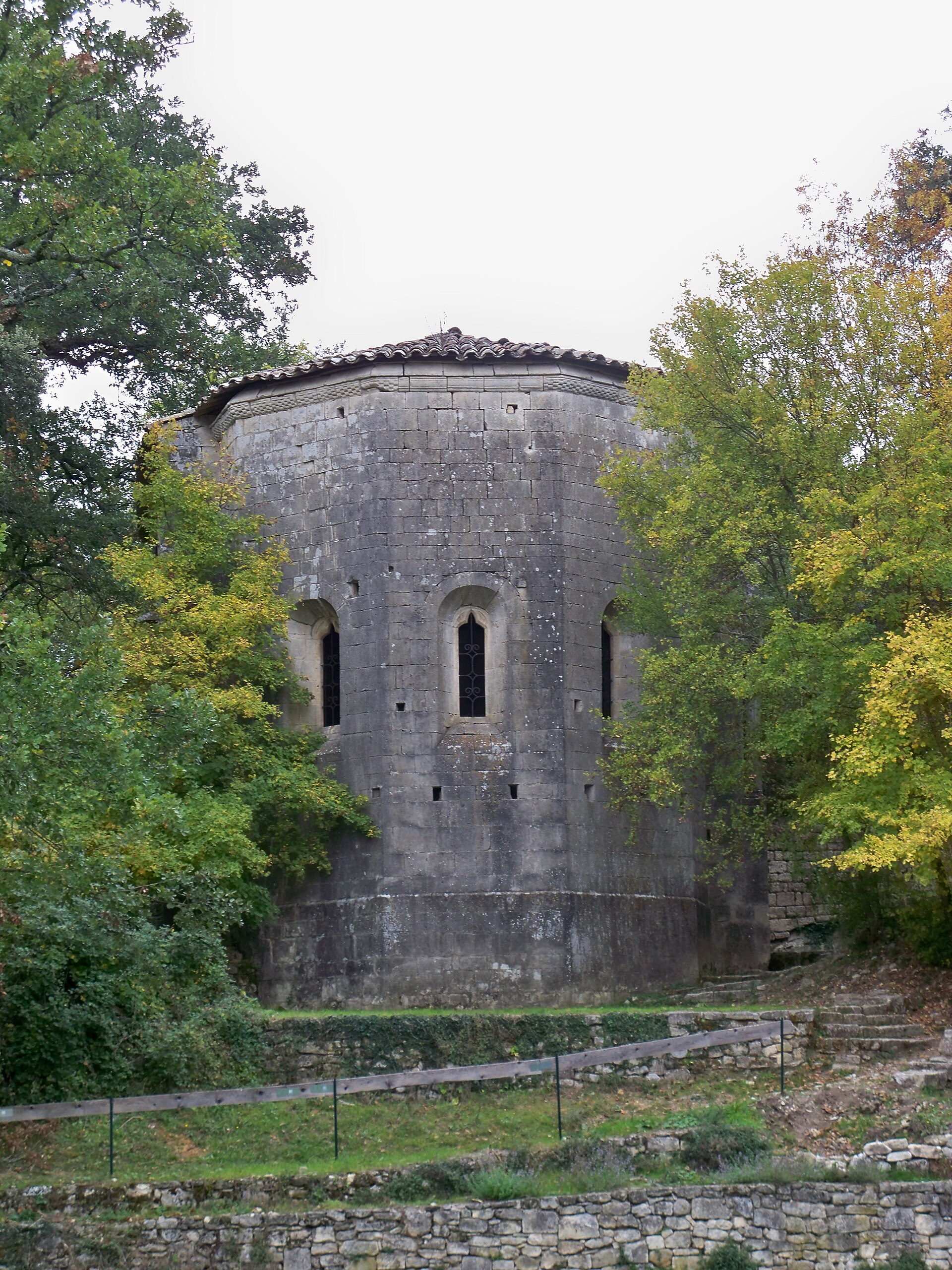
The heart of the complex is a stone Romanesque chapel with a pentagonal apse, decorated with a checkerboard frieze and carved capitals showing bird motifs. Around the chapel spreads a necropolis of rock-cut graves — the site is thought to have functioned as a pilgrimage destination where the faithful sought burial close to the resting place of local martyr-saints.
Part of the necropolis lies within a gallery carved directly into the rock face, partially vaulted and decorated with columns bearing Corinthian-style capitals, connecting straight through to the chapel. Excavations carried out in 1960-1961 uncovered further sarcophagi within this gallery, confirming that the site was used as a burial ground over an extended period. Beyond the main chapel, the ruins of two smaller churches survive nearby, partly hewn from the rock themselves — enough remains to trace the outline of the original layout, though not to reconstruct it in full.
A visit to Carluc means walking among stone ruins set against Provençal woodland rather than following a curated museum circuit — the site has kept a raw, low-key character, well away from the crowds drawn to the Luberon's better-known landmarks.
Frequently asked questions
What is Prieuré de Carluc? It is the ruined remains of a medieval priory once dependent on the Abbey of Montmajour, featuring a Romanesque chapel and a necropolis of rock-cut tombs.
When was the priory founded? The earliest document confirming a place of worship at Carluc dates from 1011; the site became a dependent priory of Montmajour around 1118-1119, under Pope Gelasius II.
Why is it called a rock-cut necropolis? Because a significant part of the burial ground, along with the gallery connecting to the chapel, was carved directly out of the rock rather than built in the conventional way.
Was Carluc an important pilgrimage site? Its position near the ancient Via Domitia, combined with the reputation for holiness of its founding figure, made it a notable stop for pilgrims traveling between Spain and Italy.
Nearby places

Earn badges for the places you visit
Download NextOnTrip, discover new places and check off your trails.