About this place
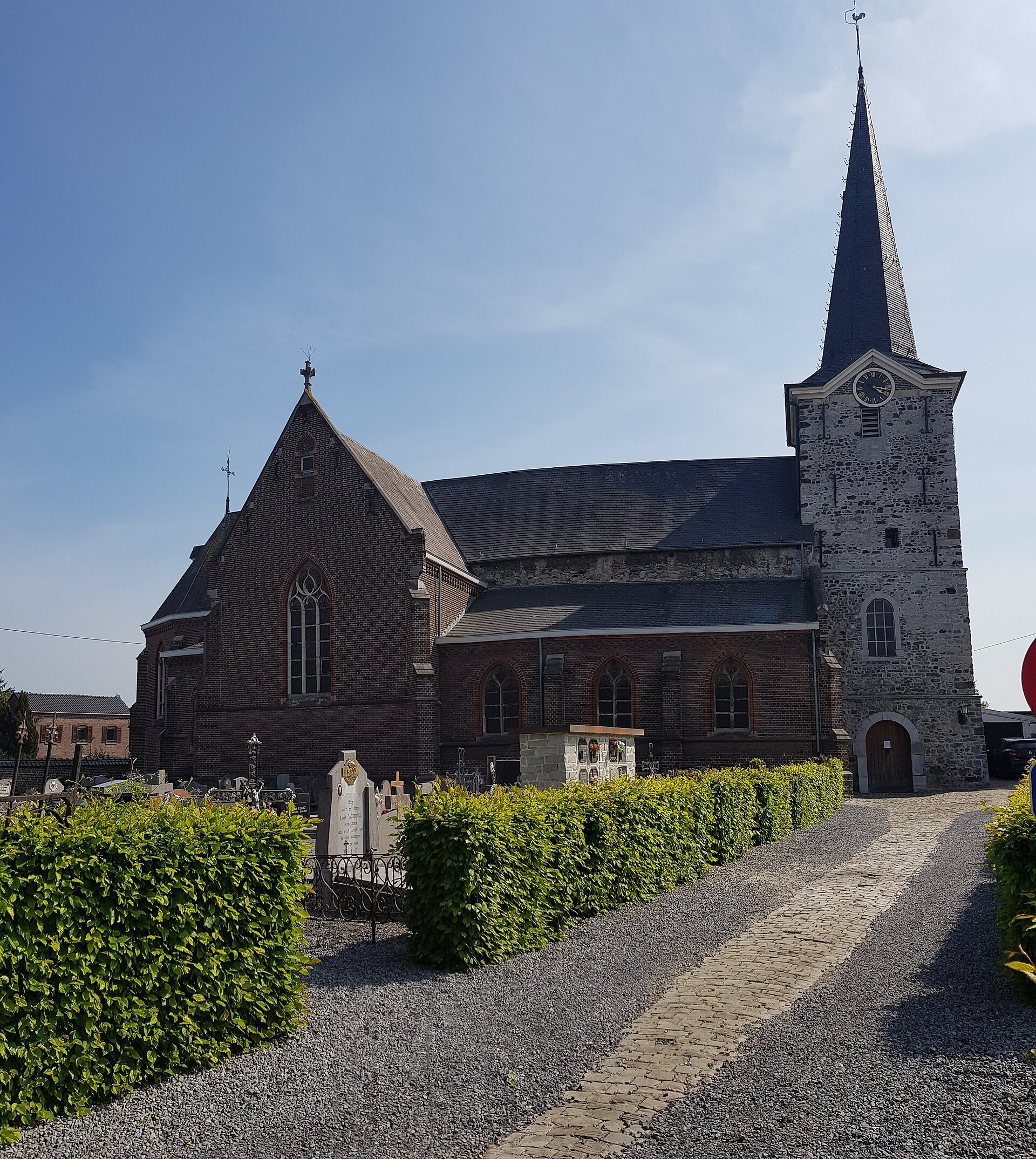
Onze-Lieve-Vrouw-Ten-Hemel-Opnemingskerk is the parish church of Moelingen, a village in the municipality of Voeren (Fourons) in Belgian Limburg, close to the borders with the Netherlands and Germany. Dedicated to the Assumption of the Blessed Virgin Mary, the church has served as the religious heart of this small community for centuries.
What is the oldest part of the church?
The tower is by far the most historically significant element of the building. It dates back to the 12th century and was built in the Romanesque style, making it the oldest surviving component of the whole complex. Local heritage sources rank it among the notable Romanesque monuments of the Voeren region. The rest of the church was added much later, in the 14th century, in the Maaslander Gothic style — a regional variant of Gothic architecture typical of the Meuse valley.
How is the building laid out?
The church takes the form of a pseudo-basilical cruciform building. The Romanesque tower projects at the west end, followed by a three-aisled nave divided into three bays, a transept, and a choir. The choir itself is composed of two straight bays finished with a three-sided apse — a closing typical of Gothic parish churches in this part of Limburg. This combination of an older Romanesque tower fused with a later Gothic body is a recurring pattern in the region's sacred architecture, where churches were expanded over centuries while their oldest, most valuable elements were deliberately preserved.
Has the church been restored?
Yes. In 2005 the monumental Romanesque tower underwent a thorough restoration. The conservation work focused on this oldest and most fragile part of the structure, ensuring its historic fabric would survive for future generations.
What surrounds the church?
To the north of the building lies the parish cemetery. Beyond serving as the village burial ground, it also functions as a site of remembrance: in its northeastern corner lie the graves of soldiers who died in both World Wars, marked by a modernist war memorial. This corner links the village's religious history with its wartime history, giving the cemetery a dual role as both a resting place and a local memorial site.
Why is this place worth a visit?
The church at Moelingen shows how a small rural parish can hold layers of history spanning nearly a millennium — from a Romanesque tower built almost a thousand years ago, through a Gothic-era expansion, to a modern memorial honoring war victims. For visitors exploring the Voeren region, better known for its rolling hills and orchards, the church offers one of the few sacred heritage sites in the area with such a long and continuous history. Because Moelingen sits away from the main tourist routes, the church and its surrounding cemetery can usually be visited in quiet, without crowds.
Frequently asked questions
To whom is the church dedicated? To the Assumption of the Blessed Virgin Mary.
From which period does the tower date? The 12th century, built in the Romanesque style.
When was the main body of the church built? In the 14th century, in the Maaslander Gothic style.
Was the tower ever restored? Yes, it was restored in 2005.
What can be found in the adjoining cemetery? Civilian graves along with war memorials for soldiers from both World Wars, located in the northeastern corner.
Where exactly is Moelingen located? It is a village within the municipality of Voeren, in Belgian Limburg, near the Dutch border.
Nearby places

Earn badges for the places you visit
Download NextOnTrip, discover new places and check off your trails.