About this place
Cemetery of Sainte-Walburge is one of the largest and oldest active cemeteries in Liège, spread across a hillside in the northern district that shares its name. The site's history stretches back much further than its current location suggests, with roots reaching into the medieval period.
Where did this place come from?
Already in the 13th and 14th centuries, a religious sanctuary stood in the Sainte-Walburge suburb. During the 14th century, a hospital for lepers and other patients was built there, and a small burial ground grew up alongside it, known at the time as the lepers' cemetery. As leprosy cases declined during the second half of the 16th century, the hospital gradually fell out of use and was abandoned.
How did a lepers' cemetery become a parish cemetery?
A turning point came on 7 September 1614, when the new parish church of Sainte-Walburge was consecrated. The former lepers' burial ground changed character at that point, becoming an ordinary parish cemetery directly adjoining the church. It continued to function this way for the next two centuries.
Why was the cemetery relocated?
French republican law of 1801 banned burials directly around churches, and Napoleon's decree of 12 June 1804 further clarified these rules for occupied territories. As a result, municipal authorities had to designate new burial grounds. The first Sainte-Walburge cemetery, located around the old church, continued operating for several more decades before it was finally closed in 1866.
When was the current cemetery established?
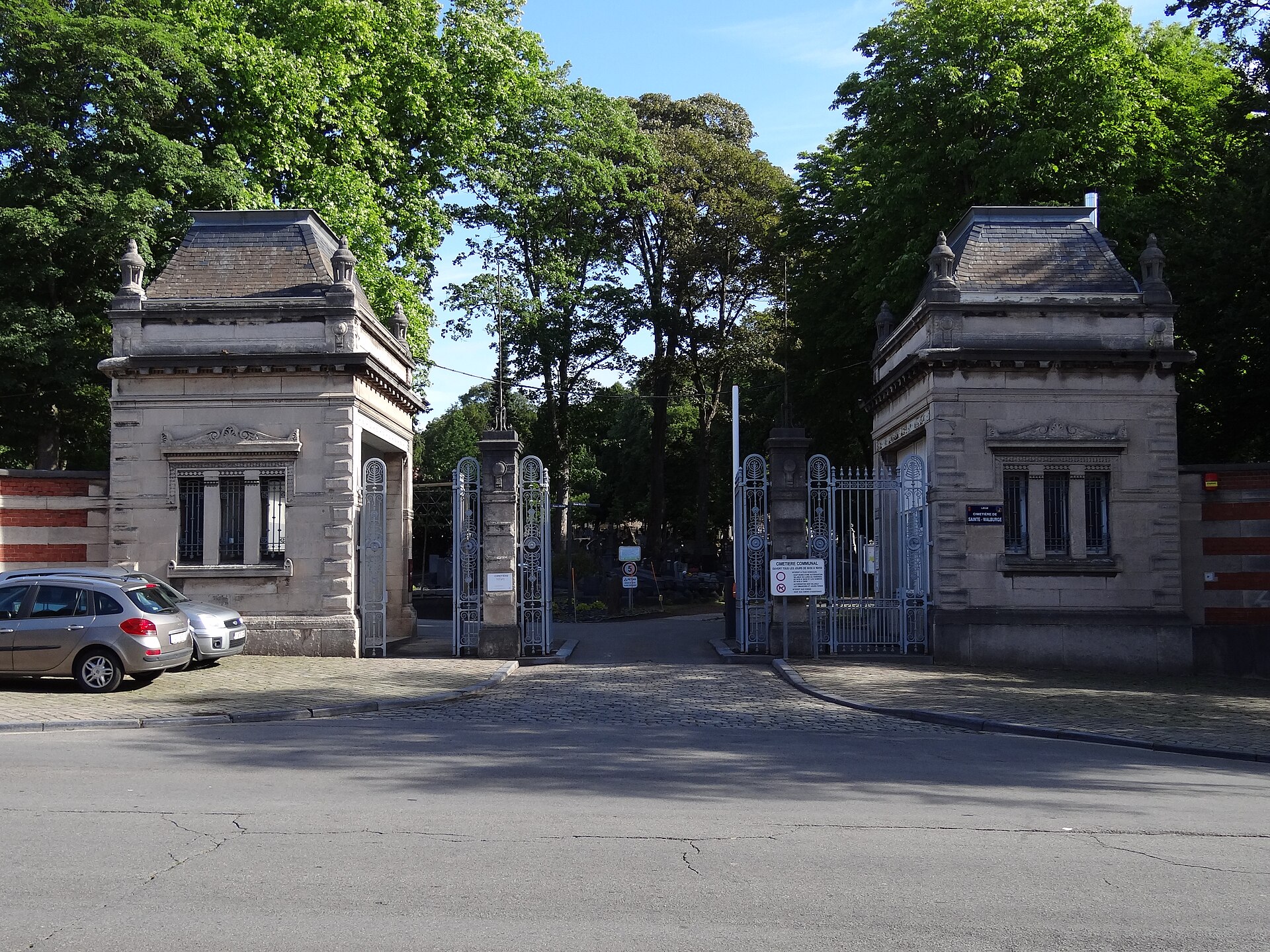
The present-day Cemetery of Sainte-Walburge opened on 20 March 1874. At the time, it stood somewhat apart from the district's built-up area, away from the more densely populated neighborhoods. Over time the city grew toward it, and the cemetery itself gradually expanded. In 1907, a monumental entrance was erected, which still stands today as a defining feature and gives the site its ceremonial character.
What is there to see on site?
The Cemetery of Sainte-Walburge is more than a burial ground — it functions as an open-air record of Liège's history. It holds a monument dedicated to the heroes of the 1830 Belgian Revolution, along with the graves of numerous revolutionaries from that period, including the legendary figure known as Charlier-Jambe-de-Bois (Charlier Wooden-Leg). Walking along its paths, visitors can also find examples of traditional funerary craftsmanship, including the porcelain medallion portraits characteristic of the region — a testament to local funeral customs at the turn of the 19th and 20th centuries.
Frequently asked questions
Is this still an active cemetery? Yes, the Cemetery of Sainte-Walburge continues to serve its original purpose and is managed by the city of Liège as part of its network of municipal cemeteries.
How does it differ from the earlier Sainte-Walburge cemetery? The current site is the third location associated with the name — it followed an earlier lepers' burial ground near the old hospital, and then a parish cemetery beside the church, which closed in 1866.
What does the 1907 monumental entrance represent? It is a ceremonial gateway added decades after the cemetery opened, once it had become firmly established as the district's principal burial site.
Are there graves connected to Belgian national history here? Yes, the cemetery holds the graves of participants in the 1830 revolution as well as a monument commemorating its heroes.
Nearby places

Earn badges for the places you visit
Download NextOnTrip, discover new places and check off your trails.