About this place
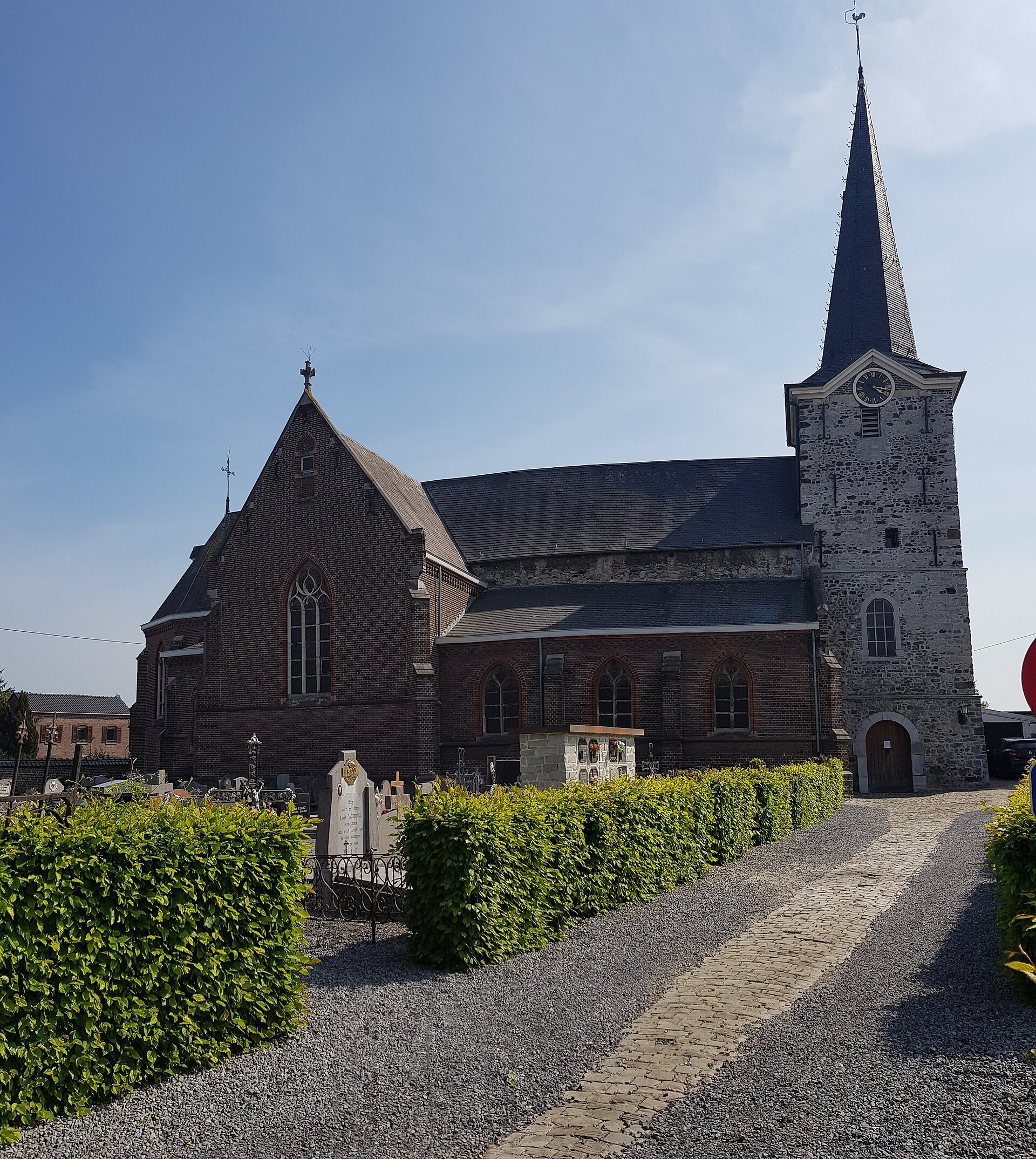
Saint Martin's Church stands on a church mound on the north side of the village centre of Sint-Martens-Voeren, along Kerkstraat, enclosed by a walled churchyard. It is one of the oldest surviving religious buildings in the Voerstreek region of Belgian Limburg, and a natural landmark for anyone exploring this hilly border area.
Where does the tower come from?
The oldest surviving part of the building is its Romanesque tower, raised in the 12th century as part of an earlier, 13th-century church. It survived later rebuilding campaigns and remains the clearest physical link to the parish's medieval origins. In 1650 the tower underwent a thorough restoration, recorded on a stone plaque still visible on its south side.
When was the rest of the church built?
The nave and choir that make up the church's main body were constructed between 1728 and 1730, commissioned by dean Dael. The choir was the last section to be finished, completed in 1730. As a result, the church combines a medieval tower with an 18th-century body — a layout typical of many village churches in the region, expanded gradually over the centuries while their oldest, most valuable elements were preserved.
What survives inside the church?
Inside, a Romanesque baptismal font carved from blue stone still dates from the 13th-century church that preceded the current building. It is one of the few surviving pieces of the original furnishings, having outlasted centuries of rebuilding and changes to the structure around it.
What history lies in the surrounding churchyard?
The churchyard around Saint Martin's Church holds the remains of six British aircrew whose plane was shot down during the Second World War, a reminder of the events that unfolded across the Voerstreek region during the war. Nearby, close to the church tower, lies the grave of parson Hendrik Veltmans, remembered as an advocate for Flemish identity in the Voeren area — a region whose language and administrative status have long been the subject of debate at the meeting point of Flemish and Walloon influence.
Why visit Sint-Martens-Voeren?
Saint Martin's Church anchors the village of Sint-Martens-Voeren, one of the constituent villages of Voeren, a hilly area at the eastern edge of Limburg known for its network of walking and cycling routes through the valley of the Voer river. Visitors passing through on hikes across the Voerstreek find in the church and its walled churchyard a quiet spot where sacred architecture meets local history — from the Middle Ages, through the early modern period, to the events of the 20th century.
The church sits at coordinates 50.749447, 5.81255, marking the heart of the old village around which parish life in Sint-Martens-Voeren developed over the centuries.
Frequently asked questions
How old is Saint Martin's Church in Sint-Martens-Voeren? Its oldest surviving part, the Romanesque tower, dates from the 12th century and is a remnant of a 13th-century church. The current nave and choir were added between 1728 and 1730.
What is buried in the churchyard? The walled churchyard contains the graves of six British aircrew shot down during the Second World War, as well as parson Hendrik Veltmans, known for his advocacy of Flemish identity in the Voeren region.
Does the church still hold any medieval features? Yes — a Romanesque baptismal font in blue stone survives from the 13th-century church and has outlasted the later rebuilding of the structure.
Nearby places

Earn badges for the places you visit
Download NextOnTrip, discover new places and check off your trails.