About this place
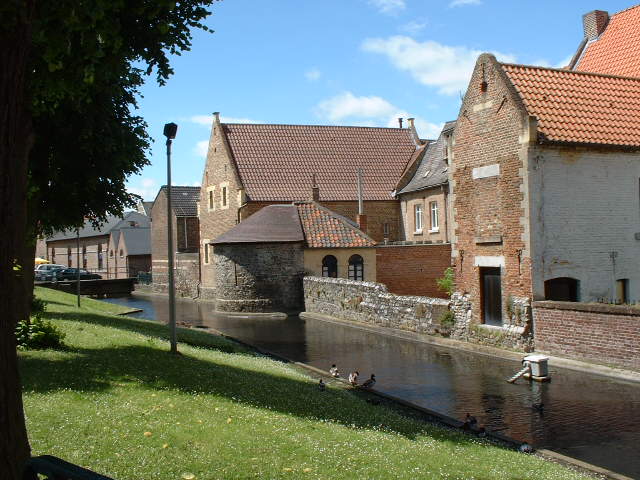
Motmolen is a historic water mill on the Overslag channel, a branch of the Jeker river, in Tongeren, one of Belgium's oldest towns, located in the Flemish province of Limburg. The site combines the legacy of medieval milling with the industrial history of the town's drinking water supply — an unusual dual identity that makes Motmolen a genuinely distinctive piece of technical heritage.
Where does the mill come from and what is its early history?
Motmolen began life as a compulsory (monopoly) mill, owned by the Prince-Bishopric of Liège, much like the neighboring Moutmolen at the Moerenpoort. Residents of surrounding villages were required to have their grain milled here, guaranteeing the bishops a steady income. On March 27, 1618, Prince-Bishop Ferdinand of Bavaria granted the mill in perpetual lease to the city of Tongeren — one of the few precisely documented milestones in the building's long history. In 1830, the mill was converted into a grain mill, continuing its original food-production role for several more decades.
How did a grain mill become a pumping station?
The real turning point came at the start of the 20th century. In 1903, Motmolen passed into municipal ownership and was rebuilt as a hydraulic pumping station, drawing spring water from the Daalbron source near the village of Lauw into Tongeren's public water network. From 1905 onward, the mill became an essential link in supplying drinking water to the entire urban area, a role it kept without interruption until 1978 — a span of 75 years.
The 1903 pumping installation was built by the firm of J. Heinrichs from Hodimont-Verviers. The late 19th-century mill building still houses its complete technical setup: an iron undershot wheel with wooden buckets (dating from 1903), a gear wheel that transferred the wheel's rotation to two piston pumps, which forced water into an expansion tank. From there, water traveled through an underground pipe to the town's water towers. Starting in 1936, the installation was gradually electrified with two electric pumps, meaning mechanical and electrical technology coexisted in the same building for a time.
What about its protected status and current condition?
Motmolen was granted protected monument status on July 2, 1986, saving this unique complex from demolition after its technical function had ended. In 2000, the entire mill complex underwent a thorough restoration, so visitors today can see both the original water wheel and the historic piston pumps in close to the condition they were still working in during the 20th century.
Why is Motmolen worth a visit?
Motmolen is a rare example of a building that went through a full transformation — from grain mill, to municipal water-pumping station, to protected industrial monument. For anyone interested in the history of pre-electric infrastructure, it's a vivid illustration of how waterpower once drove not just milling but entire urban drinking-water systems. Its location in Tongeren, a town with a rich Roman and medieval history, makes it easy to combine a visit to Motmolen with exploring the region's other historic sites.
Frequently asked questions
What was Motmolen originally? A water mill on the Overslag/Jeker in Tongeren, first a compulsory mill owned by the Prince-Bishopric of Liège, later converted into a grain mill.
When did it serve as a pumping station? From 1903 to 1978, pumping spring water from the Daalbron near Lauw into Tongeren's water supply network.
When was it protected as a monument? On July 2, 1986, followed by a thorough restoration in 2000.
What original equipment survives? The 1903 iron undershot water wheel, the gear wheel, two piston pumps, and traces of the 1936 electrification.
Nearby places

Earn badges for the places you visit
Download NextOnTrip, discover new places and check off your trails.