About this place
Kasteel Scherpenberg is a castle located in Nerem, part of the Tongeren-Borgloon municipality in the Belgian province of Limburg. The building stands along the Dreef avenue, on the edge of the De Kevie nature reserve, giving the site a setting that blends historic architecture with the landscape typical of eastern Flanders.
Where does the site's history begin?
The current building was constructed at the end of the 16th century, but it stands on the site of an earlier fortification — remnants of that structure are still visible in the western part of today's castle. The name "Scherpenberg" is linked to the de Scarpenbergh family, from whom the estate took its name.
Who owned the castle over the centuries?
Ownership of the estate changed hands many times: after the de Scarpenbergh family, it passed to the Baest family (1488), then to Hoen, de Limelette (early 16th century), van Brecht, de Berlaymont, Bex (1574), Vaes (1575), Mantels, van Spauwen (1696), de Vaes (1697), de Lenarts, Grisard (1808) and finally de Corswarem (1850). This long succession of families shows how significant a fixture Scherpenberg was among local nobility over several centuries.
What was the castle's significance in the medieval period?
Scherpenberg was an important feudal estate with a castle, dependent on the feudal court of Hamal in Rutten. This status placed the property within a broader feudal structure of the Haspengouw region, functioning as one of the nodes of local administration and the legal ties between noble families.
What happened during the Eighty Years' War?
During the Eighty Years' War, the castle's owner was Herman Vaes, who was arrested by the Dutch on suspicion of harbouring Spanish sympathizers at Kasteel Scherpenberg. Vaes was only released after it was demonstrated that the castle was not a fortified stronghold capable of sheltering Spanish loyalists. This episode shows that despite its relatively modest scale, Scherpenberg played a real role in the political and military tensions of its era.
What does the castle's architecture look like?
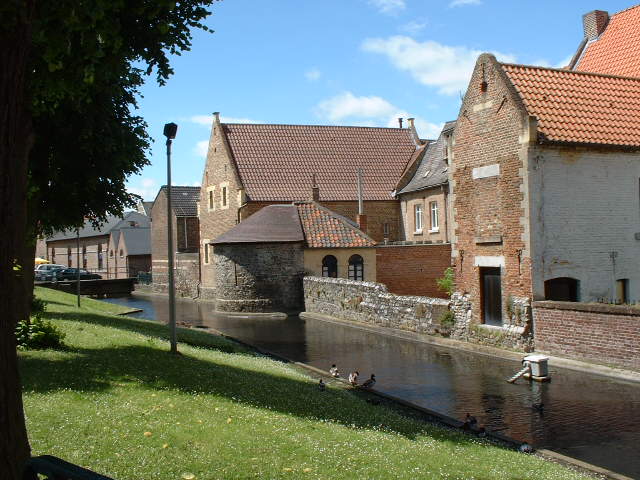
The castle is an elongated building fitted with a gatehouse, comprising two and a half storeys under a mansard roof covered in slate. The facade is decorated with ornamental stone bands and a cornice. Above the gate, a chronogram dated 1697 is carved together with the coats of arms of the Vaes and Schroots families — these details make it possible to date one of the stages of the estate's renovation precisely and indicate which families held influence over its appearance at the time.
Frequently asked questions
Where exactly is Kasteel Scherpenberg located? In Nerem, part of the Tongeren-Borgloon municipality, in the province of Limburg in Belgium, along the Dreef avenue, next to the De Kevie nature reserve.
When was the castle built? The building's current form dates from the end of the 16th century, though an earlier fortification stood on the site before that.
Was the castle ever involved in armed conflict? Yes — during the Eighty Years' War its owner was arrested on suspicion of sheltering Spanish sympathizers, though the castle was ultimately found not to be a fortified stronghold.
What architectural features stand out? The gatehouse with a chronogram dated 1697 and the coats of arms of the Vaes and Schroots families, along with a slate-covered mansard roof and decorative stone bands on the facade.
Nearby places

Earn badges for the places you visit
Download NextOnTrip, discover new places and check off your trails.