About this place
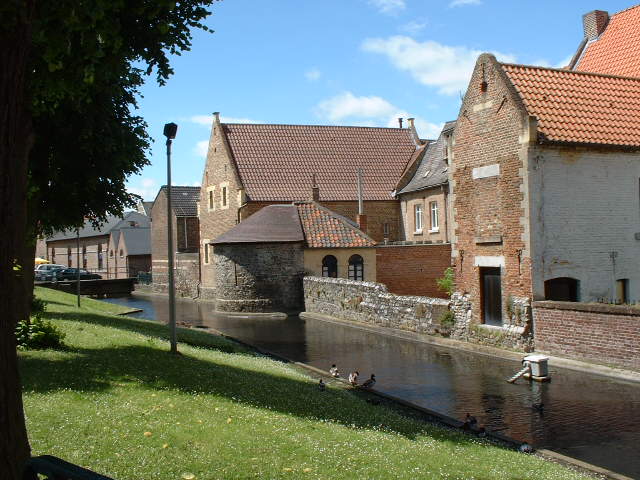
The Beguinage of Tongeren is one of thirteen Flemish béguinages inscribed on the UNESCO World Heritage List, tucked away in the heart of Belgium's oldest town. Rather than a single monument, visitors find an entire quarter here – a maze of cobbled lanes, quiet courtyards and brick houses that for centuries formed a semi-enclosed world of its own within the city.
Where did this place come from?
Beguines, laywomen who lived in religious community without taking monastic vows, were already present in Tongeren before 1239. Unwilling to choose between marriage and the convent, they set up their own walled settlement near the old Moeren Gate. The beguinage was formally founded in 1257, and half a century later, in 1294, its centerpiece was built: the Gothic Church of St. Catherine, which still stands at the heart of the complex today.
What was daily life like for the beguines?
The beguinage functioned almost like a town within a town: it had its own walls, an entrance gate, a chapel, and dozens of dwellings clustered around the main church. The women supported themselves through work such as sewing, weaving and caring for the sick, combining this with a life of prayer and communal discipline. The community reached its peak in the 18th century, when around 300 beguines lived in 100 houses – a scale large enough to genuinely shape the religious and social life of the whole town.
What changed after the French Revolution?
A turning point came in 1798, when the beguinage's property was expropriated in the wake of the French Revolution. Some of its walls and houses were absorbed into the ordinary urban fabric, and the institution lost its formerly isolated character. Even so, much of the physical fabric survived – and it is this architectural continuity, rather than an unbroken religious community, that gives the site its historical value today.
Why is it a UNESCO site?
In 1998, thirteen Flemish béguinages, including the one in Tongeren, were jointly inscribed on the UNESCO World Heritage List. They were recognized as an exceptional example of medieval architecture and urban planning tied to a women's religious movement that had no real equivalent elsewhere in Europe. The listing covers not a single building but an entire urban layout – a network of streets, squares and houses forming a coherent whole.
What can you see there today?
Walking through the beguinage, visitors can admire characteristic brick houses with white-trimmed windows, quiet courtyards, and the Gothic Church of St. Catherine standing at the very center of the complex. The atmosphere here contrasts sharply with Tongeren's busy town center – stepping through the old gate is enough to feel the pace slow down, shaped by an urban rhythm still rooted in the Middle Ages.
Frequently asked questions
Does the Beguinage of Tongeren still serve a religious function? The beguinage is no longer inhabited by a community of beguines – today it is mainly a residential quarter and a protected heritage site, though the Church of St. Catherine still stands at its center.
How many béguinages were listed alongside Tongeren by UNESCO? Thirteen Flemish béguinages, including Tongeren's, were inscribed together on the UNESCO World Heritage List in 1998.
When was the Beguinage of Tongeren founded? Beguines were already living in Tongeren before 1239, and the beguinage itself was formally founded in 1257.
Nearby places

Earn badges for the places you visit
Download NextOnTrip, discover new places and check off your trails.