- Sacred Monuments
- Religious monuments
Monastère Notre-Dame de Val Paradis
About this place
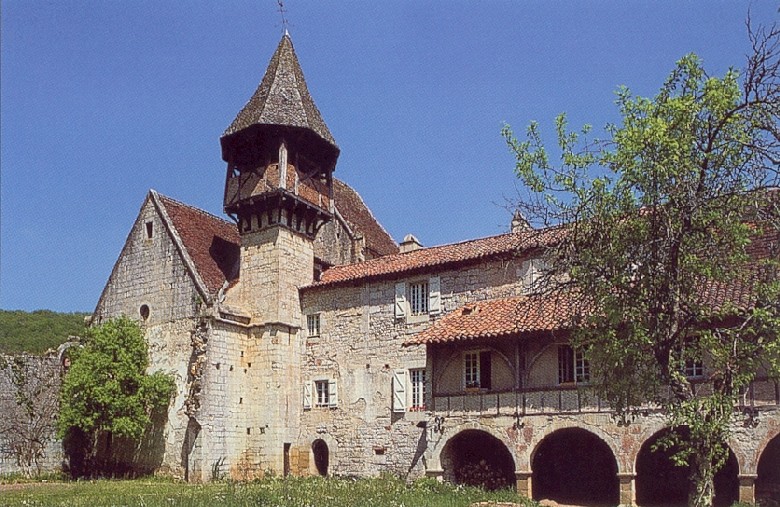
Monastère Notre-Dame de Val Paradis is a former convent of Augustinian canonesses standing on the left bank of the Célé river, right in the village of Espagnac-Sainte-Eulalie in the Lot department of southwestern France. Modest in appearance from the outside, the complex was home to a religious community for nearly six centuries and remains one of the most distinctive landmarks of the Célé valley today.
Where does the name "Val Paradis" come from?
The name reflects the setting itself: a narrow, green valley carved by the Célé and framed by limestone hills, so appealing that locals long referred to the surrounding stretch of river as a "valley of paradise." When the convent gained a new patron in the thirteenth century, that nickname was formally attached to the building's dedication to the Virgin Mary.
How did the monastery come into being?
The story begins in the mid-twelfth century, well before any women's community existed here. A monk known as Bertrand de Griffeuil (also recorded as Bertrand de Civray) set up a small hermitage on the riverbank, which grew into an oratory. Shortly before his death near the end of the 1160s, he handed his foundations over to the Augustinian canons of the abbey of Notre-Dame-de-la-Couronne, near Angoulême.
From hermitage to a community of women
The turning point came in the early thirteenth century, when a woman named Elisabeth secured permission to establish a community of nuns at Espagnac. The original building, put up too close to the water, gradually fell into disrepair. Toward the end of the century, Aymeric d'Hébrard de Saint-Sulpice, bishop of Coimbra and member of a powerful local family, commissioned a sturdier replacement. The new convent was handed over to the prioress on 16 May 1293, and, at the bishop's wish, it took its Marian dedication along with the name "Val Paradis d'Espagnac."
What happened to the community afterward?
Augustinian canonesses lived at Val Paradis almost continuously for close to six hundred years, right up until the French Revolution. In 1792 the community was dispersed and the buildings lost their original religious purpose. The structure nonetheless survived well enough to be granted official historic monument status in France in 1925.
What can visitors see today?
Visitors can still make out the medieval layout of the convent, including architectural features typical of women's canonical communities from this period. The setting itself is part of the appeal: the building sits within the Célé valley, an area known for limestone cliffs and troglodyte dwellings, making it a natural stop for anyone exploring the valley on foot or by bike.
How do you get there?
The monastery stands directly in the village of Espagnac-Sainte-Eulalie, beside the Célé, in the Lot department in southern France. A bridge crosses the river to reach it, and the village itself is easily explored on foot, by bicycle, or by car — it is a well-known stop along the Célé valley route.
Frequently asked questions
Who founded the monastery at Espagnac? The first religious foundation here was set up in the mid-twelfth century by a monk named Bertrand de Griffeuil; the transformation into a women's community began in the early thirteenth century, initiated by a woman named Elisabeth.
Where does the name "Val Paradis" come from? It refers to the strikingly scenic setting of the convent in the Célé valley, and was formally linked to the building's dedication in the thirteenth century when it was consecrated to the Virgin Mary.
What religious order lived here? Augustinian canonesses occupied the convent continuously from the thirteenth century until the French Revolution dispersed the community in 1792.
Is the monastery a protected historic site? Yes — it was listed as a French historic monument in 1925 and remains legally protected today.
Where exactly is the monastery located? In the village of Espagnac-Sainte-Eulalie, on the left bank of the Célé, in the Lot department, within a scenic stretch of the valley known for its limestone hills and cliffs.
Nearby places

Earn badges for the places you visit
Download NextOnTrip, discover new places and check off your trails.