- Sacred Monuments
- Religious monuments
église de l'abbaye cistercienne Sainte-Marie de Gourdon, dite abbaye nouvelle
About this place
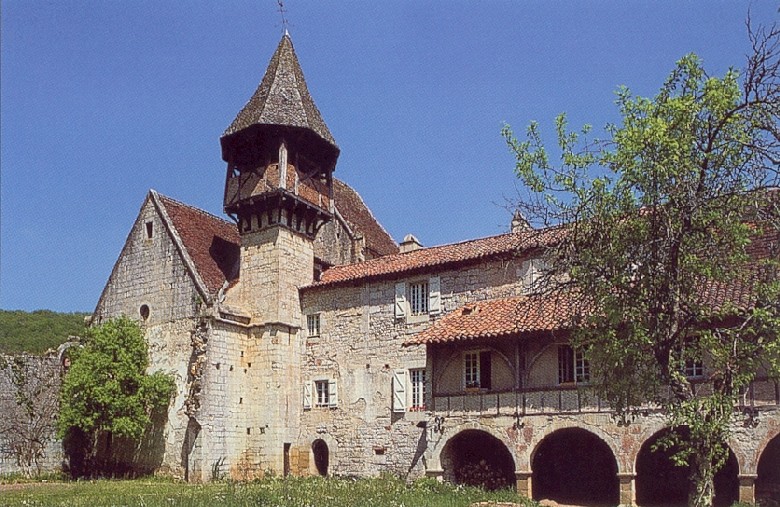
Abbaye Nouvelle is the ruined former Cistercian abbey standing near Léobard, in the Lot department of southwest France, officially recorded as the église de l'abbaye cistercienne Sainte-Marie de Gourdon. Perched on a rocky spur above the Céou valley, it is a quiet stop for travellers who want to see a genuine piece of medieval monastic France without the crowds of the region's better-known abbeys.
Where does the name "New Abbey" come from?
The monastery was founded in the 13th century as a daughter house of the abbey of Aubazine (Obazine) in the Limousin. Its foundation was made possible by a donation from Guillaume de Gourdon, lord of Salviac, recorded on 7 March 1242, granted for a new Cistercian house in the diocese of Cahors. The name "nouvelle" (new) refers back to an earlier, unsuccessful attempt to settle Cistercian monks near Gourdon around 1150 — since that first venture failed, the successful 1242 foundation became known as the "new" abbey.
Why was it built on a rock instead of a valley?
Cistercian communities almost always chose valley sites, following the tradition associated with Bernard of Clairvaux and his preference for green, well-watered land suited to farming. Abbaye Nouvelle breaks with that pattern: its monks built on a small rocky outcrop of less than 2,000 square metres, known as Pech-Gisbert, overlooking the Céou valley. This unusual, almost defensive setting still sets the site apart from other Cistercian houses in the region and explains its striking position today.
What happened to the abbey during the Hundred Years' War?
The abbey's hardest period came during the Hundred Years' War. English forces captured it on 21 February 1377, and between 1380 and 1392 it was repeatedly plundered by mercenary companies operating in the area. By 1387 the buildings were largely in ruins. The community never fully recovered its earlier standing after this destruction, and much of the monastic complex was gradually abandoned to decay.
What remains to see today?
Of the Gothic abbey church, only two bays of the former nave have survived intact, and these were long used as Léobard's parish church. The rest of the abbey buildings survive as ruins, which still let visitors trace the outline of the original monastic layout. An archaeological excavation carried out in 2014 was followed by a significant restoration project completed in late 2016, making the site safer and more legible for visitors.
How do you get there, and what should you know before visiting?
Abbaye Nouvelle lies within the commune of Léobard, close to Gourdon, in a quiet rural stretch of the Lot. The site is linked to walking trails maintained by the Pays de Gourdon tourist office, which makes it a natural stop along a countryside route rather than a destination reached by car alone. Visitors get the most out of the abbey by combining it with a longer walk through the surrounding hills above the Céou valley rather than treating it as a quick, isolated stop.
Frequently Asked Questions
Is Abbaye Nouvelle still an active monastery? No. It is a ruined former Cistercian abbey; the surviving fragment of its church now serves as Léobard's parish church.
Why is it called the "new" abbey? Because an earlier attempt to establish a Cistercian house near Gourdon around 1150 failed, and the abbey founded in 1242 was built as its successor.
What caused the abbey's ruin? Damage mainly dates from the Hundred Years' War: English troops seized the site in 1377, and it was plundered repeatedly over the following years.
Can the abbey grounds be visited today? Yes. Following archaeological work in 2014 and restoration completed in 2016, the ruins are open to visitors and form part of the local network of walking trails.
Nearby places

Earn badges for the places you visit
Download NextOnTrip, discover new places and check off your trails.